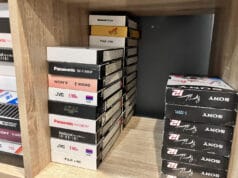
Most homes have a box like it somewhere. A jumble of VHS tapes, a few audio cassettes, a reel of Super 8, a stack of burned CDs and DVDs, maybe a MiniDV camcorder tape or two, and an old external drive nobody has plugged in for years. With it comes a quiet worry: how long does old media last, and has some of this already gone? It is a fair question, and the most useful answer is that the rated lifespan number you read online is usually the wrong question to be asking. No medium is permanent. The published lifespan estimates are contested, and the major archives are candid that reliable figures often do not exist. What actually decides whether your media survives is three things: how it was stored, how it was made, and whether anything still exists that can play it. This is a reference piece, written from the published guidance of the major film and sound archives, so you can see the real ranges per format, what kills each one, and how hard the clock is running.
The short answer: no medium is permanent, and age is the weakest predictor
If you came for a single number per format, the answer will disappoint you. The International Association of Sound and Audiovisual Archives states plainly that reliable life-expectancy estimates for magnetic media are not really available, because too many variables feed into the outcome. The National Digital Stewardship Alliance puts the digital side just as bluntly, noting that no storage medium has proven to be permanent. So the useful answer is never one figure. It is a range, plus the thing that actually kills that format, plus a sense of how urgently it needs digitising.
Two factors beat age almost every time. The first is storage, meaning heat and humidity above all, which is why a tape from a hot garage may already be failing while an identical one from a cool wardrobe plays fine decades on. The second, and often the hard limit, is obsolescence. The machine that reads the medium, the spare parts for it, and the people who know how to run it are all vanishing, and a perfectly preserved tape is worthless if nothing can play it. The table below gives the realistic ranges under good storage. Read them as best-case bands, not promises, because real-world conditions can reduce every one of them.
At a glance: how long each format really lasts
| Format | Realistic lifespan in years (good storage) | Main failure mode | Digitise priority |
|---|---|---|---|
| Magnetic videotape — VHS, S-VHS, Hi8, U-matic | ~10–30 yrs typical; well-kept proven 40–50+ | Binder hydrolysis; slow signal loss | High |
| Audio tape — compact cassette, reel-to-reel | Similar; open-reel polyester audio possibly ~100 (narrow case) | Binder hydrolysis / sticky-shed | High |
| MiniDV / Digital8 / DV | ~10–25 yrs (no institutional figure) | Tape dropouts; dead camcorders | High |
| Cine film — 8mm, Super 8, 16mm (acetate) | ~40 yrs to vinegar onset at room temp; centuries if cold | Vinegar syndrome; colour fade | Medium |
| Cine film — polyester base | 500+ yrs | Very stable | Low |
| CD-R / DVD-R (recordable) | Non-archival 5–10; quality 30–45; gold archival 50–100+ | Dye degradation; reflector corrosion | Medium–High |
| Blu-ray (BD-R / BD-RE) | BD-R ~10–20; BD-RE ~20–50 | Recording-layer degradation | Medium–High |
| M-DISC | Claimed 100–1000 (unverified for Blu-ray) | Claimed inert | — |
| Hard drive (HDD) | Plan 3–5 yrs; ~1.5%/yr failure | Mechanical / electronic failure | Not archival |
| SSD / USB flash | Only ~1 yr guaranteed unpowered | Charge leakage when unpowered | Not archival |
| Cloud | As long as you pay and the provider lasts | Account / provider / format loss | Keep your own copy |
Every figure above is a good-storage range. A medium kept cool, dry and stable lives near the top of its band, and a medium kept warm, damp or swinging lives near the bottom, sometimes well below it. The numbers are a starting point, not a guarantee for any single item.
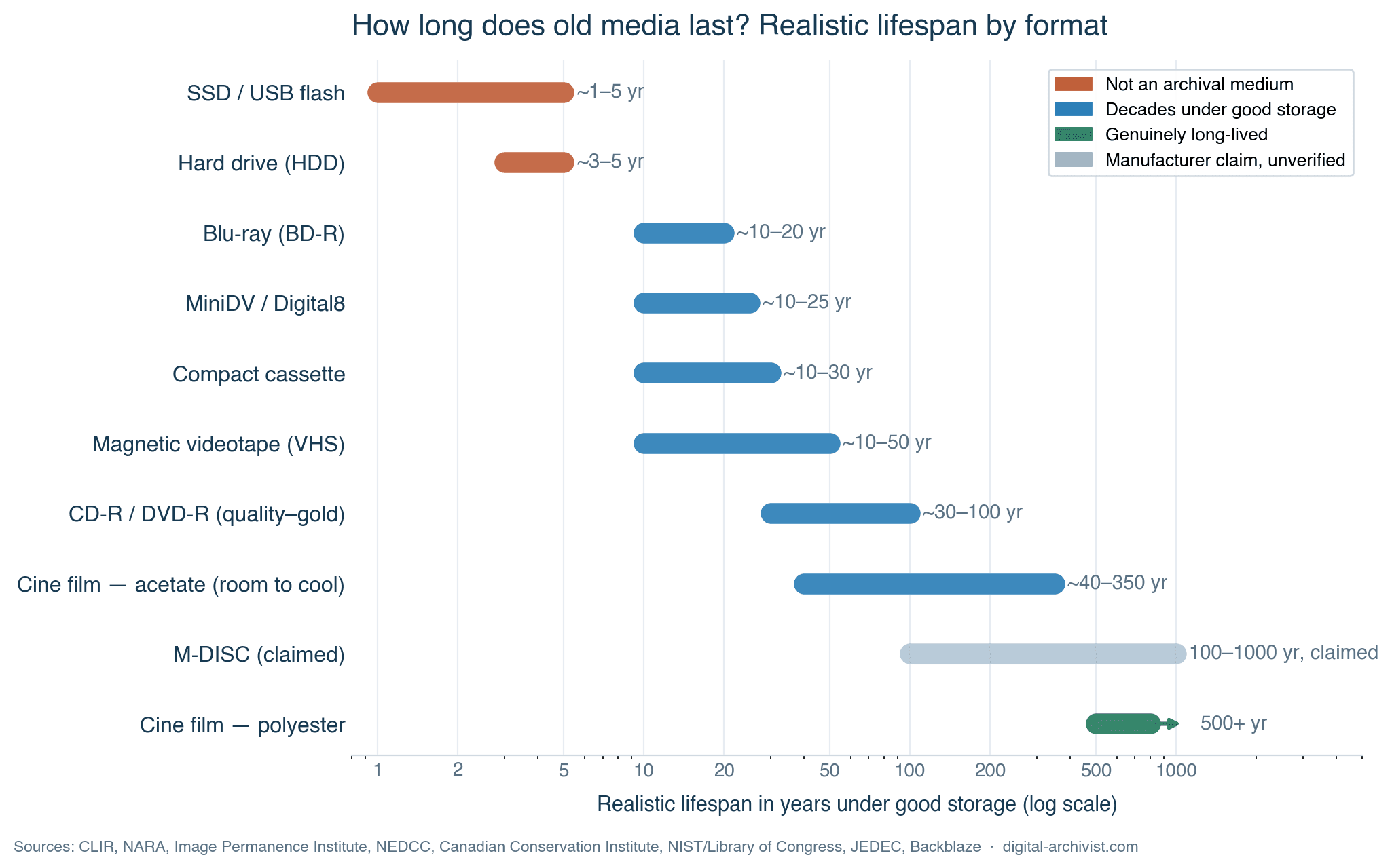
Magnetic videotape: VHS, S-VHS, Hi8, U-matic
Magnetic videotape lands at roughly ten to thirty years under typical conditions, stretching to forty, fifty years and beyond when storage is genuinely good. The US National Archives puts videotape life at about ten to fifty years under archival conditions, and the National Film and Sound Archive of Australia, drawing on its own collection, reports oldest tapes still playing at forty to fifty years while warning that the outcome is unpredictable tape to tape. The dominant failure is binder hydrolysis, where the polyurethane binder that holds the magnetic particles absorbs water from the air and breaks down, alongside a slow drain of colour and rise in noise as the recorded signal weakens. Two myths are worth correcting straight. VHS uses a polyester base, so vinegar syndrome, which is an acetate-film problem, does not apply to it. And sticky-shed syndrome is overwhelmingly a problem of professional open-reel audio tape and a few specific stocks, not of typical consumer VHS.
That is the shallow version, because videotape has its own full reference. The detail on the cited figures, the storage targets each archive specifies, and how to triage a box of tapes is in how long do VHS tapes last. If a tape already smells musty or feels tacky, the rescue routine is in rescuing a mouldy or sticky tape, and the whole transfer workflow starts with converting analogue video to digital.
Audio tape: compact cassette and reel-to-reel
Audio tape runs on much the same clock as videotape and fails the same way, through binder hydrolysis and, on certain older or professional stocks, sticky-shed syndrome where the tape turns gummy and sheds onto the heads. This is the format where sticky shed is a genuine and common concern, unlike consumer VHS. There is one striking outlier worth surfacing rather than smoothing over. A 2022 accelerated-aging study by the Council on Library and Information Resources found that playable polyester-based open-reel audio tape may remain usable for up to around a hundred years at room temperature. That is a real and encouraging result, but it has two tight limits. It applies to open-reel polyester tape specifically, not to consumer compact cassette, and the study tied the longevity to manufacturing quality rather than to good storage. So it is not a number you can stretch across the cassettes in a shoebox.
For most home collections the practical reading is the same as for video: high digitise priority, cool and dry storage, and capture the tapes that smell or feel wrong first. The hands-on side is covered in capturing cassettes and reel-to-reel audio, with the open-reel specifics in capturing reel-to-reel tapes.
MiniDV, Digital8 and DV
The digital camcorder tapes sit in an awkward gap. There is no institutional consensus figure for their lifespan, and it is more candid to say so than to invent one. Community experience and archive practice tend to put usable life somewhere around ten to twenty-five years, but the tape itself is very thin and the recording is error-prone, so dropouts (the brief gaps where the signal fails entirely) tend to bite earlier and harder than on a chunky VHS tape. The deeper problem is not the tape at all. It is the hardware. A working MiniDV or Digital8 camcorder or deck, with a clean transport and a FireWire output, is already the scarce part, and that scarcity is the real clock here.
And it is not only the camcorders that are thinning out. The computer side is going the same way. Apple ended FireWire support in its products in 2026, so the dependable route to a clean transfer now runs through Linux, which keeps the drivers and tooling alive (its support runs to at least 2029). This is a newer kind of problem than the analogue formats face. VHS and its kin were so common for so long that the decks, the spare parts and the know-how are simply around, in second-hand abundance. The digital tape formats are younger ground, and the tools that read them are ageing the ordinary way software does, dropped from one platform and carried on by another. It is worth keeping in proportion, though. FireWire arrived as a standard in 1995, ran through FireWire 400 and 800, and stayed useful for more than thirty years before Apple let it go. Thirty years is a long innings for any interface, and the format is far from dead while Linux carries it.
Because the player is the limiting factor, these tapes earn a high digitise priority even though the format is digital and feels modern. The transfer process, and what FireWire capture actually needs, is in transferring MiniDV to a computer.
Cine film: 8mm, Super 8 and 16mm
Film is the format where storage temperature makes the most dramatic difference. The Image Permanence Institute‘s figures for acetate-base film put the onset of vinegar syndrome, the sour-smelling decay of the acetate base, at roughly forty years for fresh film stored at about 21 °C and 50% relative humidity. Move that same film into cool storage at around 4 °C and the onset stretches to several centuries. Modern polyester-base film is in a different league again, rated by the Northeast Document Conservation Center at five hundred years and more. Nitrate film, used before about 1950, is the exception in every sense: chemically unstable, prone to decay, and genuinely flammable, which is a safety matter and not just a preservation one.
Colour film carries a second, independent clock. The dyes fade over time even when the base is sound, which is why an old colour reel can look washed out long before it smells of vinegar. Black-and-white film, whose image is metallic silver rather than dye, is the most stable of the lot. The single biggest lever across all of this is cold storage, far more than anything you do at room temperature, so film that matters belongs somewhere cool and dry.
Photographs, slides and negatives
Photographic film is the same chemistry as cine film, just held still, so it ages the same way. Negatives and slides on cellulose acetate are prone to the same vinegar syndrome that attacks movie film, the oldest negatives may be on unstable nitrate stock, and colour emulsions lose their colour as the dyes break down. That is why an old colour slide can look washed out while a black-and-white negative from the 1930s still prints cleanly. A black-and-white image is metallic silver rather than dye, and silver is the most stable of the lot. Prints follow the same rules as the negatives they came from.
So the levers are the ones that work for film. Cool, dry, dark storage slows the chemistry, and the colour material is the most urgent because its dyes will not wait. Scanning the ones that matter takes the worry out of it, and the process is in digitising analogue photographs, slides and negatives.
Recordable optical discs: CD-R, DVD-R, Blu-ray and M-DISC
This is where the popular idea that discs last forever is most wrong, and the figures are genuinely contested, so they are worth laying out side by side rather than averaging. Non-archival recordable discs commonly manage only five to ten years. A study from the National Institute of Standards and Technology and the Library of Congress found typical CD-R life in the region of thirty to forty-five years, with disc quality the dominant variable and inferior products failing under fifteen. The Canadian Conservation Institute‘s 2019 study put gold-layer archival CD-R and DVD-R at fifty to a hundred years and more, but rated most Blu-ray lower, with BD-R at roughly ten to twenty years and BD-RE at about twenty to fifty. That last point is counter-intuitive, because the newer, higher-capacity Blu-ray format is often shorter-lived than older CD and DVD. The National Archives adds the necessary caution that manufacturer life-expectancy claims rest on inconsistent test methods, so they are not directly comparable.
M-DISC sits apart, claiming a hundred to a thousand years from an inorganic recording layer that does not degrade the way organic dye does. That claim has been independently tested for the DVD form of M-DISC, which lends it real credibility there. The current Blu-ray M-DISC formulation, though, is a different physical product and has not been independently verified to the same standard, so the headline number should not simply be carried across to it. The failure modes for discs in general are dye degradation and corrosion of the reflective layer, and, as with every format on this page, the slow disappearance of drives that can read older formats reliably.
Hard drives, SSDs, USB sticks and the cloud
Drives are not an archival medium, and treating them as one is a common, costly mistake. A sensible planning figure for a hard drive‘s working life is three to five years. Backblaze’s 2024 fleet data put the annual failure rate at around 1.5%, roughly one drive in sixty failing each year and the rate climbing as drives age. That is datacentre drives running in steady, monitored conditions; a home drive that lives in a drawer and gets cycled occasionally fares worse, not better. The sharpest surprise is flash storage. A consumer SSD or USB stick left unpowered is only guaranteed, under the JEDEC JESD218 standard, about a year of data retention once it is near its write-endurance limit, and warmer storage roughly halves that. Flash leaks its stored charge when it has no power, which makes it the single worst choice for the put-it-in-a-drawer job most people give it.
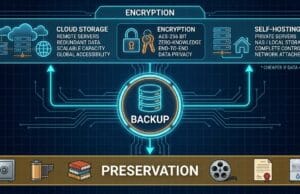
The cloud lasts exactly as long as you keep paying and the provider keeps existing, which makes it a service rather than a medium. The institutional consensus is consistent and worth taking to heart. The National Digital Stewardship Alliance states that no storage medium has proven to be permanent, and both the Library of Congress and the National Archives run their own collections on continual migration and fixity checking rather than on any single durable disc or drive. Digital survival is a process, not a medium. The working rule that falls out of it is to keep multiple copies, in more than one place, and to move them onto fresh storage over time. The how of that is in the family-archive series: designing a family archive that survives you and its preservation part, with the off-site copy covered in cloud backup for a family archive and self-hosted off-site backup.
The clock you are really racing: obsolescence
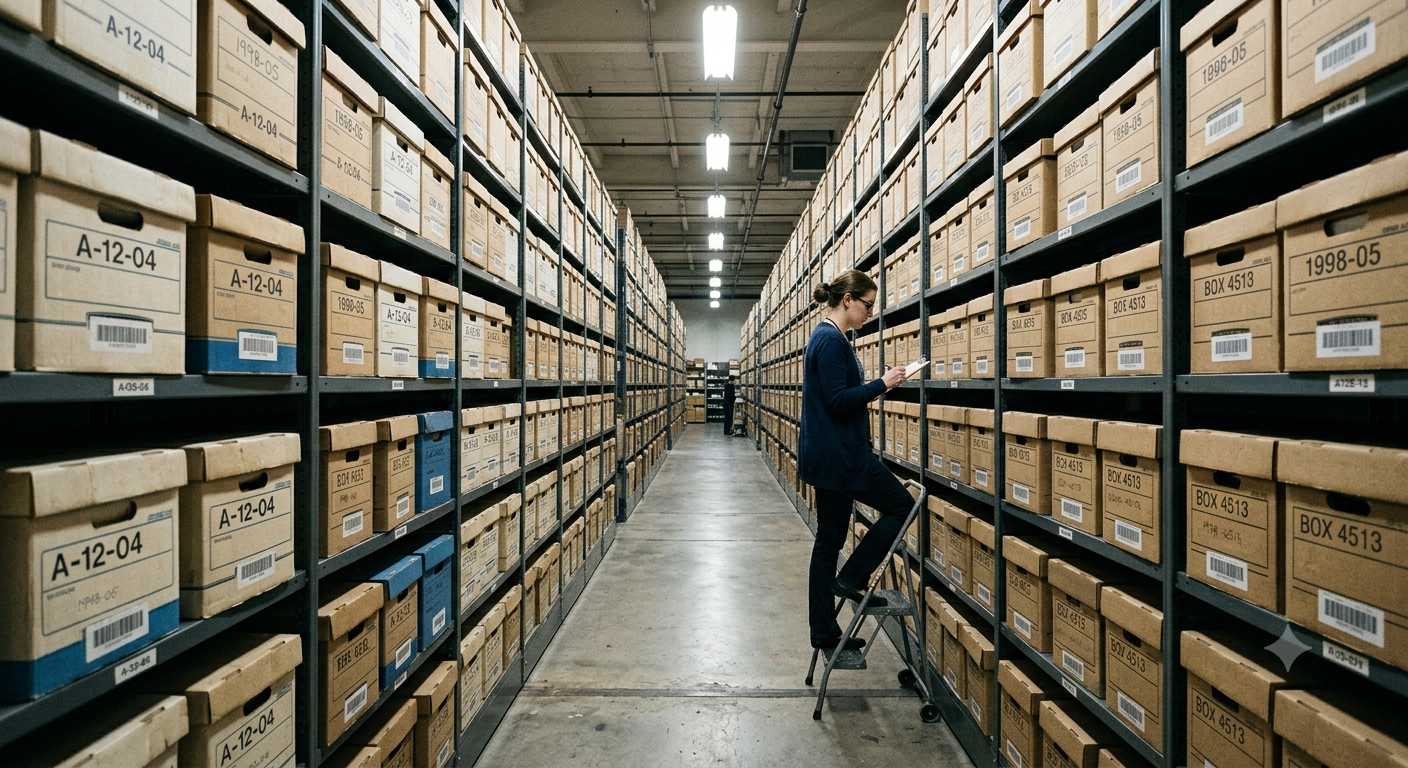
Across every format on this page runs one cross-cutting institutional point that matters more than any lifespan figure. Working players, spare parts and the expertise to run them are vanishing, and that clock is harder to slow than the chemistry one. Funai Electric of Japan, the last company in the world still making VCRs, stopped production in 2016. The National Film and Sound Archive of Australia’s Deadline 2025 campaign and IASA’s Magnetic Tape Alert both warned that the window for routine, low-cost magnetic-tape transfer was closing around 2025. That year has now passed, so it reads best as a planning horizon already closing rather than a literal cliff edge, but the direction is not in doubt. The Association of Moving Image Archivists frames the compound problem, decay plus dead players plus lost expertise, as a crisis that is already arriving rather than a distant one.
This is the heart of why the lifespan question is the wrong one to fixate on. You can improve a medium’s storage today, but you cannot manufacture a new VCR, a working MiniDV deck or a vintage disc reader. So for most people the more pressing question is not how long the medium lasts, but whether you can still play it, and whether you have copied it while doing so is still routine.
What this cannot fix
Being clear about the limits is the most useful thing a reference like this can do, because it stops you spending effort where there is no return. Once the oxide has shed from a tape, the dye has degraded on a disc, or a drive’s platters have failed, the content that lived there is gone, and no treatment puts it back. Careful handling can sometimes coax a degraded item through one last read, which is the whole point of capturing it before it gets worse, but recovery means reading what is still there, not rebuilding what has left the surface. Good storage slows future decay; it does not reverse a loss that has already happened. The colour that has already drained from a film, or the noise already baked into a tape, stays drained and stays baked.
Two further things deserve placing in proportion. Copies of copies compound loss, so a transfer made from an already-degraded source, or a copy taken from another copy, carries every fault forward and adds its own; there is no reconstructing an original you do not hold. And the archival-gold and M-DISC claims, however good, are not a substitute for keeping multiple managed copies. A single very durable disc is still a single point of failure if it is lost, broken or left in a format nothing reads. When a collection holds items at different stages, the call I would make is to triage rather than treat everything equally. Capture the ones showing distress first, store the rest properly, and accept that some early losses cannot be undone.
So, how long does old media last?
There is no single number, and any source that offers you one for every format is overclaiming. Under good storage, most formats give you somewhere between years and decades. Flash storage and cheap discs give you the least, sometimes only a year or two. Cold-stored polyester film and gold archival discs give you the most, reaching into centuries. But two things move every one of those figures more than age does. Storage, meaning heat and humidity, sets where a medium lands within its band. And the disappearance of working players, more sharply still, decides whether the band matters at all.
So the move that matters is not pinning down exactly how many years any single item has left. It is digitising while transfer is still routine, and then keeping the digital copies actively managed, in multiple places, migrated onto fresh storage over time. When you are ready to start, the capture side picks up where this leaves off: the best VHS capture card for the video tapes, and the family-archive series for keeping the results safe once they are digital.
Frequently asked questions
What is the longest-lasting way to store old media?
Physically, the most durable options are cold-stored polyester-base film, rated at five hundred years and more, and gold-layer archival optical discs at fifty to a hundred years and beyond. In practice, though, the longest-lasting approach is not a single object at all. It is a set of managed digital copies, kept in more than one place and migrated onto fresh storage over time, because that survives the failure of any one disc, drive or location.
Do CDs and DVDs really go bad?
Yes. The recording dye degrades and the reflective layer can corrode, a process often called disc rot, and it is not visible until the disc fails to read. Non-archival recordable discs commonly last only five to ten years, while better-quality CD-R can reach thirty to forty-five and gold archival discs longer still. The popular idea that a burned disc lasts forever is the misconception worth dropping first.
Is an external hard drive or a USB stick safe for long-term storage?
No, not on its own. Plan a hard drive’s working life at three to five years, and treat a USB stick or SSD as worse for cold storage, not better. Left unpowered, consumer flash is only guaranteed about a year of data retention once it nears its write limit, and warmth shortens that. Either is fine as one working copy, but neither is an archive. Keep multiple managed copies in more than one place instead.
How often should I copy my digital files to new storage?
Migrating every few years is a sensible rhythm, sooner if a drive is ageing or a format is falling out of use. The rule the major archives follow scales down well to a home collection. Keep at least three copies, in two separate places, and check now and again that the files still open. Storage that is never checked is not really a backup. Better still is storage that checks itself. ZFS, the filesystem built for this, verifies every file against a checksum and (on a pool with redundancy) repairs silent corruption and bit-rot on its own, which is about as close to a self-healing archive as home storage gets.