
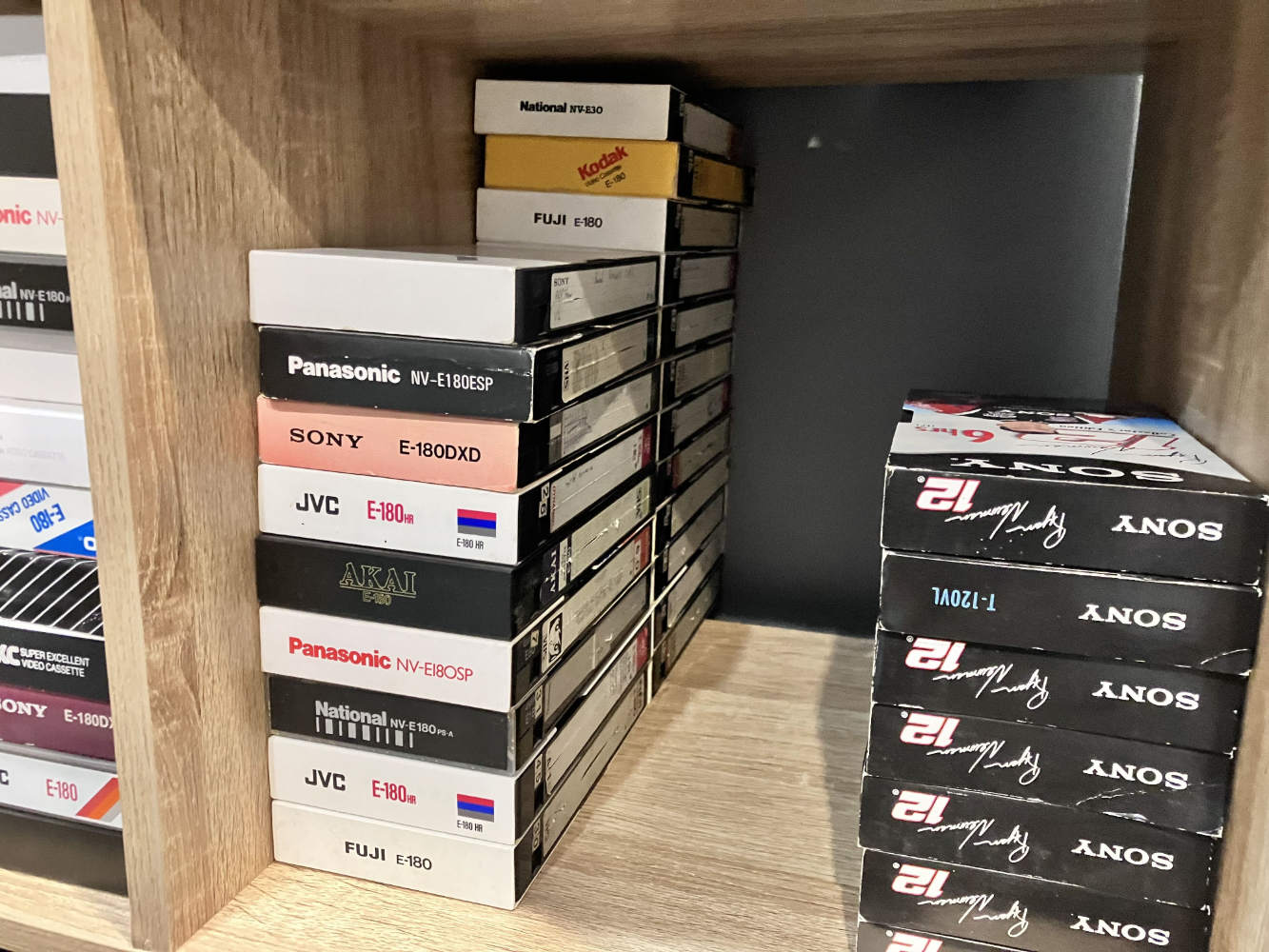
Somewhere in a lot of houses there is a box of VHS tapes in the garage or the loft, a child’s first birthday, a wedding, a grandparent who is no longer here, and a quiet worry that comes with it: how long do VHS tapes last, and have these ones already gone? It is a fair question, and the answer that gets thrown around online is usually wrong in both directions. Some service sites warn that tapes die at ten to fifteen years to hurry you into a sale. Others wave the worry away. The truth sits in between, and it is less about the tape’s age than about where it has been sitting. A tape kept cool, dry and stable can still play decades on. A tape that spent twenty summers in a hot garage may already be failing. This is a reference piece, written from the published guidance of the major film and sound archives, so you can see the real figures and where they come from.
The short answer: there is no single number
If you want one figure to write on the box, the archival consensus lands at roughly ten to thirty years for the magnetic binder under typical conditions, stretching well past that when storage is genuinely good. But the spread is the real story. The National Film and Sound Archive of Australia puts it plainly from its own collection: some of its oldest tapes still play at forty to fifty years, while others have failed at three or four. Three things decide which way a given tape goes, in roughly this order of importance: how it was stored, how well it was made, and how it was handled in use. Age, on its own, is the weakest predictor of the lot. So the worry about the garage box is the right worry, just not for the reason most people think. It is not that the tapes are old. It is that a garage is about the worst place you could have kept them.
What “lasting” actually means
Part of the confusion comes from two different questions hiding inside one. There is “will the tape still play at all”, and there is “will it still look as good as it did”. They are not the same, and they fail on different clocks. A tape can lose a little colour and gain a little noise long before it is anywhere near unplayable, and a tape can sit looking fine on the shelf while its binder quietly weakens until the day it sheds across the heads. Physical failure is the dramatic one, the tape that squeals, sticks or sheds oxide. Signal loss is the slow one, the gradual drift of colour and the creep of noise as the recorded magnetism weakens. It is worth saying straight that none of the major archive sources draws a clean line between “quality starts to slip” and “no longer plays”. The published life-expectancy figures model physical and chemical breakdown of the tape, not the gentle slide in picture quality, so when you read “thirty years” it means the medium, not the moment the picture first looked tired.
The real figures, and who stands behind them
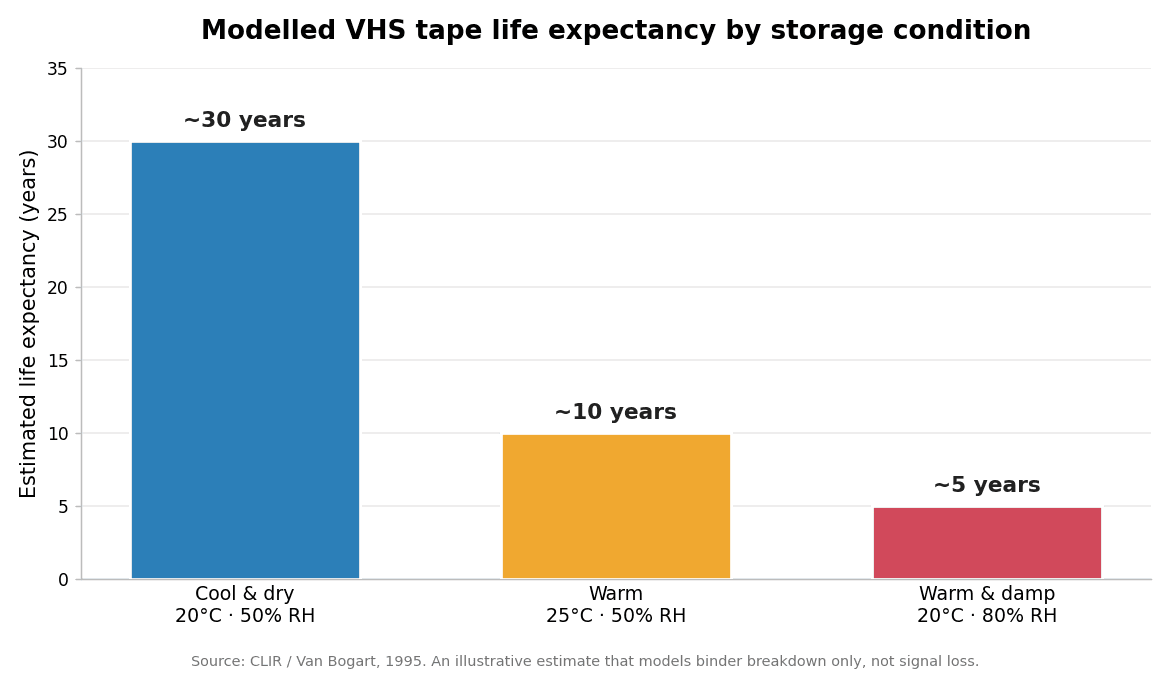
The most-cited numbers come from a 1995 study for the Council on Library and Information Resources by John Van Bogart, who modelled the life expectancy of magnetic tape against temperature and humidity. For a high-grade VHS-class tape his model gives about a thirty-year life expectancy stored at 20 °C and 50% relative humidity, falling to roughly ten years at 25 °C, and to around five years at 20 °C but 80% humidity. Two things about that model matter as much as the numbers. First, it accounts for one failure mode only, the chemical breakdown of the binder that holds the magnetic particles on, and not signal loss, friction or physical shrinkage, so it is a floor for one mechanism rather than a full prediction. Second, it shows humidity mattering more than heat, which is why a damp room is more dangerous than a merely warm one. Van Bogart’s own framing was that ten to thirty years is the realistic common range, and that the popular claim of a one-to-two-year tape life is simply a myth.
The other institutions broadly agree and widen the band at the top. The US National Archives (NARA) puts videotape life at roughly ten to fifty years under archival conditions. The National Film and Sound Archive, drawing on a working collection rather than a model, reports oldest tapes still playing at forty to fifty years while warning that the outcome is genuinely unpredictable from tape to tape. And the Association of Moving Image Archivists, in its Videotape Preservation Handbook, notes that a well-made tape kept in reasonable archival conditions has lasted fifty years and more, while adding the sober caveat that magnetic tape is not a good long-term storage medium in the first place. Put together, the picture is consistent. Under good conditions, decades. Under bad ones, a handful of years. And no source will promise you which, for any single tape, without knowing where it has lived.
What actually kills a tape, in order
The single biggest factor is storage, specifically heat and humidity, and that is why it sits at the top of every archive’s advice. The chemistry underneath is binder hydrolysis. The polyurethane binder that glues the magnetic particles to the plastic base absorbs water from the air, and over time that water breaks the binder down. It is humidity-driven, it is the main thing limiting how long the medium survives, and warm damp storage accelerates it. This is the mechanism Van Bogart’s model tracks, and it is why the figure collapses so fast as humidity climbs.
It is worth clearing up a term that gets misapplied to VHS constantly, because it changes what you should worry about. The advanced, sticky stage of binder hydrolysis is sticky-shed syndrome, the tape that turns gummy and sheds onto the heads. The important nuance, and the archival consensus here is clear, that sticky shed is overwhelmingly a problem of professional open-reel audio tape and a few specific stocks, not of consumer cassettes. The hygroscopic binder formulations that fail this way were largely not used in VHS and other consumer cassette tape, so for the vast majority of home tapes sticky shed is not the typical failure mode. There are isolated documented exceptions, but they are exceptions. If you have heard that all old VHS tapes are doomed to go sticky, that is the over-extension of a real problem from one format onto another that mostly does not share it.
After the binder, the mechanisms run roughly like this. Mould grows once the air around a tape sits at sustained high humidity, in the region of sixty-five to seventy per cent and up, and it both damages the surface and contaminates whatever deck plays the tape next. Signal loss, the slow fade of the recorded magnetism, is comparatively gentle on standard VHS because its iron-oxide pigment is relatively stable, though metal-particle and chromium-dioxide formulations hold up less well, and what you see when it happens is colour and hue draining out of the picture. Lubricant loss is the quiet one, because the lubricant in the tape depletes whether you play the tape or not, and at the cold end below about 8 °C some lubricants crystallise and can clog the heads, which is why colder is not automatically safer. And in helical-scan formats like VHS, repeated swings in temperature and humidity disturb the way the tape is wound and threaded, which shows up later as mistracking, a snowy or distorted picture that was not there before. Sitting underneath all of it is plain mechanical damage from a dirty or misaligned deck, which can wreck a perfectly good tape in a single play.
One myth deserves a flat dismissal while we are here. Vinegar syndrome, the sour-smelling decay people sometimes fear in old media, is a breakdown of acetate film base. VHS tape uses a polyester base, so vinegar syndrome does not apply to it at all. If a VHS cassette smells off, that is mould or general age, not the acetate decay that affects cine film and some older audio tape.
How to tell if your own tapes are going
You do not need a lab to triage a collection, and a few minutes with the cassettes themselves tells you a great deal. The checks I would run, before playing anything, are mostly about looking and smelling rather than testing. White, grey or fuzzy growth along the exposed edge of the tape pack, or a musty smell from the shell, points to mould, and a mouldy tape should not go anywhere near a VCR until it is dealt with, because one play spreads it to the heads and then to every tape after it. A sticky or tacky feel to the tape, or a faint shed of powder, is the sign of advanced binder breakdown, uncommon on VHS but not impossible. A warped or cracked shell, a slack or spilled tape pack, or a cassette that rattles, all point to mechanical trouble that wants sorting before play.
On playback, the tells are different. Picture that is noticeably snowier, that mistracks and tears where it used to be stable, or that has lost colour and gone muddy, points to a combination of signal loss and pack or tracking problems. A tape that squeals or drags as it plays, or that a known-good deck struggles to thread, is telling you something is wrong with the surface or the lubrication. The triage principle I would apply across a whole box is simple. The tapes that smell musty, feel sticky or look physically distressed go to the front of the queue, because those are the ones racing a real clock. The full hands-on routine, including safe handling for a tape you suspect is mouldy, is in the pieces on cleaning and prepping VHS tapes and on rescuing a damaged tape.
Storage that buys you time
Every archive lands on the same three words, cool, dry and stable, and then differs on the exact figures because they are storing for different purposes. It is worth keeping those contexts separate rather than blending them into one false “ideal” number. The US National Archives specifies magnetic tape at 50 to 65 °F (about 10 to 18 °C) and 30 to 40% relative humidity, with anything above 65% humidity flagged as a mould risk. The Library of Congress recommends a cool home environment at around 35 to 40% humidity, and for permanent vaults goes colder, 46 to 50 °F (about 8 to 10 °C) at 30 to 40% humidity, while warning never to drop below 46 °F. The International Association of Sound and Audiovisual Archives, in its TC-05 guidance, separates an access climate of around 20 °C at 25 to 35% humidity from a colder preservation climate of 8 to 12 °C, and treats 8 °C as a hard floor because lubricant can exude from the tape below it. The NFSA recommends a constant 18 to 24 °C at 35 to 45% humidity.
For a home collection the practical reading is straightforward. A cool, dry, climate-steady interior space, a wardrobe or a spare-room shelf on an inside wall, is far better than any of the places tapes usually end up. Never an attic, never a garage, never a damp basement, because those are precisely the hot, humid and swinging conditions that drive binder hydrolysis and mould. I would store cassettes upright on their edge like books rather than stacked flat, kept in their cases and away from anything with a magnet or a motor such as speakers and power supplies. And the small habit that does genuine good over years is to rewind a tape before you put it away, not after, so it sits in a known, evenly-tensioned state on the shelf. The storage chapter of the converting VHS to digital overview goes through this in more detail.
The clock you are really racing: disappearing VCRs
Here is the part the lifespan question tends to miss. Even a perfectly preserved tape is worthless if nothing can play it, and the machines are vanishing faster than the tapes. Funai Electric of Japan, the last company in the world still making VCRs, stopped production at the end of July 2016, citing an inability to source the parts. Output had already collapsed, from something like fifteen million units a year around 2000 to roughly 750,000 in its final year. Nothing has replaced it. Every working VCR now in existence is a survivor from a production line that has shut for good, and the supply of spare parts and the people who know how to service these decks is shrinking with it.
The archive sector has been sounding this alarm for years, the IASA through its Magnetic Tape Alert and the NFSA through its Deadline 2025 campaign, both making the same point. Working machines, spare parts and the expertise to run them are disappearing, and the window for routine, low-cost transfer was projected to close around 2025. That year has now passed, so it is more useful to read it as a planning horizon that is already closing than as a literal cliff edge. Tapes will still play after it, and transfers will still happen. But they get harder, scarcer and dearer as the hardware thins out. This machine clock runs alongside the chemistry one, and for most people it is the more urgent of the two, because you can improve a tape’s storage today, while you cannot manufacture a new VCR at all.
What this cannot fix
Being clear about the limits is the most useful thing a reference like this can do, because it stops you spending effort where there is no return. Once the magnetic particles have shed from the tape, the picture information that lived on them is gone, and no treatment puts it back. Careful handling can sometimes coax a degraded tape through one last play, which is the whole point of capturing it before it gets worse, but recovery means reading what is still there, not rebuilding what has left the surface. The same goes for a tape that has lost a generation: a copy of a copy compounds the softness and noise, and there is no reconstructing an original you do not hold.
One treatment is worth placing in proportion, because it gets misapplied to VHS. Baking, the controlled low-heat process that temporarily reverses sticky shed, was first worked out on reel-to-reel and computer tape. It genuinely helps a sticky tape, and VHS’s polyester base tolerates the gentle heat, so it is a real fix rather than a forbidden one. What it is not, is a cure-all. Sticky shed is rarely the VHS failure in the first place, so most home tapes never need baking, and the effect is temporary, so a baked tape wants capturing within days rather than going back on a shelf. It also rewards a stable, even heat over a guessed oven setting. The full method, and the faults that must never be baked, are in the piece on rescuing a damaged tape.
And no amount of good storage reverses what is already lost. Storage slows future decay, it does not undo the colour that has already drained or the oxide that has already shed. Which is why, when a collection has tapes at different stages, the call I would make is to triage rather than treat everything equally. Capture the ones showing distress first, store the rest properly, and accept that some early losses are simply baked in. The realistic goal is to stop the clock where it stands, not to wind it back.
So, how long do VHS tapes last?
Pulling it together, ten to thirty years is the figure the archives keep returning to for the medium under ordinary conditions, with well-kept tapes proven to play at forty, fifty years and beyond, and badly-kept ones failing in a handful. Storage, especially humidity, is what moves a given tape along that range, far more than its age. Standard VHS is not especially prone to the sticky-shed failure that dooms professional audio tape, and it is not subject to vinegar syndrome at all, so the doom-laden versions of the story are usually overstated. But there are two clocks running, not one, and the second is the harder limit. The chemistry can be slowed with cool, dry, stable storage. The disappearance of working VCRs cannot be slowed at all, because the last one was built in 2016.
So the useful answer is not a number to write on the box. It is that a tape kept well has years in hand, a tape kept badly may not, and either way the means of playing them is the part quietly running out. Acting while transfer is still routine matters more than pinning down exactly how many years any single tape has left. When you are ready to move from preserving the tapes to capturing them, the guides on capture hardware in 2026 and the best VHS capture card pick up where this one leaves off, and the piece on why a capture can look worse than the old TV did covers what to expect once the footage is on screen.
Common questions about ageing VHS tapes
How long do VCR tapes last?
VCR tapes and VHS tapes are the same thing, so the answer is the same. Ten to thirty years is the common range under ordinary conditions, with well-stored tapes proven to play past forty or fifty years and badly-stored ones failing in a handful. Storage, and humidity most of all, decides where a given tape lands.
Do VHS tapes go bad if you never play them?
Yes. The main forms of decay are chemical rather than mechanical. The binder that holds the magnetic coating absorbs moisture and breaks down whether a tape is played or not, and the lubricant in the tape depletes on the shelf as well. A cassette sitting untouched in a warm, damp loft is ageing faster than one played occasionally and kept cool and dry. Where a tape is stored matters more than how often it is used.
How can I tell if a VHS tape has gone bad?
Before playing anything, look and smell. Mould shows as white or fuzzy growth along the edge of the tape pack, usually with a musty smell, and a sticky or powdery feel points to binder trouble. On playback, a snowy or mistracking picture, drained colour, or a squeal as the tape drags all signal that a tape is degrading. The guide to rescuing a damaged tape walks through the checks in full.
Can a degraded VHS tape be saved?
Often, depending on the fault. Surface mould and genuine sticky shed are among the more recoverable problems, and a treated tape will usually play for long enough to capture. What cannot be brought back is anything on oxide that has already shed from the tape, because there is nothing left to read. The treatment routine, and the order to do it in, is in rescuing a damaged tape.