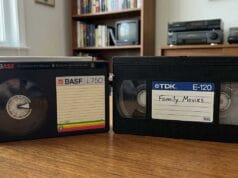
You’ve pulled a box down from the loft or out from under a bed, and the moment you open it you know something’s off. There’s a musty, cellar-ish smell. Hold a cassette up to the light and the edge of the tape pack — the spiral you can see through the window — has white or grey fuzzy spots on it, maybe a few golden-brown threads. Another one feels faintly sticky, and you’ve a half-memory of an old tape that squeaked horribly the last time anyone tried to play it. The fear that follows is the same one I had the first time: these are ruined, aren’t they, and I’ve left it too late. The reassuring part: knowing how to clean a mouldy VHS tape — and rescue a sticky, squealing one — is mostly a matter of doing things in the right order, and more is saveable than you fear.
Mostly, no. The reassuring part is that the two things you’re looking at — surface mould and sticky shed syndrome — are among the more recoverable faults an ageing VHS or cassette tape can have, and a great many tapes with one or both of them come back perfectly well. The catch is that the order of operations matters enormously, and a couple of wrong moves can destroy a tape outright or wreck the deck you play it in. So this isn’t a piece about magic fixes. It’s about doing things in the right sequence, knowing which problem you’ve actually got, and being straight about the tapes that won’t make it.
First, do no harm
The cardinal rule, before anything else, is the one that’s easiest to break in the first flush of enthusiasm: a mouldy or shedding tape must not go anywhere near your good deck. Mould and shed contaminate the heads, the capstan and the rollers the moment a dirty tape runs through the path — and from that point the machine itself becomes the carrier, infecting every tape you play after it. Preservation guidance is firm on this: if you’ve played a dirty tape, you clean the deck before the next one goes in. One bad tape can mean a half-hour deep clean of the transport…
So a suspect tape near your good deck is the first thing I’d avoid. The working answer is a cheap, sacrificial machine — a “burner” VCR you’ve paid a few dollars for and don’t mind contaminating. You use it to assess a doubtful tape and, where needed, to wind the tape onto a clean reel, keeping the contamination away from the deck you actually capture on. It’s the single most useful bit of kit for this whole job, and it’s the cheapest.
There’s a minority view in the hobbyist community worth naming so you can weigh it: that mould is effectively on every tape, that it’s not worth the fuss, and that you should simply clean your deck afterwards and move on. I’d not default to it. The preservation standards take the cautious line for two reasons that hold up — protecting the machine from cross-contamination, and protecting your own lungs — and neither of those is something I’d trade for a bit of convenience. Treat the relaxed view as a thing some experienced people do, not as permission to skip the mask.
Telling the two problems apart
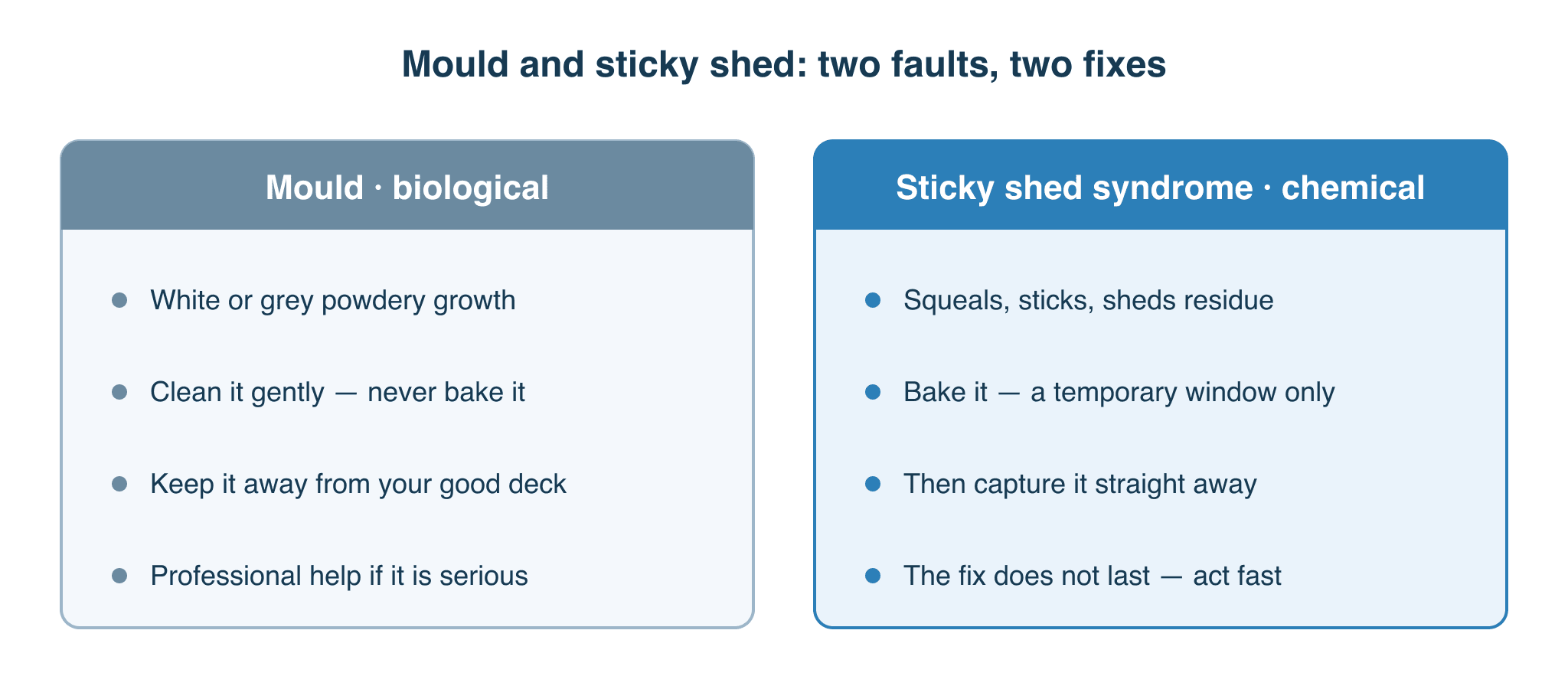
Mould and sticky shed get lumped together as “the tape’s gone bad,” but they’re different faults with different causes, and — this is the part that matters — they’re treated in opposite ways. Getting them muddled is how tapes get destroyed. So before any treatment, the job is diagnosis.
Mould
Mould shows as white or grey powdery or fuzzy growth, sometimes with golden-brown filaments, on the edges of the tape pack and visible through the cassette window. It usually comes with that musty smell. The distinction worth making is between dormant and active mould: dormant mould is dry and dusty and tends to brush or flake away; active mould is moist and will smear if you touch it. The cause is almost always damp storage — humidity sitting above roughly 70% for long enough — which is why loft, garage and under-the-house tapes are the usual sufferers.
Sticky shed syndrome
Sticky shed is a chemical failure, not a biological one. The binder that holds the magnetic coating onto the tape’s plastic base absorbs moisture and breaks down — hydrolysis is the term — and the breakdown products migrate to the surface. The symptoms are distinctive once you’ve met them: a squealing or squeaking sound as the tape plays, dusty rusty-brown particles left behind on the guides and heads, a gummy dark residue, the tape sticking to itself, and a rewind that’s sluggish or that tears. If a tape squeals and leaves grime on everything it touches, sticky shed is the first thing I’d suspect.
Here’s the crucial point, and it’s the one to fix in your mind before you do anything else: baking helps sticky shed, but a mouldy tape must never be baked. Heat doesn’t kill the fungus — it can make matters worse — and the mould has to be dealt with first, on its own terms. A single tape can suffer from both faults at once, which is exactly why diagnosis comes before treatment rather than after. Work out what you’re looking at, then choose the path.
How to clean a mouldy VHS tape — clean, don’t bake
The institutional framing here is straightforward: mould is ideally a job for a professional, handled with proper protection — mask, gloves and extraction — because the spore exposure is the real risk and a pro has the kit to contain it. That said, plenty of family archivists do tackle surface mould themselves, and for dormant, dry mould on an otherwise sound tape it’s within reach if you’re careful. Conservation bodies publish the detailed handling guidance behind this; the NEDCC preservation leaflets are a good free place to start.
The DIY approaches fall into two camps. The gentler one is mechanical: winding the tape slowly onto a clean reel while it passes through cleaning pads — a modified rewinder, or a sacrificial deck set up for the purpose — so the growth is wiped from the surface as the tape travels. The wetter one is to draw the tape through distilled water with a little isopropyl alcohol (IPA) added as a wetting agent, then wipe with sterile microfibre. It’s worth knowing the standard’s own caveat here: tapes don’t normally need cleaning at all unless they’ve got powder shed or gummy residue on them, so cleaning isn’t a routine step — it’s a response to a visible problem.
The IPA question is contested… One camp uses 99%-plus IPA and considers it safe on tape. Another warns that anything less than very pure IPA brings water with it — and adding moisture to a mould problem is feeding the very thing you’re trying to kill — and that IPA can strip the tape’s own lubrication, leaving you with a tape that then needs re-lubricating. Some in that second camp prefer hydrogen peroxide instead. There’s no clean consensus, so this is a place for caution rather than confidence: if you go the wet route, very pure IPA and a light touch, and accept that you’re in disputed territory.
If the tape matters and the mould looks at all serious, price the professional route before you risk it yourself. Restoration services run roughly USD 70–85 a tape, and some work on a “no recovery, no charge” basis, which takes a good deal of the gamble out of it. The machines the professionals use — broadcast and archive kit like the RTI TapeChek — run to thousands of dollars and aren’t a consumer purchase, so this is one area where paying someone with the right equipment can be the better-value call rather than the indulgent one.
Dealing with sticky shed — baking
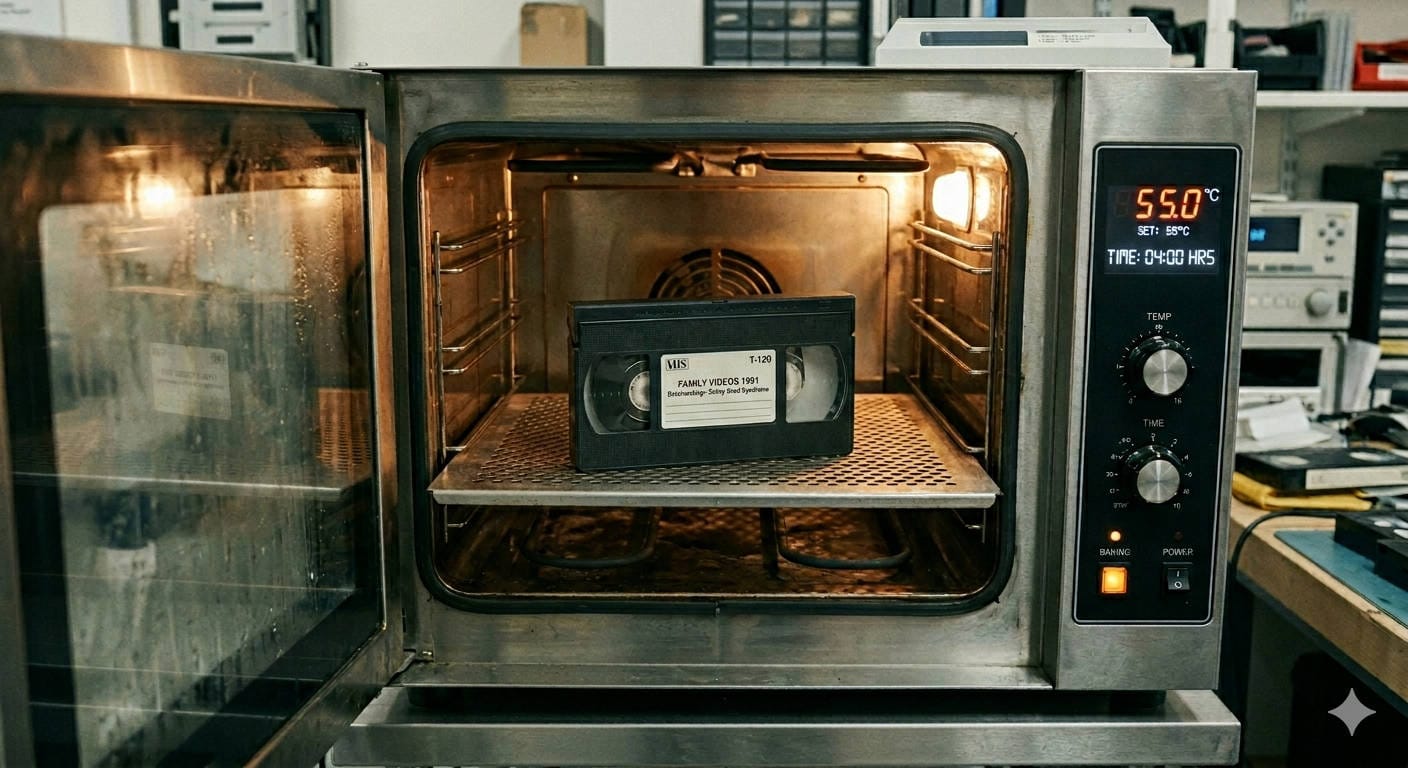
Baking is the treatment for sticky shed, and what’s actually happening is more interesting than the usual explanation. The common account — that the heat “drives the moisture out” of the binder — is one that recent research is quietly dismantling. Work by the Library of Congress’s Preservation Research and Testing Division (Davis and Shetzline, 2020) found no support for either the moisture-removal or the “re-polymerisation” story, and points instead to a specific thermal transition in the degraded binder at around 55°C. The plain-language version is unchanged — gentle, sustained low heat makes the tape playable again, without the squealing and shedding — but the mechanism is a temperature-driven physical change in the binder, not a drying-out.
And the fix is temporary, which is the part that should shape what you do next. Baking buys a window before the symptoms creep back, so the rule that comes with it is to capture promptly. How short that window is depends on the tape: loose test samples in the Library of Congress study stayed good after treatment, but tapes left wound — which is to say real tapes in storage — showed blemishes beginning to return after as little as a fortnight. So treat a baked tape as something to digitise this week, not this year.
The temperature matters more than the spread of published figures first suggests. The numbers do vary: the AMIA Videotape Preservation Handbook cites roughly 43–49°C (110–120°F); the figure most repeated in the community and on Wikipedia is higher, around 54–60°C (130–140°F); and IASA states a principle rather than a number — use the lowest temperature that still works, and go lower for video than audio, since video tape distorts more readily. The Library of Congress data helps reconcile them: it locates a meaningful transition around 55°C and finds that significantly lower temperatures produce no measurable change at all — so “lowest possible” has a floor, below which you achieve nothing. That figure is not new, either; it traces to an Ampex Corporation patent filed in 1989, which specified 54°C (130°F) precisely while saying nothing about why it worked. The practical landing point: around 54–55°C, held steady, for several hours, sometimes repeated across a day or two.
A few practicalities sit on top of those numbers. The heat source wants to be a convection oven with a stable, even temperature — stability is what actually matters, because a temperature spike can distort or even melt the tape; the Library of Congress researchers put it bluntly, that anyone serious about baking should invest in a lab-grade oven rather than trust a kitchen one. Half-inch VHS also takes longer to heat through than the quarter-inch reel-to-reel audio tape the method was first worked out on, so don’t shortcut the time. Bake in the cassette, and let the tape cool for about a day before you play it. One caveat worth holding on to: that Library of Congress research was carried out on reel-to-reel audio tape, and the authors themselves note that VHS and cassette form factors may change the heating behaviour — so treat the precise figures as the best science we currently have, not VHS-specific gospel. This is hobbyist territory; if the tape is precious, the same professionals who handle mould keep ovens built for exactly this.
Cleaning the machine afterwards
After any bad tape — mouldy, shedding, or both — the tape path gets cleaned before the next tape goes in. This is the discipline that keeps one bad tape from becoming a dozen — build it into the routine rather than treating it as an occasional chore.
The consensus method uses 99% IPA. Cotton swabs do the guides, the rollers and the rims. The head drum is the exception, and it’s an important one: a folded sheet of printer paper, lightly dampened with IPA, is what cleans the drum — drawn gently across it. Cotton swabs on the head drum are exactly the thing to avoid, because the fibres snag in the head gap and can snap the heads clean off — turning a cleaning job into a dead deck. The handbook’s standard tool for the whole path is a Pellon-paper cleaning cassette, which does the same job in cassette form if you’d rather not go in by hand.
Format matters more than you’d expect
Not all tapes take this kind of trouble equally well. VHS is comparatively tough — the tape is wide and reasonably robust, and small amounts of surface mould are often still transferable once cleaned. The small-format camcorder tapes are a different story. Video8, Hi8 and MiniDV use much narrower tape, and that narrowness makes them far more fragile: they tend to stick and tear, so mould often renders them unplayable outright, and recovery may not be cost-effective even when it’s possible. For those formats I’d be gentler still, and I’d weigh up earlier whether a professional is the better call — the margin for a DIY mistake is much thinner than it is on VHS.
Why your capture method matters for a fragile tape
There’s one more reason the order of operations matters, and it’s about how many times you make a fragile tape pass the heads. With a treated tape — one you’ve baked, or cleaned of mould — every play is a small risk, so you want to play it as few times as possible, ideally once.
This is where RF capture with vhs-decode earns its place. Rather than producing a finished picture as it plays, it records the whole raw signal coming off the heads in a single pass, and lets you re-decode that recording afterwards — refining the result as many times as you like without ever touching the tape again. “Capture once, decode forever” is the shorthand, and it makes a treated, fragile tape a strong case for one careful RF pass instead of repeated plays. If that’s new to you, how vhs-decode actually works explains the technique, which VCR for vhs-decode RF capture covers the deck, and capture hardware in 2026 walks through the gear that takes the signal off your tap.
What can’t be saved
Be straight about the tapes that won’t come back, because pretending otherwise helps no one. When mould has actually eaten into the tape surface — not just sitting on it, but having consumed the coating — the recorded signal has gone with the coating, and no process puts it back. The same is true when the binder or oxide has delaminated and physically shed off the plastic base: where the magnetic layer has left the tape, the recording has left with it. And there’s a cruel second edge to this — exercising or cleaning a badly deteriorated tape can itself finish off what little was left, so the act of trying to save it is sometimes what destroys it.
The harder truth underneath all of it is that magnetic tape is a finite, decaying medium. It was never meant to last forever, and a great many family tapes are already past the point where they should ideally have been migrated to something more durable. The line between “degraded but recoverable” and simply “gone” often isn’t visible from the outside — you frequently can’t tell which side of it a tape sits on until you try. That uncertainty is the real argument for handling each tape gently and, where the contents genuinely matter, paying a professional rather than gambling on a kitchen oven and a steady hand.
If a tape does turn out to be beyond saving, I’d not read that as your failure. It’s the medium reaching the end it was always going to reach, often after decades in conditions no one chose well. And it’s worth ending where we started, because it’s the part that’s true for most people who open that musty box: the majority of tapes with surface mould or sticky shed, handled in the right order — diagnosis first, mould before heat, a sacrificial deck, a clean path afterwards — do come back. The ones that don’t are the medium’s limit, not yours.
Where next
Once a tape is treated and stable, the next decision is how you capture it — and the preparation that goes around a single careful pass is laid out in Capturing Analog Video Tapes — Part IV — Preparation. And if this box of tapes has you thinking about the longer game — keeping what you recover safe for the people after you — Designing a family archive that survives you — Part II: Preservation is the companion to read next.