
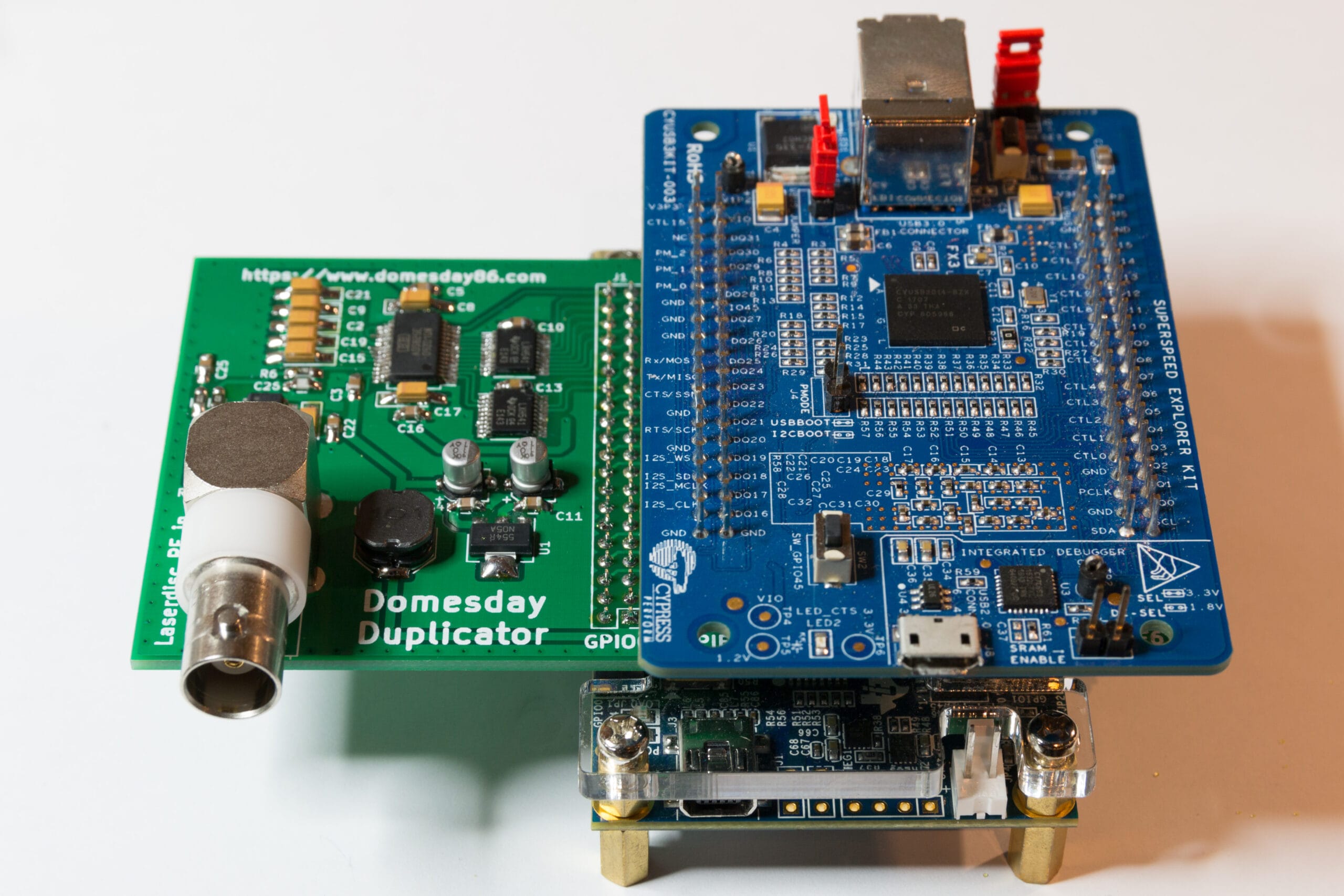
If you've already decided that vhs-decode is the right tool for your tapes, the next question lands almost immediately: which capture hardware should I actually buy? The open web has remarkably little to say on this. The GitHub readmes assume you've already picked. The forum threads are years out of date. The Discord channels where the real conversation happens are deep and unsearchable, and most of the useful comparison sits in scrollback nobody has written up. The point of this article is to translate that scrollback into something a person sitting in front of these options can use to make a decision.
A note on scope before going further. This article assumes you already have a working sense of what RF capture is and why anyone bothers with it — the bit depth, sample rate, head-amplifier tap, the whole conceptual move from "capture the deck's output" to "capture the deck's input". If any of that is unfamiliar, the vhs-decode explainer is the right place to start. The piece you're reading now sits one step beyond that — picking which hardware path to commit to, and dealing with the awkward second question that follows immediately after: how to capture audio in sync with the RF, because most of these paths capture RF only and treat audio as somebody else's problem.
There are five paths worth considering in 2026. Two are production-ready, one is mature but increasingly legacy, and two are still firmly in the "watch this space" category. I'll walk through each, then settle the audio-with-the-DdD question, then try to offer something resembling a real recommendation.
The 2026 RF capture baseline — CX2388x + Clockgen Mod + Rewolf amp
If you've read any vhs-decode discussion in the last year and a half, this is the build you've seen mentioned more often than any other. It's the current consensus starting point — the cheapest viable RF capture chain, the one with the most documentation, the one with the largest community of people who have got it working. It's the recommendation I'd give first to anyone who isn't sure where to start.
The build is three parts. A Conexant CX2388x capture card, in either PCI or PCIe form — sold originally as a generic TV-capture card, available second-hand for somewhere between fifteen and forty dollars depending on condition — does the actual analog-to-digital conversion. (The chip itself is fundamentally a PCI device; cards that present on PCIe slots do so via a bridge chip, and the cxadc driver doesn't care which.) A Clockgen Mod board (a small Raspberry Pi plus a Si5351 clock generator and a PCM1802 audio ADC, a community-designed PCB) replaces the CX card's stock crystal with a programmable shared clock, and adds an onboard 24-bit stereo audio ADC for line-level audio. A Rewolf ADA4857 amplifier board, fitted inside the VCR, buffers the deck's high-impedance head-amp test point down to the 75-ohm input the CX card expects to see.
Each of those three parts is doing real work. The CX card on its own is fine as a fast ADC, but its stock 28.6 MHz crystal locks it to a single sample rate, and — more importantly — its clock has nothing to do with whatever clock your audio capture is using. Two clocks from two crystals drift, because manufacturing tolerance and temperature drift make every crystal slightly different. Over a two-hour tape that drift accumulates into audible audio-versus-video sync error. The Clockgen Mod fixes both problems at once: it lets the CX card sample at 20, 28.6, 40 or 50 MHz and switch live during capture, and it derives the audio ADC's clock from the same source, so video and audio are bit-exact synchronous for the entire length of the recording. The Rewolf amplifier is the other half of the puzzle — the head-amp test point inside a VCR is an internal circuit node that was never designed to drive a load, and connecting a capture card directly to it pulls the signal down and distorts what you measure. The amplifier sits invisibly between the test point and the cable, presenting a high-impedance load to the deck and a 75-ohm source to the card.
A reasonable rough budget for the whole build, deck not included, sits somewhere in the 150 to 250 US dollar range. The CX card is fifteen to forty used. The Clockgen Mod is sold as a kit via a community Ko-fi store; the exact price moves with chip availability and shipping, and I'd check the current listing rather than commit to a number here. The ADA4857 amplifier is around forty dollars when in stock, though it was reported sold out at one point in early 2026, which is worth being aware of — these are small-batch community-built products, not high-street items. Cables, connectors, RG178 or RG316 coax for the short runs inside the deck, and a few odds and ends bring the total up.
The skill floor is real but manageable. The CX card needs its stock crystal removed (a single SMD desolder). The Clockgen Mod ships as a kit you assemble — surface-mount soldering on a small PCB. The amplifier wants per-deck resistor tuning to match the signal level coming off your particular VCR's tap point, which means either following one of the documented combos for a known deck model or measuring with an oscilloscope and adjusting by hand. None of this is exotic, but none of it is plug-and-play either. Plan on a weekend.
What you end up with is, as of mid-2026, the build the community most commonly recommends for VHS RF capture. It isn't because the raw specs are the highest available — the DdD's 40 MS/s at a full 10 bits gives more data per second than the CX card in any mode — but because the CX path gets the practical job done at the lowest cost, with synchronous audio in the same package, and with the deepest documentation and community support of any current path. The configuration is 40 MS/s at 8-bit, or 20 MS/s at 10-bit if you switch the driver's tenbit flag on — you trade sample rate for bit depth, you don't get both at once. Synchronous 24-bit audio. Linux-native via the cxadc driver. It works, it's documented, and the community knows how to help when something goes wrong. One structural limitation is worth flagging up front: the CX card needs a free PCI or PCIe slot, which rules out laptops, Macs without a Thunderbolt-to-PCIe enclosure, and compact desktops with no expansion. If that's your machine, the DdD (next section) is the USB-3 alternative. For most readers with a tower desktop who want to start now, the CX path is the answer.
The DomesdayDuplicator — the purpose-built path
The DomesdayDuplicator (DdD for short) is the original RF capture device the community produced, designed years before the CX-card workflow had been figured out. It's built around a DE0-Nano FPGA development board, a discrete analog ADC, and a Cypress FX3 USB-3 endpoint. The FPGA's job is to buffer samples against USB jitter so that no frames are dropped at sustained rates. It samples at 40 MS/s at 10 bits, with a fixed onboard low-pass filter at around 14 MHz.
It was originally built for LaserDisc, where the higher sample rate and the LD-tuned filter are both important. For VHS, the rate is more bandwidth than the format strictly needs and the LD-optimised input stage is mild overhead — but the device still works perfectly well, and the 10-bit depth (a factor of four more amplitude resolution than the CX card at 8-bit) is part of why some archivists prefer it. I use a DdD myself, for what it's worth — the original 10-bit / 40 MS/s configuration. Whether that bit-depth advantage produces a measurable improvement in the decoded picture compared to a CX card running at the same rate is, honestly, an open question. The principle that more information at capture time is better than less is sound, and I'd rather have data I don't need than lack data I do need. But the claim that one card produces visibly better video than another is the kind of thing I'd want side-by-side captures to settle, not first-principles arguments, and the side-by-side captures haven't been published.
The reasons people pick the DdD are usually some combination of: it was the device they bought when they first got into RF capture and the workflow still works fine, they value the slightly higher bit depth, or — for LaserDisc work — there is no real alternative on offer. The DdD remains the LD reference device. Nothing has replaced it on that side.
The reasons people might abandon it for VHS work tend to come down to two things. The first is audio. The DdD captures one RF channel and nothing else; audio is a separate problem to solve, with no single canonical answer (more on this in the audio section below). The second is USB reliability. The FX3 + libUSB path has a reputation for being quietly fragile on Windows — particularly sensitive to USB-3 cable quality in a way that produces silent capture corruption rather than obvious failure. Linux users report fewer problems. The common first-step debugging advice is to swap the cable, which is exactly the kind of advice you only need if cable quality is doing more work than it should be.
On cost, the historical PCBway path was around 130 US dollars in 2023 for five bare boards plus one fully assembled — a figure that gets quoted occasionally but is now several years old, and PCBway pricing, component availability and chip costs have all shifted since then. I wouldn't commit to a 2026 figure without checking; the more useful thing to know is that the ordering path is still available, my own DdD came that way, and the community has walked dozens of people through the process. Pre-built units occasionally appear second-hand, though availability is hit-and-miss.
The honest summary in 2026: the DdD is mature, supported, and still in active use, but newcomers to the project are no longer routinely pointed at it as the first hardware to buy. For VHS work specifically, the CX-card-plus-Clockgen path is the more common recommendation. For LaserDisc work, it's still the answer.
MISRC V2.5 — the integrated successor
The Multi-Input Simultaneous Raw Capture board (MISRC) is the longer-term aim of the community's hardware effort. It's the device a CX-card-plus-Clockgen-Mod build wants to grow up to be: dual 12-bit ADCs and the clock generator and four-channel integrated audio capture all on one PCB. One USB-3 connection, one board to assemble, no clock-sync wiring to get wrong. The current dev prototype (V1.5a) is in production and people are using it, and a tidied next revision (V2.5) is approaching release at the time of writing.
The pitch is straightforward. Twelve-bit RF on two channels means you can capture video RF and HiFi RF simultaneously, both clocked from the same source, on a single device. A four-channel integrated baseband audio ADC — clock-synced to the same master — handles line-level audio capture in the same unit, so for the common case of a linear-track-only tape you get clean baseband audio from the deck's RCA outputs without needing a separate Clockgen Mod, and for HiFi tapes you have the option of capturing HiFi RF on the second channel for software re-decode. The new anti-alias filter handles LaserDisc cleanly, which the V1.5a doesn't. And the capture software is being explicitly aimed at cross-platform stability — the design intent is that it should be the device a Windows user can buy, plug in, and have working.
The catch is that V2.5 isn't shipping yet. As of this writing the dev batch has been built and is in the developer's hands, and the remaining blocker is software stabilisation — particularly USB stability across platforms. It's positioned as a release version rather than a tinkering development version, and the project's stance is to hold the release until it actually works that way. That's the right call, but it does mean the article you're reading can't give you a release date.
The price is also higher. V1.5a is around 90 US dollars depending on chip pricing and tariff exposure. The V2.5 dev batch is being floated in the 350 to 375 GBP range all-inclusive — board, case, capture card, tested and shipped — which is a dev-batch margin-rate price rather than a production price. The expectation is that production V2.5 may come down somewhat with cheaper fabrication, but I wouldn't budget for that until it's confirmed.
The MISRC also doesn't replace the Rewolf amplifier on the deck side. The amplifier is required regardless of which ADC you pair it with; the MISRC is the ADC half of the equation, not the amp half.
For a reader picking hardware right now, the practical question is whether to start with CX-plus-Clockgen and switch when V2.5 ships, or to wait. My honest answer is to start now. The CX path works, parts are available, and the conversion from one to the other is a card swap rather than a workflow overhaul — the deck-side amplifier and tap point don't change. Waiting for the next thing has cost the project a steady stream of would-be users over the years, and the captures you didn't make while waiting are captures you can't go back and make.
The cheap-and-experimental direction — hsdaoh and the RP2350 boards
There's a parallel line of work that doesn't fit the same CX → Clockgen → MISRC evolutionary story, and it's worth understanding even if you don't end up using it. It's based on a clever observation: cheap HDMI capture sticks contain ADCs running at impressive sample rates and the silicon has registers that let you bypass the video-pipeline processing and ingest raw data instead.
The project is called hsdaoh — High Speed Data Acquisition over HDMI. It repurposes the MacroSilicon MS2130 / MS2131 family of HDMI capture sticks (the ones sold on AliExpress for around thirty dollars each) as raw-data ingest pipes. The sticks have to be reflashed with a custom firmware via an open-source tool, and then they happily push raw 12-bit ADC samples back to the host at well over 175 MB/s sustained. Pair the stick with a Raspberry Pi Pico 2 (the RP2350 board, around five dollars) running matching firmware, plus one or two cheap AD9226 ADC modules, and you have a usable 12-bit 40 MS/s capture chain for a BOM target of around fifty dollars total. A PCM1802 audio ADC module covers audio in the usual way.
A community-designed PCB integrates the RP2350, two AD9226 ADCs and the audio path into a single board, with reported performance around 38 dB SNR. Several people have built it; it produces working captures. Going through the project's hardware-hacking discussion channel turns up a handful of working builds in production use.
So why isn't this the recommendation? A few reasons, and they're worth being direct about. There is no anti-alias filter on the front end — you need to build a small external low-pass filter as part of the input stage. There is no production kit available; you order the PCB from the design files, source the components yourself, and flash the firmware yourself. The discussion channel where this work happens is a research-and-development conversation rather than a beginner-support channel, and the software side is still evolving — Windows support is partial, and the documentation lags the current pull requests. The 38 dB SNR figure floating around for the dual-ADC RP2350 board is the designer's own measurement; to my knowledge it has not been put head-to-head against a fully-set-up CX card in controlled conditions, so comparing it directly to the CX card's commonly-quoted figures is misleading.
The honest take: if you enjoy the build, want a sub-fifty-dollar BOM, and don't mind being a contributor as much as a user, this is one of the most interesting directions in the project. If you want to capture a tape this weekend without any of the above, it isn't the recommendation. The disruptive potential is real — if a kit version ever materialises, the entry cost of the project halves overnight — but that hasn't happened yet, and predicting when it might isn't something I'm in a position to do.
Audio with the DomesdayDuplicator — four paths
If you go the DdD route — either because you already have one, because you specifically want the 10-bit depth, or because you're working on LaserDisc as well as tape — the audio-in-sync question is its own small project. The DdD captures one RF channel and nothing else. Audio has to come from somewhere, and it has to share a clock reference with the DdD if you want it to stay in sync over a long capture. There are four ways people are solving this in 2026, and they're worth laying out together because the right choice depends on what you already have on the bench.
A quick note on terminology, because it trips people up. Baseband audio is the deck's analog audio output — the signal at the RCA sockets after the deck has decoded whatever was on the tape. That's the audio most VHS tapes carry as a linear track recorded along the edge of the cassette, and it's also the audio you get from a HiFi-equipped deck after it demodulates the HiFi carriers internally. HiFi RF is a different thing: the FM-modulated audio carrier pair sitting at around 1.4 megahertz on the helical drum tracks, captured before any in-deck demodulation. Capturing HiFi RF directly (and decoding it in software) only matters for tapes that were recorded in HiFi to begin with — and the majority of consumer tapes from the early eighties through into the mid-nineties were linear-track only. For a family archivist working through home videos from that era, capturing clean baseband audio in sync with the video RF is the actual problem to solve, and HiFi RF capture is a non-issue.
The first path is the Clockgen Lite mod plus an external audio ADC and the ddd-capture-toolkit project. This is the route I use. The toolkit has a specific history. In April 2025 a number of people, myself among them, discovered after the fact that they had built or bought a DdD without realising it wouldn't capture audio in the same pass — the DdD's official capture app is GUI-only, and a GUI-only app can't be coordinated with a separate audio capture from a script. The toolkit started as a fix for exactly that. Its load-bearing technical contribution is adding command-line support to the official DdD capture app, which lets a single command kick off the RF capture and a synchronised audio capture together. That CLI patch was submitted upstream as pull request #2 on the official DomesdayDuplicator-gui-app repo in January 2026; it's still open with no maintainer activity at the time of writing, so the toolkit runs from a fork of the official app that's periodically resynced to upstream master when significant changes land. If you'd like the CLI support to land in the official app, the PR thread is the right place to say so. A Clockgen Lite (a simpler, hand-wired version of the Clockgen Mod scaled down for the DdD's needs) shares the DdD's master clock with a PCM1802 audio ADC module — the same chip used in the full Clockgen Mod for the CX-card workflow. The audio path produces a -72 dB noise floor at 24-bit, which is to say it's perfectly clean. I've run six-hour captures with this setup. One honest limitation worth flagging: the audio-video alignment still requires a one-off manual calibration pass — a known alignment tape played through the deck so the toolkit can lock the relationship between the two streams. The toolkit creates the alignment file for you and walks through the recording, but the alignment itself isn't yet automatic; I don't know that this is solvable with the DdD at the hardware level. The trade-off is the soldering and wiring of the Clockgen Lite mod, the fact that there's no kit version — you build it from documentation — and that one calibration pass.
The second path is a recent piece of community work: a custom FPGA gateware build for the DE0-Nano that multiplexes audio samples from the DE0-Nano's own onboard ADC128S022 directly into the DdD's RF data stream. This is the cheapest possible path because the audio ADC is already on the board — it's part of the development kit and the DdD just doesn't use it by default. Two 5 kΩ resistors and a 68 µF capacitor per channel are the only external parts needed. The catch is that the onboard ADC isn't an audio-grade part; the achieved noise floor is around -30 dB, which is honest but audibly hissy compared to a PCM1802. The author's own framing is that it is good enough rather than excellent, which strikes me as fair. The other catch is that this is custom FPGA work, with the gateware partly LLM-generated and described as a first-time FPGA project by its author. The code works; anyone integrating it upstream would want to read it carefully first.
The third path is a variant of the second, swapping in a PCM1802 for the onboard ADC. Same gateware, same multiplexing-into-the-RF-stream idea, but with the PCM1802's clean 24-bit / -72 dB audio going into the DE0-Nano's spare FPGA pins instead of using the dev board's onboard ADC. You get the audio quality of path one with the no-separate-USB simplicity of path two. The trade-off is that you have to build the gateware (Quartus for the DE0-Nano), flash it to the FPGA, and demultiplex the audio out of the RF stream in post-processing. The PCM1802 module itself has a small build gotcha worth knowing about — the mode jumpers on the back of the module need a specific bridge configuration, and people regularly get this wrong on first build.
The fourth path is a purpose-designed daughterboard for the DdD that wraps the third path in a production-friendly PCB rather than a hand-wired prototype. The first revision had a connector flipped and the wrong board dimensions; the second revision works correctly and is documented at github.com/JonasCz/DomesdayDuplicator-audio-ADC with compiled firmware in the releases section. There's no production batch, but the design files are available for anyone willing to order the board themselves. One open question worth flagging: a 5 kHz whine in the baseband audio has been reported, appearing the moment the DdD starts capturing — not present when it's idle. The cause hadn't been identified in the material I had to hand. If you go this route, expect that it may or may not still be an issue depending on whether it's been chased down by the time you read this.
One thing all four DdD audio paths share: none of them captures VHS HiFi RF directly. They all rely on the deck's internal HiFi demodulator (when the deck has one and the tape was recorded in HiFi) and capture the resulting baseband audio at the deck's output. Capturing HiFi RF separately — sampling the 1.4 megahertz carrier pair from the head amp and decoding it in software — needs its own RF channel in the capture chain. The DdD has one RF input, occupied by the video RF. The gateware approaches multiplex a single baseband audio stream into the existing RF data stream; there's no room for a second RF capture.
Whether any of this matters depends on what's on the tape. For the majority of family-archive tapes — home videos from the eighties and into the mid-nineties, recorded linear-track only — there's no HiFi RF on the tape, the deck plays back from the linear track, and the baseband audio at the deck's output is everything there is. The four paths above cover this case completely. If your tapes were recorded in HiFi VHS specifically — later consumer camcorders, commercial pre-recorded tapes, some 90s home recordings — and you want to re-decode the HiFi RF in software rather than trust the deck's internal demodulator, then the DdD is structurally the wrong device. The architectures that handle HiFi RF directly are the CX-card-plus-Clockgen-Mod build with a second CX card, and the MISRC (V1.5a with HiFi on channel 2, or V2.5 with both video and HiFi natively).
A decision tree, given different starting points
The honest answer to the question of which one to buy depends on what you have on the bench, what you want to capture, and how much fiddling you enjoy. Some rough recommendations follow, expressed as how I'd think about it rather than as one-size-fits-all.
If you have no rig yet and want to start now, I'd go CX2388x + Clockgen Mod + Rewolf ADA4857 amp. It's the cheapest viable working chain, the documentation is the best of any path, and the community can help when something goes wrong. Two hundred dollars and a weekend gets you a working setup. The caveat is that this assumes a desktop tower with a free PCI or PCIe slot — see the next point if that isn't you.
If your machine has no PCI or PCIe slot — laptop, Mac, or compact desktop — the CX-card path isn't an option, and the DdD over USB-3 is the obvious answer. The audio-pairing approaches in the section above all work over USB. The MISRC V2.5 will be a USB-3 alternative once it ships, and worth waiting for if you can. hsdaoh paired with the RP2350 board is another USB-based direction but isn't beginner-ready.
If you already have a DdD — and this is partly speaking from my own experience — keep using it. The bit-depth advantage is real if not dramatic, the LaserDisc capability is real if you ever cross over to that side, and the audio-sync problem is solvable with any of the four paths above. The Clockgen Lite plus the ddd-capture-toolkit is what I use; the daughterboard approach would be where I'd look first if I were starting that piece today rather than a year ago.
If you specifically want the cleanest, most-integrated future-proof option and you're willing to wait — the MISRC V2.5, when it ships. Two channels of 12-bit RF, four channels of integrated audio, single board, single USB. It will be the right answer when it's ready. Right now it isn't quite ready.
If you want the lowest possible cost and you enjoy the build, hsdaoh paired with a community RP2350 dual-ADC board is the interesting direction. Plan on contributing to the project as much as consuming it, and accept that some pieces of the workflow are not yet plug-and-play.
If you specifically need to capture VHS HiFi RF as well as the main video RF, the DdD is structurally the wrong choice. Either two CX cards on a Clockgen Mod with both clocked synchronously, or wait for the MISRC V2.5 with its dual channels.
If the tapes you care about are LaserDiscs, the DdD is still the answer; the MISRC V2.5 will join it once it ships.
What's coming
The landscape is still moving and a few items are worth keeping an eye on. The MISRC V2.5 release will be the most consequential single event — when it ships and stabilises, it becomes the obvious starting recommendation, and CX-plus-Clockgen takes a step back into legacy. The RP2350 dual-ADC board, if it ever productionises as a kit, halves the entry cost of the whole project; that would change everyone's recommendation. hsdaoh as an ecosystem may mature to the point of being beginner-friendly, though I wouldn't bet on the timeline. The DdD audio daughterboard may evolve into something with kit availability and the 5 kHz whine resolved. The CX2388x cards themselves are second-hand-only and the supply is finite — at some point in the next several years the path is going to disappear, which is part of why the MISRC matters as a successor.
None of these is far enough along to base today's purchase decision on. They're worth keeping a soft eye on rather than a held breath.
What's next
The vhs-decode explainer covers the wider question of whether this approach is right for your tapes at all, if you're still weighing that. The TBC versus frame sync article and the longer piece on why a time-base corrector matters are relevant if you're also considering a conventional capture path alongside this one — the principles overlap, even though the hardware doesn't.