
In the betamax vs vhs format war of the late 1970s and early 1980s, VHS won, but the popular line that “Betamax was better and lost” is only half true. Betamax had a marginally sharper picture and a smaller cassette, yet for ordinary home users those gaps were small. VHS won on the things that actually mattered to households, rental shops and electronics makers: longer recording time, cheaper and more open licensing, and a broad alliance of manufacturers behind it. This piece tells the story straight, then explains why, for anyone with old tapes today, the result still matters.
A one-year head start that did not last
Sony introduced Betamax in Japan on 10 May 1975, with a United States launch later that year. JVC followed with VHS in Japan in 1976 and in the US across 1976 and 1977, so Betamax held roughly a one-year head start. That lead evaporated quickly. By 1980 VHS held about 60 per cent of the North American market. By 1981 Beta had fallen to around 25 per cent of US VCR sales, and by 1987 VHS commanded about 90 per cent of the US market. In 1988 Sony tacitly conceded by announcing it would add VHS models to its own range. According to the documented history of the videotape format war, the contest was effectively over within a decade of VHS arriving.
The root of the split goes back to 1974, when Sony demonstrated the Beta prototype to other electronics makers in the hope they would all back a single shared standard. JVC chose to go its own way and build a rival. That decision set up the war rather than preventing it.
Betamax vs VHS on picture quality: a smaller edge than the legend says
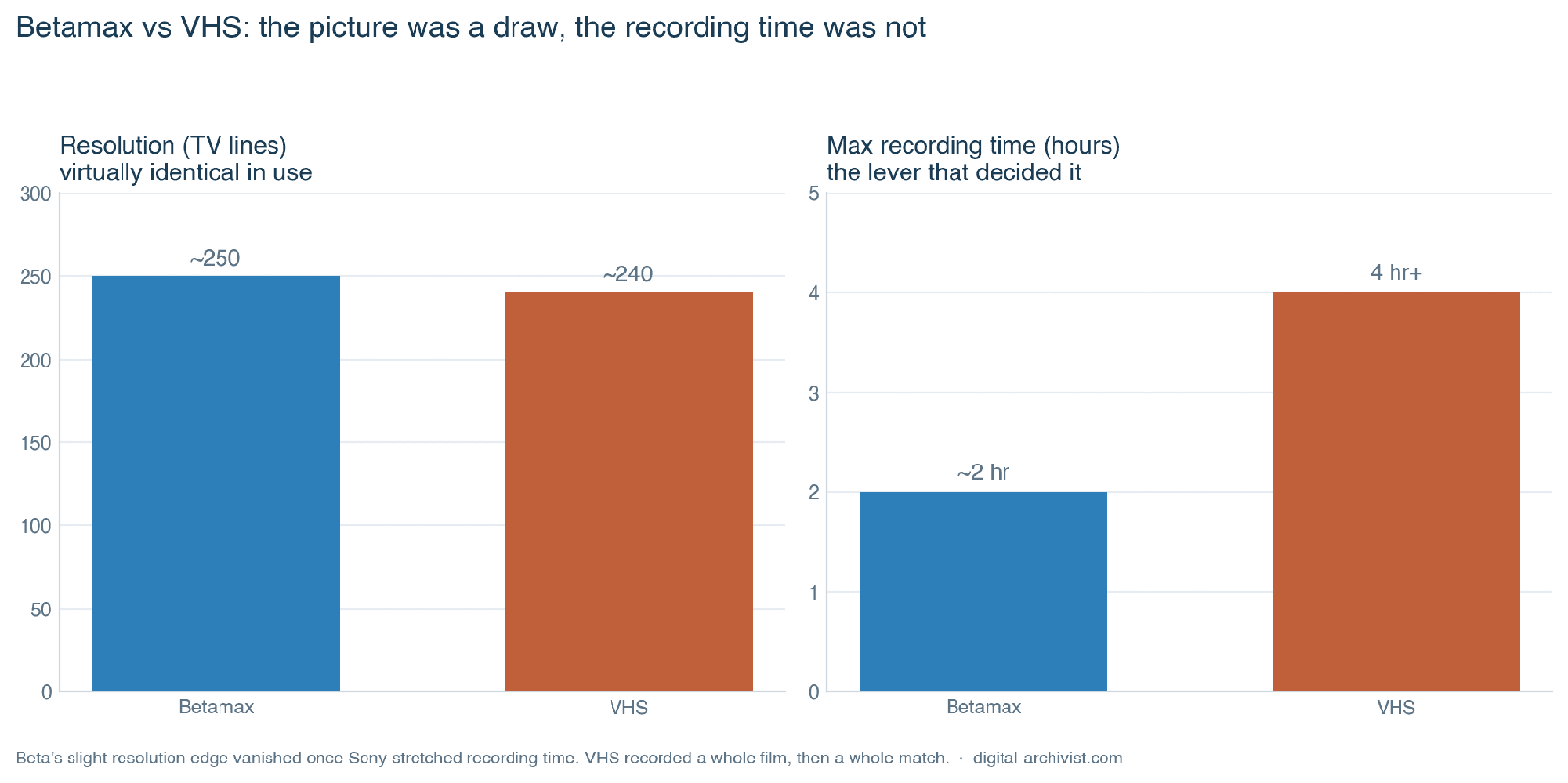
The “Beta looked better” claim holds, but only conditionally. In its original Beta I speed, Betamax delivered roughly 250 horizontal lines of resolution against VHS’s roughly 240, a small but measurable edge. The catch is that this advantage only held at the shortest, highest-quality recording speed. When Sony introduced the Beta II speed to double recording time to two hours, resolution dropped to about 240 lines and the gap closed. Later, the VHS HQ extension lifted VHS to around 250 lines. As the technical record on Betamax notes, a typical user could expect virtually identical resolution from either format in normal use.
Betamax did keep one tidy advantage: the cassette was physically smaller and more compact than the VHS shell. For a household choosing a machine, though, a slightly neater cassette counted for far less than what you could actually record on it.
Recording time – The lever that decided it
Early Beta tapes were limited to 60 minutes, which the record itself describes as impractical for recording films or sporting events. Sony’s Beta II speed doubled that to two hours, but only by giving up the resolution advantage. VHS launched with a two-hour capability and pushed on to four hours and beyond. That was enough for a whole feature film on one tape, and then a whole American-football game without changing cassettes mid-play.
This is the factor named most often as decisive. A household could tape an entire match unattended. A rental shop could put a complete movie on a single tape rather than two. Once recording length became the headline feature buyers cared about, Betamax was forced to choose between its picture edge and the runtime customers wanted, and it could not have both at once.
Licensing and the manufacturer alliance: the structural reason
The deeper reason runs through business strategy rather than the tape itself. JVC licensed VHS broadly and cheaply, which pulled in a wide field of manufacturers, including RCA, Panasonic’s parent Matsushita, Sharp, Magnavox and Zenith. Competition among them drove hardware prices down and put VHS machines in more shops. Sony initially resisted licensing Beta widely, which kept the field of Beta makers narrow and the machines comparatively pricey. The history of VHS records that Sony’s own co-founder Akio Morita later attributed the loss to that licensing approach, though many commentators rate recording time and the rental market as more important still. Treat Morita’s view as one named perspective, not the settled verdict.
The rental ecosystem turned a lead into a rout. JVC built relationships with American film studios and helped seed the home-video rental market, which several histories single out as the move that, more than anything else, gave VHS its edge. Cheaper, more widely available VHS hardware drew rental shops and pre-recorded-movie distributors toward VHS, and a deeper catalogue of rentable films drew more buyers to VHS machines. Each side of that loop reinforced the other. The standards body ANSI has written about this format war as a textbook case of how an open, widely-licensed standard can beat a technically tidy but tightly-held one.
Did the adult-film industry decide it? Not really
One legend insists VHS won because the adult-film industry backed it and Sony refused to license Beta for adult titles. The evidence does not support that. Adult films were released on both VHS and Beta to maximise sales, so the industry did not back one format exclusively. As reporting that examined this claim found, researchers were unable to turn up substantiated evidence that adult-film sales meaningfully changed the outcome.
This disagreement deserves setting out plainly, not blending together. The founder of Vivid Entertainment has said his company pushed VHS harder and in that sense had something to do with VHS winning. A technology-industry analyst, by contrast, credits the open format and licensing. The straightforward reading is that adult producers preferred VHS for the same reasons everyone else did, longer runtime and cheaper, more available hardware, which makes the format’s adult catalogue a symptom of the real causes rather than the cause itself.
What betamax vs vhs means for your old tapes today
For anyone preserving family or archival recordings, the winner of the format war is less important than what both formats have in common now. Betamax and VHS are both obsolete magnetic tape, and they suffer the same decay: binder hydrolysis, often called sticky-shed, along with oxide loss and mould. The clock runs on every tape regardless of which side it backed. The site’s reference on how long VHS tapes last and the broader pillar on how long old media lasts set out those timelines in detail.
The bigger difference today is the playback hardware. Sony stopped making Betamax recorders in August 2002 and sold its last blank Beta cassettes in March 2016. VHS decks, by contrast, were produced in vastly greater numbers and survive in far greater quantity. Finding a working, reliable Betamax machine, and someone who can service one, is materially harder than finding a VHS deck. Because that pool of serviceable players is so much thinner, Beta tapes are often the more urgent to digitise first. The bottleneck is as much the dwindling supply of machines that can read the tape as the tape decaying itself. Preservation efforts to rescue off-air Betamax recordings of early television make the same point: those tapes are at risk now, while the hardware to play them is still around.
The practical upshot is simple. Sort your tapes by format, move Betamax to the front of the queue, and start converting those tapes to digital files while the players to do it still exist.
Frequently asked questions
Was Betamax really better than VHS?
Only slightly, and only in narrow conditions. At its highest-quality speed Betamax managed about 250 lines of resolution against VHS’s 240, and its cassette was more compact. But that picture edge vanished once Sony stretched Beta’s recording time to two hours, and a later VHS upgrade closed the gap entirely. For everyday home viewing the two looked virtually the same.
Why did VHS beat Betamax?
Longer recording time, cheaper and more open licensing, and a broad alliance of manufacturers. VHS let you record a whole film and then a whole match on one tape, JVC licensed the format widely so hardware was plentiful and cheap, and rental shops gravitated to it. Sony kept tighter control of Beta, which left it pricier and less widely stocked.
Can you still play Betamax tapes?
Yes, but it is getting harder. Sony stopped making Betamax recorders in 2002 and stopped selling blank Beta cassettes in 2016. Working machines are scarce on the second-hand market and few technicians still service them, so finding a deck in good order, ideally one that has been properly maintained, is the main obstacle to playing or digitising Beta tapes today.
Are Betamax tapes worth digitising?
If the recordings matter to you, yes, and sooner rather than later. Beta tape decays the same way VHS does, but the bigger risk is the shrinking pool of working players. Because reliable Betamax machines are now much rarer than VHS decks, Beta tapes often deserve to go to the front of the digitising queue while the hardware to read them still exists.