

How long do cassette tapes last? A well-made compact cassette that has been kept cool, dry and stable can still play back after 30 years or more, but the number of years is the wrong question to ask. A rated lifespan is misleading, because what a cassette survives is decided almost entirely by how it was stored and, over the long run, by whether anyone still has a working deck to play it on. The chemistry is the same magnetic-tape chemistry found in video cassettes, and so is the conclusion drawn in our companion piece on how long VHS tapes last. Digitise the recordings you cannot replace while players still exist, and the physical tape becomes far less of a worry.
How long do cassette tapes last under good conditions, and bad
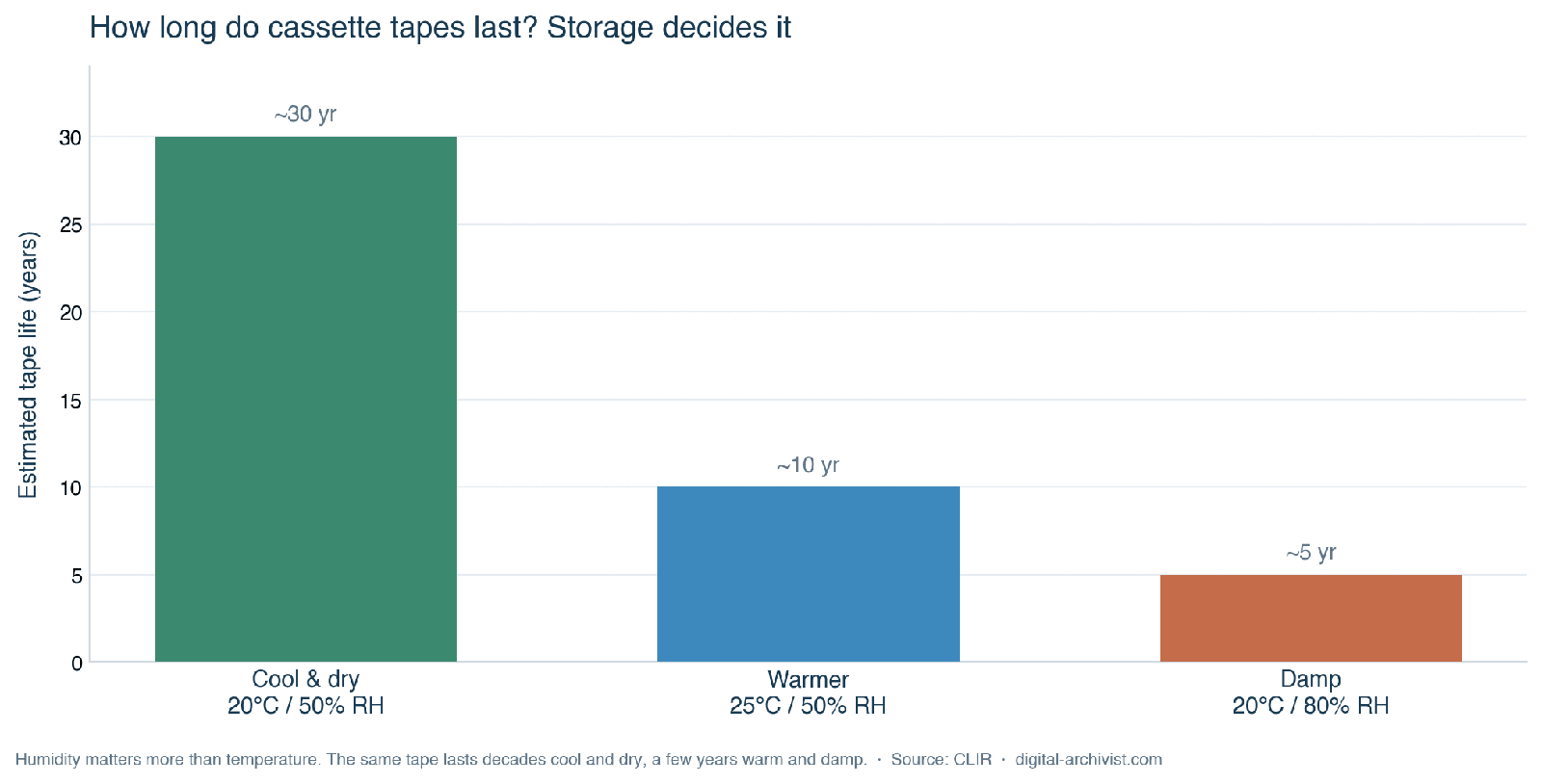
The benchmark figures come from CLIR Publication 54, Magnetic Tape Storage and Handling (Van Bogart, 1995), which models all magnetic tape, audio and video alike. Its life-expectancy estimates apply directly to cassettes.
- At 20°C (68°F) and 50% relative humidity, around 30 years is the upper limit for magnetic tape products.
- Raise the temperature to 25°C (76°F) at the same humidity, and the estimate falls to roughly 10 years.
- Raise the humidity to 80% at 20°C, and it collapses to about 5 years.
CLIR states that humidity matters more than temperature in deciding how long a tape lasts. A cassette in a cool, dry cupboard is in a different world from one in a hot, damp attic or garage, and the gap between them is decades, not years. So the 30-year figure is a ceiling under good conditions, not a promise. Treat any single number you read with suspicion, because the storage history behind it is doing all the work.
Sticky-shed: common in reel-to-reel, rare in VHS
Sticky-shed is most associated with reel-to-reel and professional audio tape, where certain 1970s and 1980s stocks are notorious for it. It is uncommon in VHS, which largely used binder formulations less prone to the fault, and it affects only some cassette stocks rather than all of them. Where a cassette does have it, though, the chemistry is the same. The central way magnetic tape goes bad is in the binder, the glue that holds the magnetic oxide particles onto the polyester base. In vulnerable stocks that binder is a polyurethane formulation that is hygroscopic, meaning it slowly absorbs moisture from the air. Over years that moisture drives a chemical breakdown called binder hydrolysis, the urethane degrades, and the coating turns soft and sticky. This is the well-known sticky-shed syndrome, and it is the same fault that afflicts old video cassettes, which is why the two articles reach the same verdict.
You hear and see it on playback. The tape squeals or drags, and it sheds rusty oxide dust onto the heads, guides, rollers and capstan, clogging the path and degrading the sound. The Library of Congress runs a dedicated research project on the problem and calls it a ubiquitous preservation challenge for recorded sound on magnetic tape, noting that the shed residue can both damage equipment and harm the signal. High humidity drives it faster, and above about 70% relative humidity degradation accelerates, with fungi able to attack the binder at elevated temperature and humidity as well.
Baking is the known rescue. Heating an affected tape gently at low temperature for a sustained period drives moisture out of the binder so it can be played long enough to copy or digitise it once. As the documentation on the preservation of magnetic audiotape makes clear, this is a one-time solution rather than a cure, because the binder stays unstable and reverts. Sticky-shed is stock-dependent, and it plagued certain premium open-reel and some video stocks far more than ordinary domestic cassettes, so not every old cassette has it. Not every tape fault is sticky-shed either, since other degradation modes exist too. Sticky-shed is stock-dependent, and it plagued certain premium open-reel and some video stocks far more than ordinary domestic cassettes, so not every old cassette has it. And not every tape fault is sticky-shed, since other degradation modes exist too.
Print-through, pressure pads and shell failures
Beyond the binder, a few faults are particular to wound tape and to the cassette shell itself. Print-through is the first. Adjacent layers of tape on the hub pick up a faint magnetic copy of the signal from the layer next to them, producing a soft pre-echo or post-echo of loud passages. It is worse on thin tape, which is why long-playing C-90 and C-120 cassettes are more prone than a standard C-60, and worse again at high recording levels and after long storage somewhere warm. The historical defence was to store tapes fully wound and re-spool them now and then. For a cassette the practical version is simply to fast-wind it end to end occasionally and store it wound rather than stopped halfway through.
Then there is the mechanism, which can fail while the tape itself is perfectly good. A small foam-backed felt pressure pad holds the tape against the head, and that foam degrades and crumbles with age. When the pad disintegrates or falls into the shell, sound goes muffled and low, and the tape can end up scraping bare metal and scoring the head. This is a common failure on old cassettes, especially some budget stocks, and re-padding is routine work in cassette restoration. The shell can fail too, with brittle plastic, seized hubs and stretched or slipped tape. Most consumer cassettes use a polyester or Mylar base that is far tougher than the older acetate, which tends to break and can suffer a vinegar-syndrome style breakdown where Mylar simply survives. The reassuring part is that these mechanical faults are repairable by someone with the parts and the skill, which leads straight to the real long-term problem.
The killer is obsolescence, not the tape
What makes a cassette unplayable is usually not the tape. It is the disappearance of the means to read it. The Library of Congress National Recording Preservation Plan warns that nearly all recorded sound is at risk of becoming inaccessible within a few generations, because the playback equipment will become obsolete. Survival depends on migrating the signal off these formats while they can still be played at all.
Australia’s National Film and Sound Archive put a date on it. Its Deadline 2025 report, published in 2015, named three converging threats to recordings on magnetic tape: the tape deteriorates, the playback equipment becomes obsolete, and the human expertise vanishes as the technicians who maintained and aligned these machines retire. On then-current investment, the NFSA estimated only around 30% of magnetic tape could be saved in time. Well-aligned cassette decks are no longer built to any quality standard, and serviceable units, spare belts and heads, and the people who can set them up correctly are a shrinking pool. The tape may well last 30 years. The deck and the know-how may not.
How to store cassettes so they last
The practical lever is storage, and the rule is short. Cool, dry and stable, with stability mattering as much as the actual numbers. CLIR’s access-storage range is roughly 15 to 23°C with 25 to 55% relative humidity, and it keeps swings tight, because cycling stresses the tape physically. The International Association of Sound and Audiovisual Archives caps the rate of change at no more than 3°C and 5 percentage points of humidity per 24 hours for the same reason.
IASA recommends roughly 7 to 13°C for magnetic tape and cautions against very cold storage, because some tape lubricants can exude below about 8°C, while CLIR’s recommendation for long-term archival storage goes colder still. For a home reader the safe synthesis is this: cool and dry, around domestic room temperature or a little below, and above all stable and never damp. Store cassettes upright on their edge, like books, not stacked flat, which is the origin of the upright advice and follows CLIR’s guidance to keep tapes on end. Keep them wound and in their cases, away from dust, heat, direct sunlight and magnetic fields, and let a cold tape warm up to room temperature before playing it so condensation does not form. For context on what good practice looks like at scale, the Library of Congress keeps its sound vaults at 50°F (10°C) and 30% relative humidity.
The point: digitise while you still can
A good cassette stored well genuinely can survive 30 years or more, but you cannot lean on any number, because heat, damp and instability can cut that to 5 or 10 years. Even a perfectly preserved tape is worthless once there is no working deck and no one left who can service one. So the answer that actually protects your recordings is to digitise the irreplaceable ones now, while players and expertise still exist. Once the audio is captured to a managed digital file, it is safe regardless of what the physical tape does next. Our guide to converting cassette tapes to digital walks through the process, and the wider question of how long old media lasts sets cassettes in the context of every other format on your shelf.
Frequently asked questions
How long do cassette tapes last?
A well-made cassette kept cool, dry and stable can play after 30 years or more, which is the upper limit CLIR models for magnetic tape at 20°C and 50% relative humidity. That figure falls fast in poor conditions, to around 10 years if the temperature climbs to 25°C and to about 5 years at high humidity. Storage decides the outcome far more than the age of the tape.
Do cassette tapes degrade over time?
Yes. The main chemical fault is binder hydrolysis, the breakdown of the polyurethane binder as it absorbs moisture, which can lead to sticky-shed syndrome where the tape squeals and sheds oxide. Wound tape can also suffer print-through, and the cassette mechanism ages independently, with foam pressure pads crumbling and shells turning brittle. Cool, dry, stable storage slows all of these.
How should I store cassette tapes?
Keep them cool, dry and stable, around room temperature or a little below, and never anywhere damp. Avoid large swings in temperature or humidity, since the cycling stresses the tape. Store cassettes upright on their edge like books rather than stacked flat, keep them wound and in their cases, and keep them away from heat, sunlight, dust and magnetic fields. Let a cold tape warm up before playing it.
Can a 40-year-old cassette still play?
Often, yes. Plenty of cassettes from the 1980s play fine today if they were stored well, though some will need a new pressure pad, a clean, or in bad cases a low-temperature bake to get through one last play. The bigger risk at that age is having a working, well-aligned deck to play it on. If the recording matters, digitise it now rather than waiting.
How long does other media last?
This is part of a series on how long different formats survive, and what actually shortens their life. The companion guides:
- How long does old media last? — the overview across every format.
- How long do VHS tapes last? — magnetic videotape.
- How long does film last? — 8mm, Super 8 and cine film.
- How long do CDs and DVDs last? — recordable and pressed optical discs.
- How long do hard drives and SSDs last? — drives, and why digital is not permanent.