
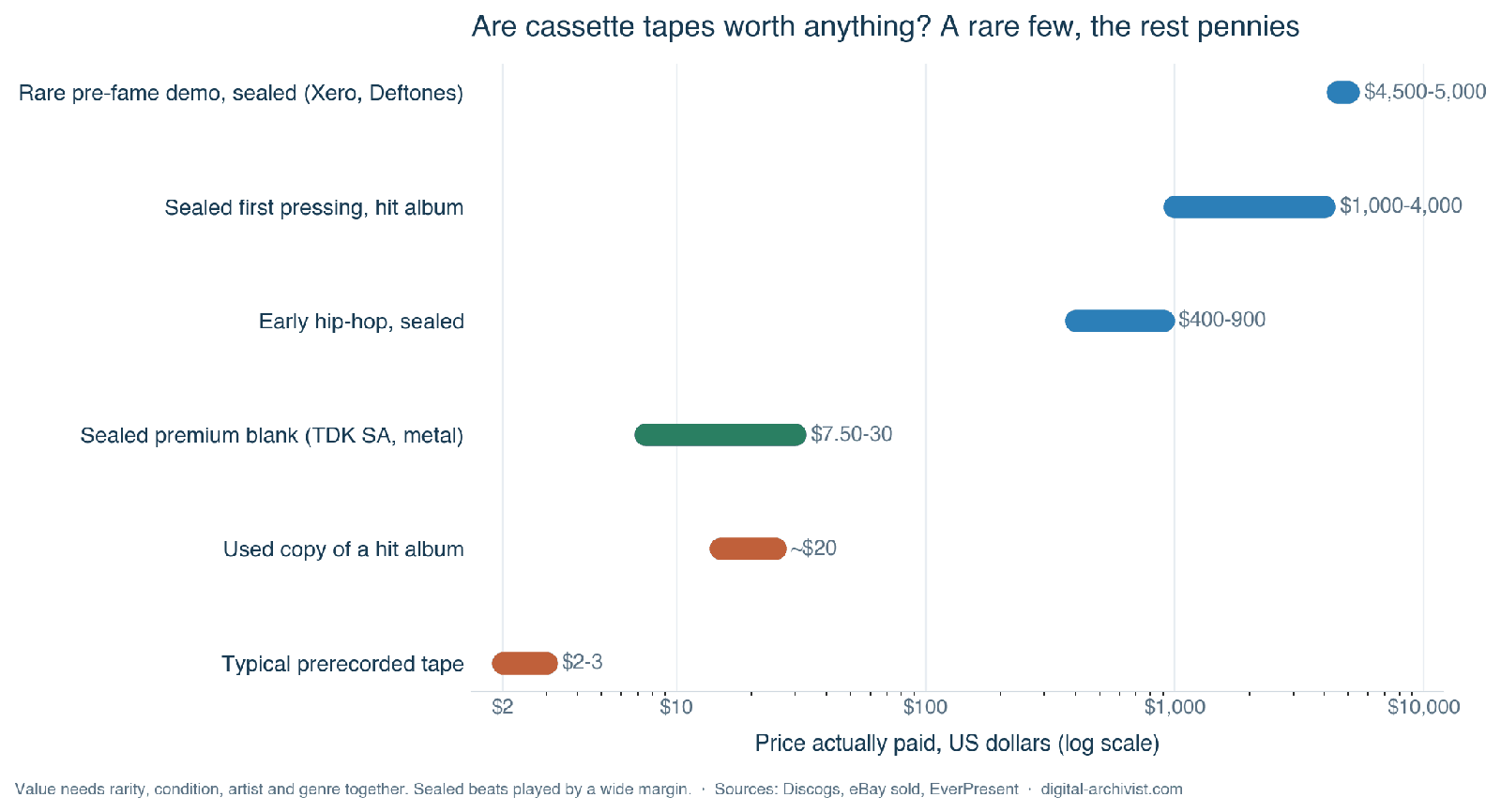
The straight answer to “are cassette tapes worth anything?” is that almost all prerecorded cassettes are worth very little. The music on a common pop, rock or R&B tape is everywhere now, on streaming, CD and vinyl, and the tapes themselves were mass-produced in their millions. A dusty box of 1980s and 1990s hits is not a payday. In bulk, common second-hand cassettes change hands for roughly two to three dollars each (one Facebook Marketplace seller listed a box of 100 used tapes for £250, about £2.50 a tape). Mainstream rock, pop and R&B from the cassette’s heyday are routinely described by collectors as not worth much because of that mass production. A handful of exceptions exist, and the next section covers them. But for most people the true value of a cassette is not money at all. It is what is recorded on the family’s own home tapes.
Are cassette tapes worth anything? What actually sells
Value comes down to four things working together: rarity, condition, the artist, and the genre. A few genres hold value far out of proportion to the rest, mainly early hip-hop and rap, metal, grunge, and self-released demos by artists who later became famous. It is sealed, rare, an early run or a demo, and in a collectible genre. It is rarely just “old”.
The headline example is Linkin Park’s pre-fame demo “Xero”, self-released in tiny numbers, which has fetched around $4,500 on Discogs. A first self-titled Deftones demo cassette sold for $5,000 in May 2024, among the most expensive ever recorded. Prince’s “The Black Album”, pulled before release and circulated only as a leaked promo, has reached $5,000 and more, with one copy reported at $8,750 in 2017.
Sealed first runs of famous albums can also climb, though the gap between sealed and played is enormous. A sealed first run of Pearl Jam’s “Ten” (1991) has reached up to $4,000 on eBay, while a used copy averages about $20. That contrast is the whole story in one tape. A factory-sealed Beastie Boys “Licensed to Ill” has reached $1,500, a sealed Nirvana “Nevermind” up to $1,500 (one source cites $850), and a sealed Metallica “Ride the Lightning” up to $1,000, with the “No Life ‘Til Leather” demo fetching $400 and more.
Early hip-hop is its own corner of the market. A sealed Nas “Illmatic” has reached up to $900, Notorious B.I.G.’s “Ready to Die” $500 to $600 sealed, Snoop Dogg’s “Doggystyle” $500 and up (averaging around $330), and Jay-Z’s “Reasonable Doubt” up to $400. Private and locally issued hip-hop tapes can go further still, with single tapes reaching £2,000 to £3,000, and Eminem’s original “Infinite” cassettes are genuinely rare thanks to a limited local run. Early Norwegian and American black metal demos are similarly sought after. Publications like Mental Floss and Grunge keep running lists of these, which is a useful sanity check before you assume a tape is worthless or priceless.
The lesson is to check the right way. Look at completed, sold eBay listings rather than hopeful asking prices, and cross-reference Discogs, before deciding a tape is valuable.
Are blank cassette tapes worth anything?
This is the surprise in the question “are cassette tapes worth anything?” Blank tapes can be worth more than the prerecorded ones around them. Ordinary blank or unused cassettes sit at about two to four dollars each, according to EverPresent. But sealed high-grade tapes are a different story. Type II high-bias (chrome) and metal-position blanks, the prized formulations like TDK SA and Maxell XLII and XLII-S, have a small but genuine collector market. Sealed, new-old-stock examples commonly list around $7.50 to $30 each on eBay, and specialty retailers price high-bias Type II tapes at roughly $19.99 to $29.99, well above what they originally cost.
The buyers are people still recording to tape who prize the Japanese-made high-bias and metal formulations, which are no longer manufactured at that quality. So check a stash of sealed, premium, high-bias or metal blanks before anything goes to recycling.
The cassette revival lifts some prices, not your whole box
You have probably read that cassettes are back, and the sales figures back it up. Cassette sales surged 204.7% in the first quarter of 2025 to 63,288 units, and were projected to pass 600,000 copies across the year, according to Headphonesty. US sales in 2023 reached 436,400 units, more than eight times the figure a decade earlier. The global cassette market was valued at $302 million in 2024 and is projected to grow to around $422 million by 2033.
One November 2025 study reported a headline 1,000% price surge on collectible cassettes amid a fresh collector boom. Treat that figure with caution, as it is a single popular-press claim and the underlying methodology is not clear. What is clear is what is driving the revival. It is Gen Z and millennial buyers and limited-run indie and artist editions, not the back catalogue. Taylor Swift’s “The Tortured Poets Department” was 2024’s best-selling cassette at about 24,000 units, and Sabrina Carpenter’s “Short N’ Sweet” topped the UK cassette chart that year, per the Official Charts Company. The revival is about new and limited-edition releases plus a thin slice of rare back-catalogue. It has not made the average box of old hits valuable.
The real value is your home recordings
Mixtapes, answering-machine messages, dictation, interviews, lectures, a garage band’s only demo, a relative’s voice. These are irreplaceable and one of a kind. EverPresent puts it plainly: a personal mixtape has minimal monetary value, but its sentimental worth may be priceless, and the right move is to digitise it rather than sell it. Flea-market cassette grab-bags bear this out, being mostly dubs of common music, with the occasional indie recording, lecture or home tape as the actual prize while the unrecorded ones simply get resold as blanks.
The Library of Congress documents that analogue audio tape degrades over time. The Library of Congress documents that analogue audio tape degrades over time. Sticky-shed syndrome is binder hydrolysis, where the polyurethane binder that holds the magnetic coating to the tape absorbs atmospheric moisture and breaks down. It is most common in tapes made with certain polyester-urethane binders from the 1970s onward. A degraded tape sheds a gummy residue that clogs and can even stop playback equipment, and it causes signal loss. Oxide shedding and print-through reduce clarity further. In its own preservation guidance, the Library of Congress stores tapes at 50°F and 30% relative humidity and treats reformatting, meaning digitisation, as urgent.
General preservation guidance puts the practical life of magnetic audio tape at roughly 15 to 30 years, with many sources settling near 20, though well-stored tapes can exceed 50. The unique recordings on a personal cassette are on a clock. If you want to understand the wider picture, our guide to how long old media lasts sets cassettes alongside film, discs and drives, and our walkthrough on converting cassette tapes to digital shows how to capture them before the audio is gone.
What to do with a box of cassettes
Work through it in order. First, triage: pull out anything sealed, any demo, and anything in hip-hop, metal or grunge, and check completed eBay sold listings and Discogs before assuming a value either way. Second, set realistic expectations for the rest, which is a couple of dollars a tape at most and often nothing. Third, check for sealed premium blanks, the TDK SA and Maxell XLII and metal-position tapes, which carry a small bonus market. Fourth, and most important, find the home recordings. Those are the keepers, and they should be digitised rather than sold, before tape degradation takes them for good.
The same question comes up for other formats. We look at whether old vinyl records are worth anything and whether old VHS tapes are worth anything in their own references.
Frequently asked questions
Are cassette tapes worth anything if they are old?
Age alone does not make a cassette valuable. Almost all prerecorded tapes of common pop, rock and R&B are worth very little, often a couple of dollars in bulk, because they were mass-produced and the music is available everywhere. The tapes that fetch real money are nearly always sealed, rare, an early run or a demo, and in a collectible genre.
Which cassette tapes are valuable?
The valuable ones cluster in early hip-hop and rap, metal, grunge, and self-released demos by artists who later broke through. Examples include Linkin Park’s “Xero” demo (around $4,500), a Deftones debut demo ($5,000), Prince’s “The Black Album”, and sealed first runs of Pearl Jam’s “Ten”, Nirvana’s “Nevermind” and Nas’s “Illmatic”. Condition is decisive, with sealed copies worth many times a played one.
Are blank cassette tapes worth anything?
Some are. Ordinary blanks are worth two to four dollars each, but sealed high-grade Type II high-bias and metal-position blanks, such as TDK SA and Maxell XLII, have a small collector market and commonly sell from around $7.50 to $30 each. People still recording to tape buy them for the Japanese high-bias formulations, so a stash of sealed premium blanks is worth checking before recycling.
Should I throw away old cassette tapes?
Not before you check what is on them. Prerecorded albums are usually low value, but home recordings such as mixtapes, voices, interviews and band demos are irreplaceable. Digitise those before tape degradation like sticky-shed syndrome makes them unplayable. Sealed rare albums and premium blanks are also worth checking, so sort first and discard last.