
You have come across a box of old VHS tapes in a cupboard or a garage, and somewhere in the back of your mind is the same question everyone asks. Are old VHS tapes worth anything? Maybe you read that a sealed copy of some film sold for a small fortune, and now you are wondering whether the stack in front of you is a forgotten payday. So here is the straight answer first, before any of the detail. Almost all VHS tapes are worth very little or nothing on the resale market. A handful of titles, in very specific conditions, sell for thousands. Yours almost certainly are not those titles. The tapes in your box are very likely worth more to you than to anyone else, and that distinction is the whole story.
Why most VHS tapes are worth almost nothing
The reason is simpler than the resale myths suggest. A pre-recorded tape carries a film, and the value of a collectible comes from scarcity. With a commercial VHS release, the film is not scarce at all. Almost every title you owned on tape is now freely available on DVD, Blu-ray or streaming, often in a better picture than the tape ever managed. Nobody pays for a worn cassette of a film they can watch in higher quality with two taps on a remote. The content has no scarcity, so the content carries no value.
If a tape is going to be worth significant money, the value has to come from the object itself rather than the movie on it. That window is much tighter than people expect, and it is the key to the whole question.
Which VHS tapes do have collector value
A small set of tapes fetch serious money but the conditions almost never overlap with an ordinary collection. The tapes that sell for thousands tend to tick several boxes at once. They are factory-sealed and have never been opened. They have been professionally graded by a third-party authentication service such as CGC or IGS, the same kind of grading that drives the rare-coin and trading-card markets. They are a genuine first printing or an early release of the title. And there is active collector demand for that specific film. All of those at the same time, not just one of them.
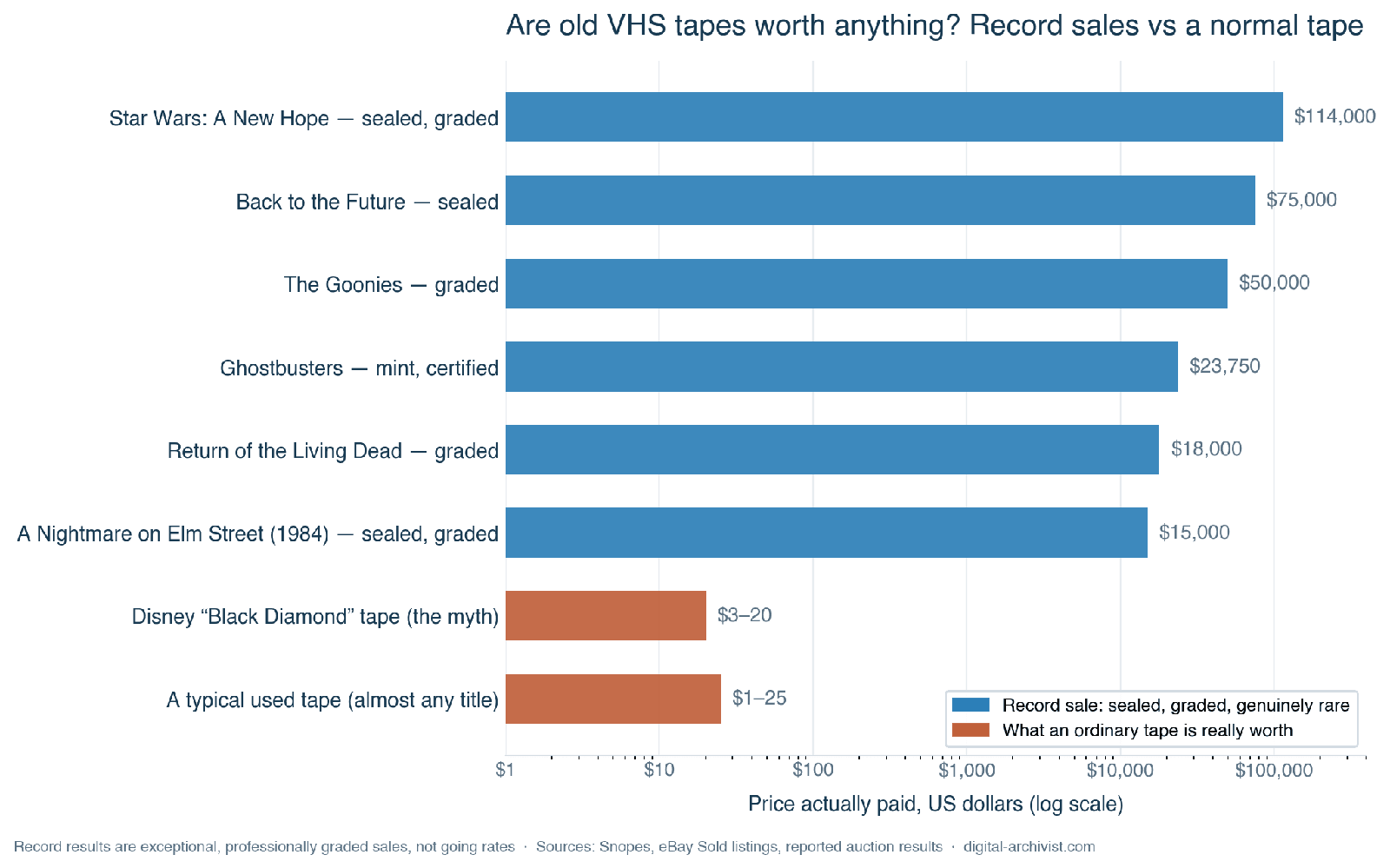
The record sales make the point. A sealed, graded first-release copy of Star Wars: A New Hope reached around US$114,000. A sealed Back to the Future sold for roughly US$75,000. A graded The Goonies went for about US$50,000, a mint certified Ghostbusters for around US$23,750 in mid-2022, a graded Return of the Living Dead for about US$18,000, and a sealed, graded 1984 copy of A Nightmare on Elm Street for roughly US$15,000 in late 2022.
These are record results, not going rates. They are the exception that proves the rule. The value sits almost entirely in the sealed scarcity and the third-party grade, not in the film. An opened, watched copy of any of those same titles is worth a tiny fraction of the figure, often a few dollars. The moment a tape has been unwrapped and played, it leaves the collector market and rejoins the pile.
The Black Diamond myth, and how to check a real price
One belief comes up a lot, the story goes that Disney “Black Diamond” tapes are worth thousands. They are not. The black diamond on the spine simply marks Disney’s “The Classics” line, released between 1984 and 1994. It is a logo for a product range, not a rarity stamp or a limited-edition marker. These tapes were sold in enormous numbers, which is the opposite of scarce. Typical sold prices run from about three to twenty dollars.
The “worth thousands” idea traces back to a viral 2016 article that reported sellers’ asking prices, some as high as US$9,000, as though they were prices the tapes had actually fetched. They almost never sell at those numbers. Anyone can list a tape for any figure they like. That tells you nothing about what a buyer will pay. The fact-checking site Snopes has documented the gap between the asking-price hype and reality.
The value that isn’t on eBay
The tapes in your box that are genuinely worth keeping are almost never the commercial films. They are the home recordings. A wedding, a child’s first steps, a birthday, a school play, a relative who has since passed and whose voice survives only on that cassette. None of it has a resale price, and that is exactly the point. It cannot be replaced, re-bought or streamed. There is one copy, and you are holding it.
The money is almost never there. The memory often is. That is why the box is worth caring about. Not a jackpot, just the footage you would be sorry to lose.
Are old VHS tapes worth anything to keep?
If a tape holds footage you would miss, then yes, it is worth getting it off the tape. There is a growing reason for that. Magnetic tape degrades over time, and the VCRs needed to play it are getting older, scarcer and more expensive to keep running. The Library of Congress, along with preservation standards from bodies such as IASA and CLIR, and national archives like the NFSA, all make the same point about magnetic media. The signal will not last forever, and the bigger problem is often the machines. Once working players become genuinely hard to find, a tape you cannot play is no better than a blank one. Digital files, by contrast, are easy to copy and read on ordinary equipment for decades to come.
That said, this is urgency, not an emergency. There is no need to panic-pay for a same-week rush job. If these tapes had not crossed your mind for years, a few more months will not decide their fate. Take the time to do it properly. You can read the full picture on how the medium ages in our deep-dive on how long VHS tapes last, and see where tape sits alongside other formats in our guide to how long old media lasts.
Do not throw out the original tapes after you transfer them. A good VHS cassette can still play after twenty-five years or more in ordinary household storage. Tapes recorded in the early 1980s are still readable today. The tape is a surprisingly capable backup of itself, so keep the originals in a cool, dry, stable spot even after you have a digital copy. A transfer can be re-done from a surviving tape. It cannot be re-done from a tape you binned.
Do it yourself, or pay a service?
Once you have decided to preserve the footage, there are two routes, and the sensible choice depends mostly on how many tapes you have and how much you care about control.
For a small batch, roughly under ten to twenty tapes, or if you have no gear, no time and no interest in the technical side, a reputable conversion service is the practical call. Most home footage does not need museum-grade treatment, and a good service spares you the setup. Know what a good one should offer before you hand anything over. Clear quality standards, support for the formats you actually have, the return of your original tapes, and respect for the privacy of private family footage. On top of that, ask what their gear is — a USB capture stick is unlikely to give a very good result. There are dozens of places claiming to offer digitisation sevices that have no idea what they’re doing. Ask them and come back here and check if you’re not sure. Those are the things I would ask about.
For a larger collection, or when you want the best possible quality and full control, doing it yourself wins. It is cheaper per tape at volume, it gives you a lossless master rather than a compressed file someone else chose the settings for, and it keeps private family footage in your own hands the whole way through. And as mentioned above, many produce nothing better than you could achieve at home with a decent VCR and a capture device. If you would like to take the DIY route, our walkthrough on capturing analogue video tapes covers the gear and the workflow.
The bottom line
Are old VHS tapes worth anything? On the resale market, almost never. The rare four-figure and five-figure sales are sealed, graded, first-printing collector pieces, and an ordinary watched copy is not one of them. The actual value in most boxes is the home footage that no shop ever sold, and that is what is worth saving. Keep the originals, transfer the irreplaceable recordings without panic but without indefinite delay, and you will have done the one thing that actually matters with a box of old tapes.
The same question comes up for other formats. We look at whether old vinyl records are worth anything and whether old cassette tapes are worth anything in their own references.
Frequently asked questions
Are old VHS tapes worth any money?
For the most part, no. A commercial tape carries a film you can buy or stream in better quality, so the tape itself has little resale value, often only a few dollars. The exception is a narrow set of factory-sealed, professionally graded, genuinely rare early releases, which can sell for thousands. An opened, watched copy of the very same title is worth a tiny fraction of that.
Which VHS tapes are worth the most?
The record holders are sealed, third-party-graded first releases of popular titles. A sealed graded Star Wars: A New Hope reached around US$114,000, with sealed copies of Back to the Future and graded copies of The Goonies and others fetching tens of thousands. These are exceptional results, not typical prices. The value is in the unbroken seal and the grade, not the film, so the vast majority of copies of these same titles are worth very little.
Are Disney Black Diamond VHS tapes worth thousands?
No. The black diamond simply marks Disney’s “The Classics” range from 1984 to 1994, and these tapes sold in huge numbers, so they are not rare. Typical sold prices are about three to twenty dollars. The “worth thousands” claim came from a viral article that quoted sellers’ asking prices rather than what tapes actually sold for. Check eBay’s Sold filter and you will see the real figures.
Should I throw away my old VHS tapes?
Not the home recordings, and not without checking what is on them first. Family footage is irreplaceable and worth transferring to digital. And even after you transfer a tape, keep the original. Good VHS can still play decades later, which makes the tape a useful backup of its own footage. Another interesting angle is old Adverts. A lot of people enjoy watching digitised versions of these uploaded to youtube because they are a bit like old street photography, they take you back to a time when things were different – and now that’s 40-50 years ago which is quite a gap. Commercial films you can re-buy or stream are the only ones safe to let go, and even then there is no rush.