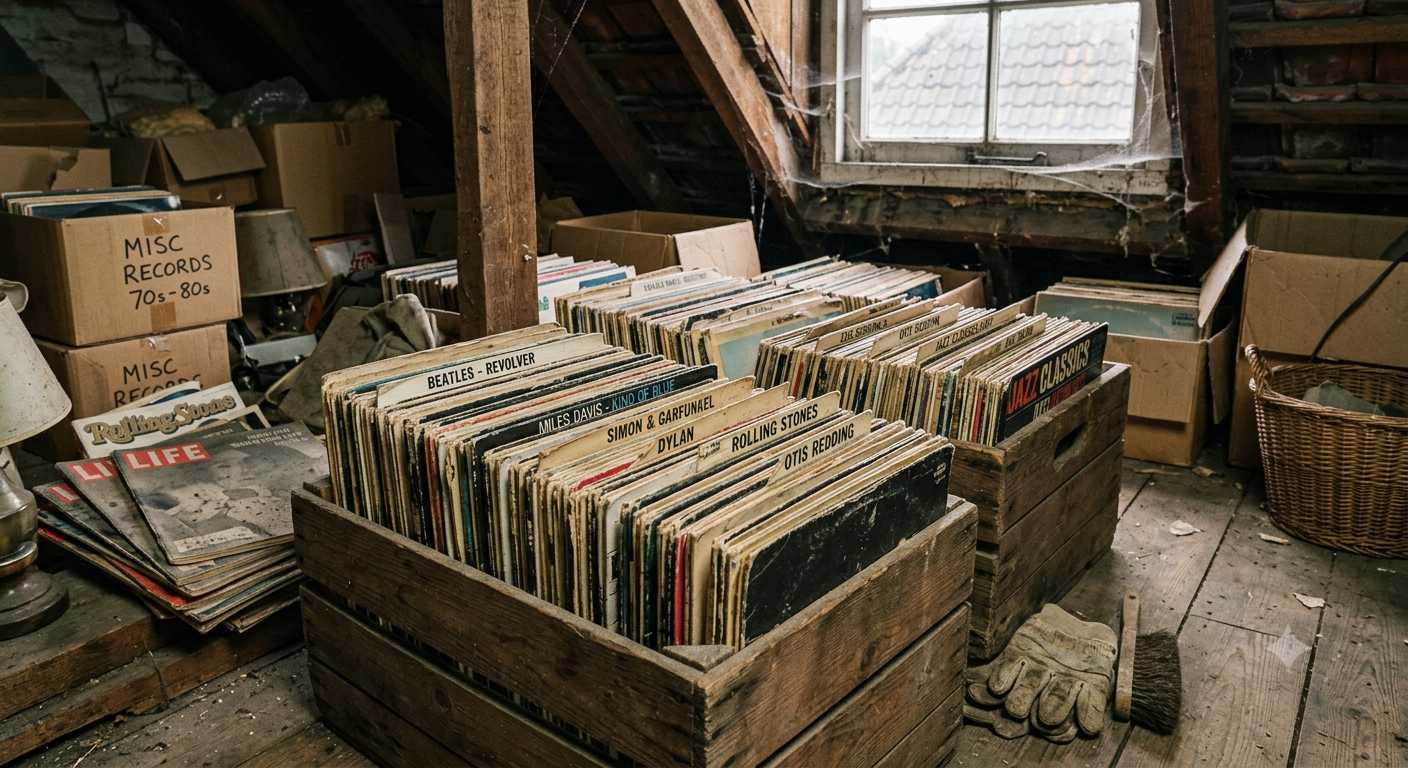
If you are asking are vinyl records worth anything, the straight answer is that most are worth only a few dollars. Value has very little to do with the music being on vinyl. It comes from scarcity of the physical object, demand for that particular release, and the condition of the disc. The common albums that fill thrift-store crates and parents’ attics were pressed in the hundreds of thousands or millions, the music is freely streamable, and supply massively outstrips collector interest. The records that fetch real money are the exception, and they make headlines precisely because they are rare.
It helps to separate two things people often confuse. Vinyl as a format is thriving. In 2024, US vinyl reached roughly 44 million units and about $1.4 billion in revenue, the highest since 1984 and the eighteenth straight year of growth, outselling CDs in units for the third year running, according to the RIAA 2024 Year-End Report. That boom is about new sales of fresh pressings. It is not a sign that your old copies have become scarce. If anything, a healthy market keeps ordinary titles cheap and easy to find.
Are vinyl records worth anything? What actually drives the price
Four levers decide whether a record is worth anything beyond pocket change. Get all four right and you have something a collector wants. Miss any of them and the price drops fast.
- Rarity of the object. Small pressing runs, withdrawn or recalled releases, regional-only editions, error pressings, and unusual variants (colour, shape, speed) all create scarcity. Test pressings, of which only five to ten copies typically exist, are a recognised collectible format in their own right.
- Demand. Scarcity is worthless without an active fanbase or cultural significance. Jazz, punk, soul and funk consistently perform well. A rare record nobody wants is still a cheap record.
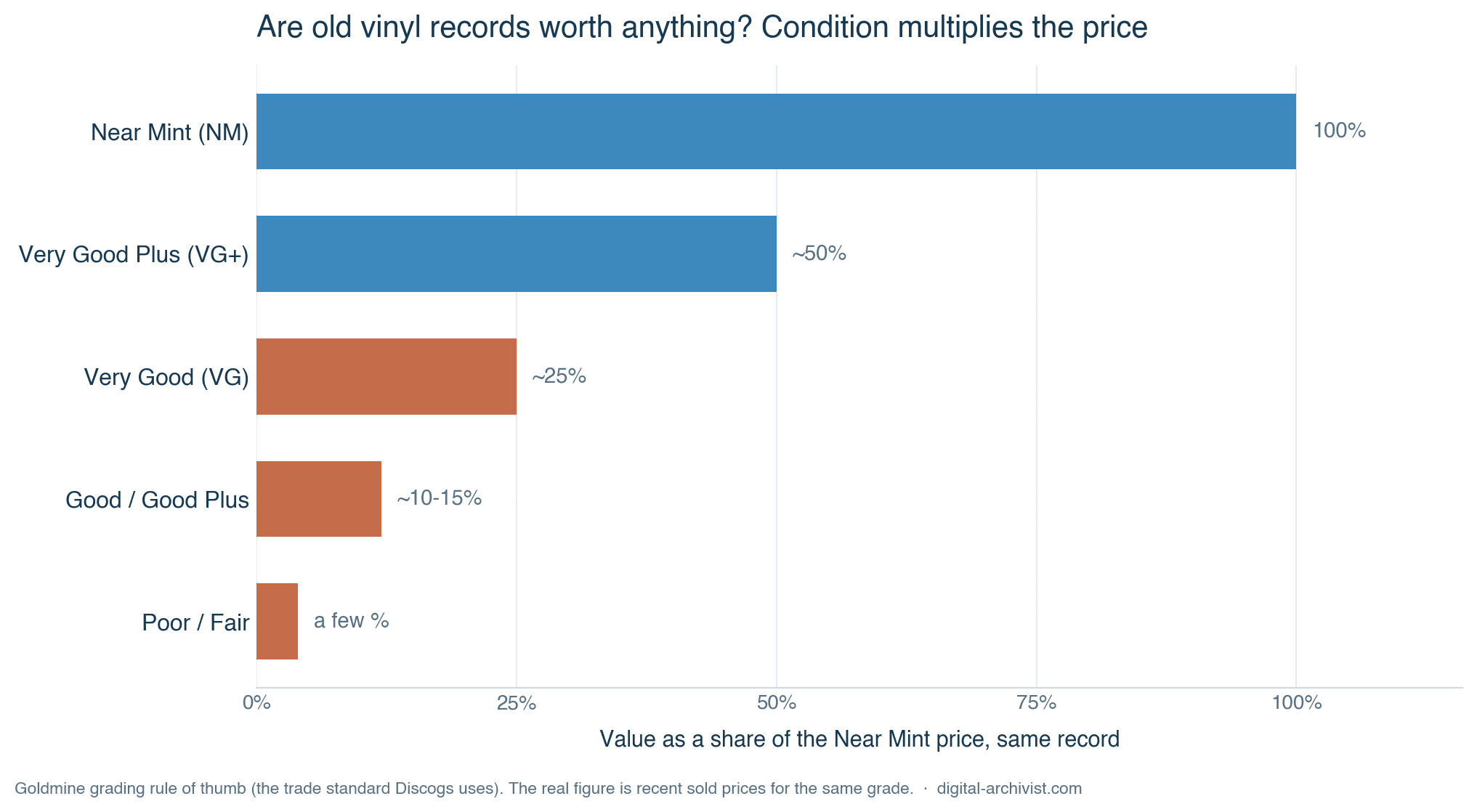
- Condition. This multiplies or destroys value. The grading scale below is the language the whole hobby uses.
- First pressing versus reissue. Original pressings sit closest to the master and the artist’s intent, and are worth far more than later reissues of the same album.
The useful rule to remember is that rarity beats perfection. A rare pressing in Very Good Plus condition is generally worth more than a common pressing in mint condition. But on a common title, where rarity offers nothing to argue about, condition is most of what is left.
Condition and the Goldmine grading scale
The grading standard the trade runs on comes from Goldmine magazine, and Discogs uses the Goldmine Standard as its grading guideline. It runs in eight steps from best to worst.
- Mint (M) — absolutely perfect, sealed or with no evidence of ever being handled.
- Near Mint (NM) — very minor signs of wear. This is the practical top grade most collectors will ever handle.
- Very Good Plus (VG+) — light surface marks that do not affect playback, occasional faint background crackle. Played, but still sounds great.
- Very Good (VG) — clearly worn but usable. Light pops and clicks, visible scratches, surface noise on quiet passages, possibly a split edge. The music stays clear.
- Good / Good Plus (G/G+) — plays through without skipping, but with significant surface noise, scratches and visible groove wear.
- Fair / Poor (F/P) — cracked, badly warped or deeply scratched, skipping or repeating. A disturbing thing to listen to.
Condition does not nudge the price, it multiplies it. A widely quoted rule of thumb is that a Very Good record is worth roughly 25 percent of the Near Mint value, with each grade down discounting sharply again. Treat that figure as a common heuristic rather than a fixed law. The real number is whatever comparable copies in the same grade have recently sold for, which is the point of the sold-price tool below.
Old does not mean valuable, and the Beatles myth
Two beliefs send people to the attic with high hopes. The first is that old equals valuable. The second is that the Beatles records their parents owned must be a fortune. Both are usually wrong, for the same reason. The copies most people own are common reissues, not the originals.
Take the Beatles. Reissues carrying the later EMI and Parlophone box labels are worth a fraction of the value of the original black-and-gold Parlophone pressings, according to Atlas Records. The genuinely valuable copies are specific and rare. An original UK mono first pressing of Please Please Me with black-and-gold Parlophone labels runs roughly $4,000 to $8,000 in Near Mint, and standout, misprint or signed copies have reached $30,000 and above. Those are a tiny minority of surviving copies. For pre-1969 Beatles, mono pressings are generally worth more than stereo, because the band oversaw the mono mixes.
This is where the difference between the object and the music becomes concrete. To tell an original from a reissue, look at the run-out area, the smooth band of vinyl between the last groove and the label. Original pressings often carry hand-etched matrix numbers there, while reissues are commonly stamped. Label design, rim text and catalogue details all help date a pressing. The record-collecting convention is that demand sits highest on the earliest pressings, identified by exactly these small variations.
The record-breaking sales follow the same logic. A withdrawn A&M pressing of the Sex Pistols’ “God Save the Queen” can fetch $15,000 to $20,000 or more for a single seven-inch, but only because A&M destroyed most of the roughly 25,000 pressed and only a handful survived. Scarcity of the object, not the brilliance of the song.
How to check what your record is really worth
There is one reliable way to find out, and it is free. Use Discogs sold history, not asking prices. Asking prices show you what hopeful sellers want. Sold prices show you what buyers actually paid.
- Find your exact version first. Search by catalogue number or barcode, or open the master release and use “Find Your Version”. Different pressings of the same album can differ wildly in value, so this step matters more than any other.
- Read the sold figures, not the listings. Discogs shows the lowest, median and highest price a release has actually sold for, calculated from its 30 most recent sales. The median is the closest thing to market reality.
- Match the condition grade. Click “Last Sold” or the sales history to see every recent sale together with the grade of each sold copy and a trend chart. Compare your disc only against sales in the same Goldmine grade over the past three to six months.
The most common mistake is reading a headline median and ignoring condition. A title that shows a tempting median may have reached it on Near Mint copies, while your well-played one belongs three grades down. Match the grade and the picture usually becomes sober quite quickly.
If it is not collectible, the value is in listening
For the vast majority of records, which are not collectible, that is not bad news. The worth was never going to be money. It is the music, the sleeve you grew up with, a recording that may not be available anywhere else. That worth is real, and it is worth protecting. The way to protect it is to clean the records properly and digitise them, so you can enjoy them without wearing out the originals.
Clean before you play or capture. Dirt in the groove becomes transient surface noise that gets baked permanently into a recording, and it wears the stylus. Clean gently in a circular motion, following the direction of the grooves, using distilled water rather than tap water, which leaves mineral deposits, and a soft lint-free cloth. Brush systems, a Spin Clean bath, or a vacuum cleaning machine handle deeper grime. Most experts now caution against alcohol on vinyl unless absolutely necessary, since it can strip the plasticiser that keeps the disc stable. Anti-static products help, because vinyl attracts dust electrostatically. Handle discs by the edge and label only.
Digitising follows an ordered process that the record-restoration field has long described: clean the disc, transcribe it to a digital file, process out clicks, pops and crackle, adjust volume and tone, reduce any remaining surface and broadband noise, then save. For preservation, keep a lossless master in WAV or FLAC. Make a separate lossy MP3 if you want something small for the car or phone. Our step-by-step guide to converting vinyl to digital walks through the whole chain, and the wider question of how long old media lasts explains why doing this sooner rather than later is the sensible call.
In summary, most records are worth a few dollars, value needs scarcity plus demand plus condition, the Goldmine scale runs from Mint to Poor and can cut a price to a quarter, the “valuable” beliefs about old records and parents’ Beatles albums are usually wrong because those copies are common reissues, and the only reliable way to know is Discogs sold history matched to your record’s grade. For the records that are not collectible, the worth is in listening. Clean them, digitise them, and keep them.
Frequently asked questions
Are old vinyl records worth anything?
Usually only a few dollars. Age alone does not create value, because the common albums from past decades were pressed in huge numbers and survive in quantity. So when people ask are vinyl records worth anything just because they are old, the answer is that worth needs scarcity, demand and good condition together, not simply a date on the label.
How much are vinyl records worth?
Most common records sell for roughly one to ten dollars, and plenty for less. A smaller number in clean condition fetch tens of dollars, while genuinely rare first pressings reach hundreds or thousands. The reliable figure for any specific record is its recent Discogs sold prices, matched to the same condition grade.
How do I know if my vinyl is valuable?
Identify the exact pressing first, using the catalogue number, barcode and run-out markings, then check the Discogs sales history for that version. Read the median of recently sold copies, not current asking prices, and compare only against sales in the same Goldmine condition grade over the last three to six months.
Are Beatles or classic rock records worth money?
Most copies are common reissues worth modest sums. The valuable ones are specific original pressings, such as a UK mono first pressing of an early Beatles album on black-and-gold Parlophone labels, which can run into thousands in Near Mint. Check the matrix etching and label design to tell an original from a reissue.
What is the most valuable vinyl record?
Prices change, but the famous outliers share one trait, extreme scarcity. A withdrawn A&M pressing of the Sex Pistols’ “God Save the Queen” can fetch $15,000 to $20,000 or more because almost all copies were destroyed. The record matters less than how few survive.