

The short version of how to store VHS tapes is this: stand them upright, never flat or stacked, resting on the long edge with the spine facing up, keep them in their cases in a cool, dry, stable room, well away from magnets, sunlight and heat, and ideally wind each tape fully to one end before it goes on the shelf. Do that and a cassette can keep playing for decades. The longer version, with the reasons behind each rule, is below, drawn from the institutions that actually look after magnetic tape collections.
One thing to hold onto from the start. Good storage slows decay, it does not stop it. So treat what follows as a way to buy time for the tapes that matter, then digitise the important ones while they still play.
How to store VHS tapes: upright on the long edge, spine up
Stand cassettes vertically, resting on their long edge with the spine facing up. That is not quite how a book sits, since a book stands on its shorter bottom edge, but for a cassette the long edge supports the wound tape pack most evenly. Never stack them flat in a pile, and never leave them lying on their side for long stretches. The Library of Congress puts it plainly in its guidance on the care of audiovisual materials: store all formats upright, with cassettes on the long edge. The US National Archives agrees, saying video tapes should be stored vertically and in their boxes, and warning specifically not to stack tapes on top of one another. The CLIR/NIST report on magnetic tape storage says the same in its own words: tapes should be stored on end and should not be allowed to lay flat for extended periods.
The reason is mechanical. Inside the shell, the tape is wound into a pack on its hubs. Lying flat or stacked lets the weight and any unevenness in that wind press on the edges of the pack, which distorts the reel and can cause the layers to slip against each other. Conservators call this pack-edge damage, tape slip or cinching. Standing the cassette upright lets the hub support the pack as it was designed to, so nothing sags onto an edge.
You will sometimes hear the argument that orientation barely matters because the spool is round and gravity pulls on it from every angle anyway. That is a minority view, and the institutions that care for tape collections (the Library of Congress, the National Archives and CLIR among them) are unanimous on storing upright. Follow the institutions.
Keep the climate cool, dry and above all stable
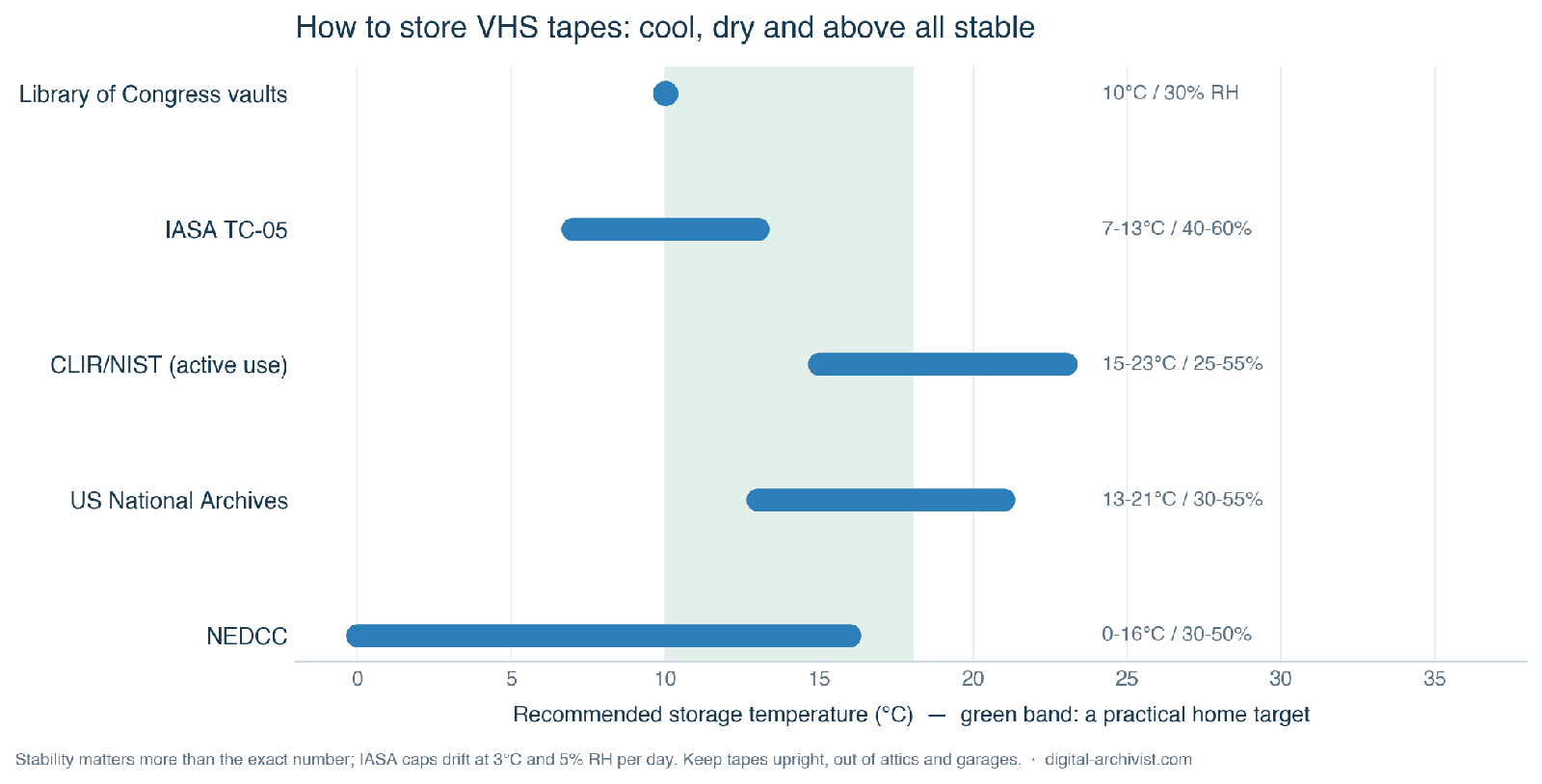
Cool, dry and stable is the whole of it. The institutions agree on that direction but publish different exact numbers, mostly because they are answering different questions: some are setting targets for everyday access, others for deep archival storage.
- The Library of Congress runs its own vaults at about 50°F (10°C) and 30% relative humidity, held non-fluctuating. It describes that cool, steady environment as helping retard threats from breakage and warping to delamination and, in the worst cases, the growth of mould.
- The National Archives recommends roughly 55 to 70°F (about 13 to 21°C) and 30 to 55% relative humidity for video, and tells you to avoid unregulated spaces such as attics and garages and to keep media up off the floor.
- The IASA TC-05 standard for sound and audiovisual archives recommends 7 to 13°C (about 45 to 55°F) and 40 to 60% relative humidity. It stresses that stability matters more than the exact value. Temperatures up to 35°C cause no immediate irreversible damage, while very cold storage below about 8°C risks the tape lubricant exuding. Its key number is the limit on drift: no more than 3°C and 5 percentage points of relative humidity over any 24 hours.
- The CLIR/NIST report is the most explicit about the split. For long-term archival storage it suggests going as low as 40°F (5°C) and 20% relative humidity. For tapes in active use it gives 60 to 74°F (15 to 23°C) and 25 to 55% relative humidity, with the variation kept tight in both cases.
- The Northeast Document Conservation Center sits in a similar place, suggesting magnetic and video tape at roughly 32 to 61°F with 30 to 50% relative humidity, and a cooler, drier figure where you can manage it.
For a home, consistency matters more than chasing a perfect number. A stable interior cupboard at room temperature on the dry side will outlast an attic or garage that swings with the seasons every time. The swings are what do the damage, because temperature and humidity changes make the tape expand and contract, and that movement stresses it.
Why dry matters so much: binder hydrolysis
A VHS tape is a plastic ribbon coated with a binder that holds the magnetic particles in place. That binder absorbs moisture from the air, and when it holds too much it breaks down through a reaction with water called hydrolysis. The CLIR/NIST report is direct about it: storage at high humidity, above roughly 70% relative humidity, results in increased degradation of the binder. Higher heat and humidity speed the reaction up, cooler and drier storage slows it down.
The result of that breakdown is the gummy condition known as sticky-shed: the tape squeals, sheds residue and clogs the heads of any deck you play it on. This is the mechanistic reason every institution caps humidity and warns against damp basements and garages. It is not only about mould. The binder is chemically self-destructing, in proportion to how much moisture it is holding.
Away from magnets, sunlight and heat
The recording on a VHS tape is magnetic, so a strong magnetic field can disturb it. The National Archives tells you to store magnetic tapes away from anything that can create an electromagnetic field, naming loudspeakers and other items containing magnets in particular. IASA TC-05 puts a figure on it, asking for a magnetic environment not in excess of 10 oersteds. The practical version is simple. Keep tapes well clear of speakers, motors, magnets and old CRT televisions, and keep them out of direct sunlight and off any heat source. Sunlight and heat both raise the local temperature and degrade the shell and the tape inside it.
Wind state: store fully wound to one end
Store a tape evenly wound onto one hub, not parked in the middle of a recording. The CLIR/NIST report is firm that a tape should never be ejected in the middle of an important recording, because that leaves the pack tension uneven and the recorded section sitting at a point of strain. Wound cleanly to one end, the tension across the pack is even.
This is also the considered answer to the perennial “rewind or not?” question. The principle is to store the tape evenly wound to an end at the tension the deck last left it, not stopped halfway through. A clean rewind to the start and a clean fast-forward to the end both satisfy that. What you are avoiding is a half-wound tape, and avoiding the habit of repeatedly fast-shuttling back and forth just to “exercise” the tension. The old advice to “always store rewound” is fine in practice, but the real substance is evenly wound to an end, not which end.
Exercise long-term tapes every few years
For tapes you are keeping for the long haul, a gentle full wind and rewind every few years helps. The CLIR/NIST report notes that some manufacturers recommend tapes be unspooled and rewound at regular intervals, often around every three years, to relieve uneven pack stress and redistribute the tension. Do not overdo it though. Every pass through a deck is also handling and a little wear, so a careful wind every few years is the goal, not a regular ritual.
Let a cold tape acclimatise before you play it
If a tape has been somewhere cold or damp, let it equilibrate to room conditions before you play it. The CLIR/NIST report explains that equilibration times scale with the mass of the tape, from around an hour for temperature on a small cassette to much longer for humidity or large reels. The Library of Congress gives the same advice: allow tapes and any equipment used with them to reach the ambient room temperature and humidity first. Playing a cold or damp tape straight away risks condensation and the tape sticking to the heads. For a VHS cassette brought in from a cold space, a few hours in the room is enough.
Handle them by the shell, keep them in their cases
Never touch the tape surface itself. Handle a cassette by its shell, and keep it in its case when it is not in the deck, as the Library of Congress advises. The CLIR/NIST report adds the list of things to keep tapes away from: dirt, dust, fingerprints, food, cigarette smoke and ash, and airborne pollutants. Cigarette smoke comes up again and again in the literature as particularly harmful to magnetic media, so a smoke-free shelf genuinely helps.
If a tape is in an open-ended cardboard sleeve rather than a closed case, you can store it open-end-down instead of up to stop dust settling inside. It is still resting on its long edge either way. Just check the cassette cannot slide out of a loose sleeve. A closed clamshell case or an archival box avoids the trade-off entirely and lets you keep the labelled edge up for easy reading.
Signs of trouble to check for
When you take a tape down from the shelf, give it a quick look and a sniff. Three things are worth catching early.
- Mould. Fluffy or web-like growth on the edge of the tape pack or on the shell. The Library of Congress lists mould as a classic high-humidity failure. Do not play a mouldy tape, because it spreads spores and contaminates the deck. It needs cleaning or specialist handling first.
- A vinegar or sour smell. An off, sour or vinegary smell signals active chemical breakdown, the well-known “vinegar syndrome” in older acetate-based tapes and binder breakdown in others. The tape is degrading as you hold it.
- Squealing or sticky tape. A tape that squeals, sheds residue and clogs the heads is showing the audible symptom of sticky-shed. The CLIR/NIST report ties this directly back to humid storage.
Storage buys time, it does not stop the clock
Every institution frames it the same way. cut lead-in — states the fact directly. Binder hydrolysis, lubricant loss and shell warping all continue, only more slowly. Magnetic tape is a finite-life carrier, and no shelf, however cool and dry, changes that.
Good storage buys you time. If you want to understand how much, the companion piece on how long VHS tapes last walks through the lifespans, and the wider reference on how long old media lasts sets tape alongside discs, film and hard drives. Use that time well. Store the collection properly, then digitise the tapes that matter while they still play cleanly. Good storage is the bridge to digitisation, not a substitute for it.
Frequently asked questions
How to store VHS tapes: what is the best way?
The best way to store VHS tapes is upright, on the long edge with the spine up, never flat or stacked, in their cases, in a cool, dry and stable room away from magnets, direct sunlight and heat. Wind each tape fully to one end before it goes on the shelf, and for long-term storage give it a gentle wind and rewind every few years. A steady interior cupboard beats an attic or garage that swings with the weather.
Should VHS tapes be stored flat or upright?
Upright, on the long edge with the spine facing up. The Library of Congress, the US National Archives and CLIR/NIST all agree that cassettes should be stored vertically and never stacked flat. Lying flat or stacked lets weight press on the edges of the tape pack, which distorts the reel and can cause the layers to slip. Standing upright lets the hub support the pack as intended.
Should you rewind VHS tapes before storing?
Store a tape evenly wound to one end, not parked halfway through a recording. A clean rewind to the start or a clean fast-forward to the end both work. The important thing is even tension across the pack, not which end the tape sits on. Avoid leaving a tape half-wound, and avoid shuttling it back and forth repeatedly just for the sake of it.
Does cold or heat damage VHS tapes?
Heat is the bigger enemy. Warmth and humidity speed up the chemical breakdown of the tape’s binder, so attics, garages and sunny windowsills shorten a tape’s life. Cool storage helps, but extreme cold has its own risk, since temperatures below about 8°C can cause the tape lubricant to exude. The institutional advice is cool, dry and stable, and to let a cold tape come up to room temperature for a few hours before playing it to avoid condensation.