
Whether vinyl sounds better than digital depends on what you mean by “better”: in pure, measurable fidelity terms, digital wins, but in terms of the listening experience, vinyl has a real charm that the numbers do not capture. A record has a narrower dynamic range, a higher noise floor, worse channel separation, more harmonic distortion, audible wow and flutter, and it physically wears with every play. A CD or a hi-resolution digital file beats it on every one of those measures. What listeners love about vinyl is a pleasant colouration and a physical ritual, not greater accuracy.
That is the straight engineering answer. The rest of this article walks through the measurements, explains where vinyl’s famous “warmth” actually comes from, and covers the one place where a record really can sound better than its digital release. None of that changes the verdict for preservation: records degrade, so the responsible move is to digitise them.
Does vinyl sound better than digital when you measure it?
Fidelity is just how faithfully a system reproduces the original signal, and it is measurable. On every axis an engineer would test, digital reproduces the master more accurately than vinyl does.
Dynamic range. This is the span between the quietest and loudest sounds a medium can carry. A vinyl LP manages roughly 60 to 70 dB in real-world playback. A 16-bit CD reaches about 90 to 95 dB in practice, close to its theoretical ceiling of around 96 dB, and 24-bit hi-res affords up to about 144 dB in theory. As a rule of thumb each bit adds roughly 6 dB. For context, the span from a quiet studio to the threshold of pain is only about 95 dB, so CD already covers what any room or ear can use. The published figures for dynamic range put digital well ahead.
Noise floor. Vinyl is a physical medium, so it carries surface noise, clicks, pops, rumble and hiss as a matter of course. Turntable rumble is typically specified at “at least 60 dB below output level”. Digital has none of that; its noise floor is set by quantisation and converter noise, sitting well below the music. The comparison of analogue and digital recording documents the gap in some detail.
Channel separation. On a record both stereo channels share a single groove, so each bleeds a little into the other. A good playback cartridge manages only about 20 to 30 dB of separation at 1 kHz, falling to roughly 10 to 15 dB at 12 kHz. In digital the left and right channels stay fully discrete data until the converter, so separation comfortably exceeds 90 dB and crosstalk is negligible.
Distortion, wow and flutter, and wear. Good digital sits around 0.002 to 0.003% total harmonic distortion; vinyl runs markedly higher, and that distortion is part of why it sounds the way it does. Turntables also suffer slow speed variation, called wow, of under about 0.05% on a good deck, while digital is clocked to a crystal oscillator and has no wow or flutter at all. And because the stylus physically rides the groove, a record degrades with play and handling, whereas a bit-perfect digital copy is identical to the original every time.
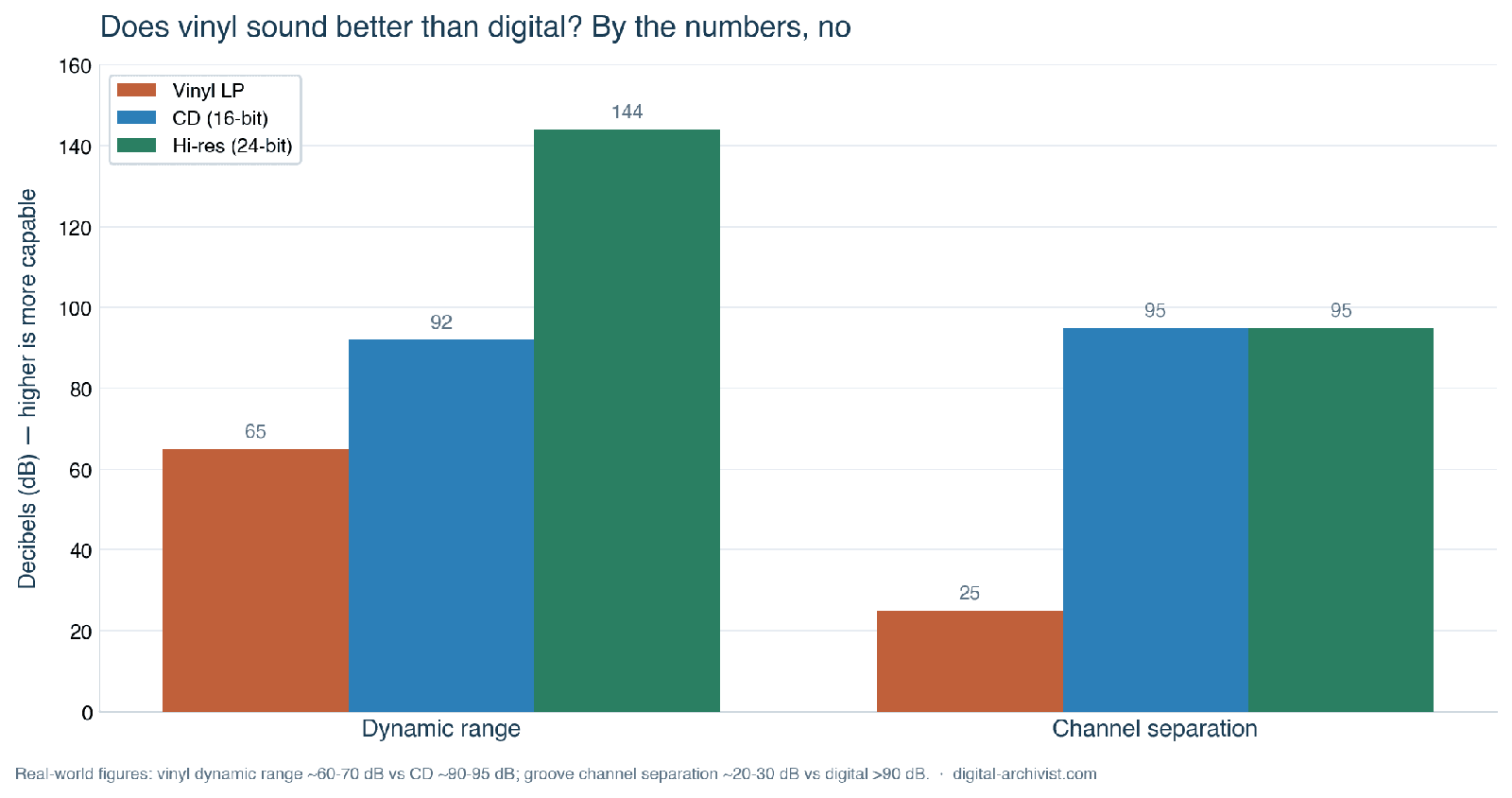
Put the figures side by side and the pattern is consistent: wider window, lower noise, better separation, less distortion, no speed error, no wear. By the numbers, digital is the more faithful medium.
The RIAA curve: vinyl is deliberately shaped, then un-shaped
One reason vinyl needs so much engineering is built into the format itself. Records are not cut flat. The RIAA equalisation standard, in place as the de facto global standard since 1954, applies pre-emphasis when the disc is cut and the exact inverse de-emphasis on playback. Bass is reduced and treble boosted in the groove, then your phono preamp puts it back for a net-flat response. The curve is defined by three time constants (3180, 318 and 75 microseconds) with boost and cut at the band extremes on the order of 20 dB.
The reasons are physical. Cutting the bass reduces how far the groove has to swing, so grooves pack tighter and you get longer playing time while stressing the stylus less, (I once had this described to me at theSchool of audio engineering as, ‘If the bass wasn’t attenuated down, the resulting wide grooves would make the stylus fly off the track” – a nice example that sticks in ones mind). Rolling the treble back on playback attenuates the high-frequency hiss and clicks that come from the medium. In other words, the format’s own equalisation exists specifically to manage vinyl’s physical and noise limitations. That is engineering working around the medium, not evidence that the medium is more accurate.
Why vinyl sounds “warm”: it is colouration, not accuracy
The warmth people hear is not faithfulness to the recording. It is a set of pleasant departures from the master.
Pleasant harmonic distortion. Vinyl adds low-order, predominantly even-order harmonic distortion that is musically related to the notes being played. The ear reads this as richness and thickness rather than as error. Engineers chase the same effect deliberately, which is why studios use plugins and outboard gear to add harmonic distortion for analogue warmth. The key point is that this is information added by the playback chain, not something that was in the original.
Tonal tilt. Highs are often rolled off slightly to tame surface noise and sibilance, and the low end tends to get an analogue lift. The result reads as a fuller, warmer balance, as several analyses of why vinyl sounds warm describe.
Limited dynamic range evens things out. Because vinyl’s window is narrower, very loud and very quiet passages get gently constrained. That built-in compression can feel cohesive and punchy, which many listeners enjoy.
The ritual. Sleeve, side-flip, the physical object, the deliberate attention you give an album you have to get up and turn over. That is a real and valuable listening experience, and it is reasonable that people conflate it with sound quality. But it is psychological and experiential, not an electrical measurement.
The one real nuance: mastering and the loudness war
There is a single place where “vinyl sounds better” can be true, and it has nothing to do with the groove. It is about how the music was mastered.
The loudness war is the long industry habit of heavily peak-limiting and brickwall-compressing many CD and streaming masters to make them as loud as possible. That flattens the dynamics substantially. Some records were cut from a separate, less-compressed master, so that particular pressing can audibly sound better than the CD or stream. The cause, though, is the master, not the medium. Vinyl’s own physics make extreme brickwalling harder to press, because a very loud cut can throw the stylus out of the groove, and that historically nudged labels toward gentler vinyl masters.
That advantage is increasingly unreliable. Many modern vinyl releases simply reuse the same brickwalled digital master at a lower level. The 2017 reissue of Prince’s Purple Rain, for instance, dropped more than 5 dB of dynamic range versus the original LP. Worse, the Dynamic Range Database that audiophiles consult is itself misleading, because the meters read peak-to-RMS over short windows and the vinyl format artificially inflates the number. One analysis found the inflation can reach about 70%, so a record cut from a flat, compressed digital master can register a flattering figure on the meter while sounding no better. Detailed measurements show how the vinyl format inflates dynamic range numbers, and the same loudness-war practices have, as you might expect, followed records into the vinyl era.
A given record sometimes sounds better, decided by its mastering, and you have to verify it for the specific pressing. It is not a general property of vinyl, and it is not a fidelity advantage of the medium.
Being fair to both sides
There are two long-standing camps in audio, and the fair reading respects both. The objectivist view is well supported by measurement: digital has higher fidelity, with no clicks, pops, wow, flutter or rumble, a better signal-to-noise ratio, wider dynamic range, lower distortion, and a flatter, more extended response. The body of audio equipment testing backs this up.
The subjectivist view is that some listeners genuinely prefer the analogue presentation, and that the experience matters. Some early CD-era complaints were real, things like heavy reconstruction filtering and poor low-level converter behaviour, but those have since been measured and engineered out through oversampling, better digital filtering and far better converters. The fair synthesis is simple: preferring the analogue sound is perfectly legitimate as a preference, and it does not make vinyl a more accurate reproduction medium.
For preservation, digitise your records
Whatever you think of the sound, the preservation answer is not in doubt. Records wear and degrade, both with play and with time. The responsible move is to digitise them at a high resolution so you keep the music, including the record’s own character, without the ongoing physical wear of playback. A common archival target is 24-bit at 48 or 96 kHz, which captures everything the record holds with plenty of headroom; higher than 24/96 offers no audible benefit for listening.
If you want to do that yourself, our guide to converting vinyl records to digital walks through the chain step by step. And because no physical format lasts forever, it is worth understanding how long old media lasts before you decide what to preserve first.
Frequently asked questions
Does vinyl actually sound better than digital?
Not in terms of fidelity. Digital reproduces the master more accurately, with a wider dynamic range, a lower noise floor, better channel separation and no wow, flutter or surface noise. What people love about vinyl is a pleasant colouration and a physical ritual rather than greater accuracy. A specific record can sound better than its CD or streaming version, but that comes down to mastering, not the medium.
Why does vinyl sound warmer?
Mostly because of pleasant even-order harmonic distortion that the ear reads as richness, a slight tonal tilt that rolls off the highs and lifts the lows, and a narrower dynamic range that gently evens out loud and quiet passages. All three are departures from the master, added by the format, rather than a more faithful version of the recording.
Is vinyl higher quality than CD?
By measurement, no. A 16-bit CD has a wider dynamic range, a far lower noise floor, better channel separation and lower distortion than an LP, and it does not wear with play. The only case where a CD can lose is when its master was brickwall-compressed in the loudness war and the vinyl was cut from a gentler master, which is a mastering decision rather than a property of either format.
Should I digitise my vinyl records?
Yes, if you want to preserve them. Records degrade with play and with age, so capturing them digitally protects the music. A practical archival target is 24-bit at 48 or 96 kHz, which keeps the full character of the record, including its warmth, without the ongoing wear of dropping a stylus on it every time you listen.