
If you want to know how to clean vinyl records properly, work from the lightest method first and only escalate when you need to. A carbon-fibre brush handles dry surface dust before each play. Manual wet cleaning with distilled water and a proper record-cleaning solution lifts real grime, always wiping with the grooves and never across them. For a whole collection, a vacuum or ultrasonic record-cleaning machine does the heavy lifting. Dust and grit raise the noise floor, wear out your stylus and the grooves, and a clean record both sounds better and digitises better.
Why clean a record at all
Dust is the single biggest threat to an LP. The conservation literature describes household dust as probably the number one contributor to damage. Left in place, it becomes embedded permanently in the grooves, causing distortion, ticks, pops and inferior sound, to the point a disc can become virtually unlistenable. Fingerprint oils, adhesives, soot, cigarette smoke and cooking grease all add to the problem.
Vinyl is a soft material that readily picks up a static charge, so it pulls in dust that is then hard to remove. That dust, along with any scratches, is what produces the clicks and pops you hear, and it can make the needle skip or lock in a groove. The damage is mechanical as much as audible. As the stylus tracks a contaminated groove, the trapped particles work much like sandpaper. It is not one speck but the cumulative array of grit over endless miles of groovebed that grinds a stylus down and presses permanent wear into the groove walls. So a clean record protects two things at once, the disc and the stylus.
This is also why preservation labs clean before they transfer. The Library of Congress carefully cleans every disc on a vacuum machine before transferring it to high-resolution 96 kHz/24-bit WAV files. A clean record gives a lower noise floor and a cleaner capture, and it avoids embedding grit that you would otherwise have to chase out in software later.
How to clean vinyl records: the method ladder
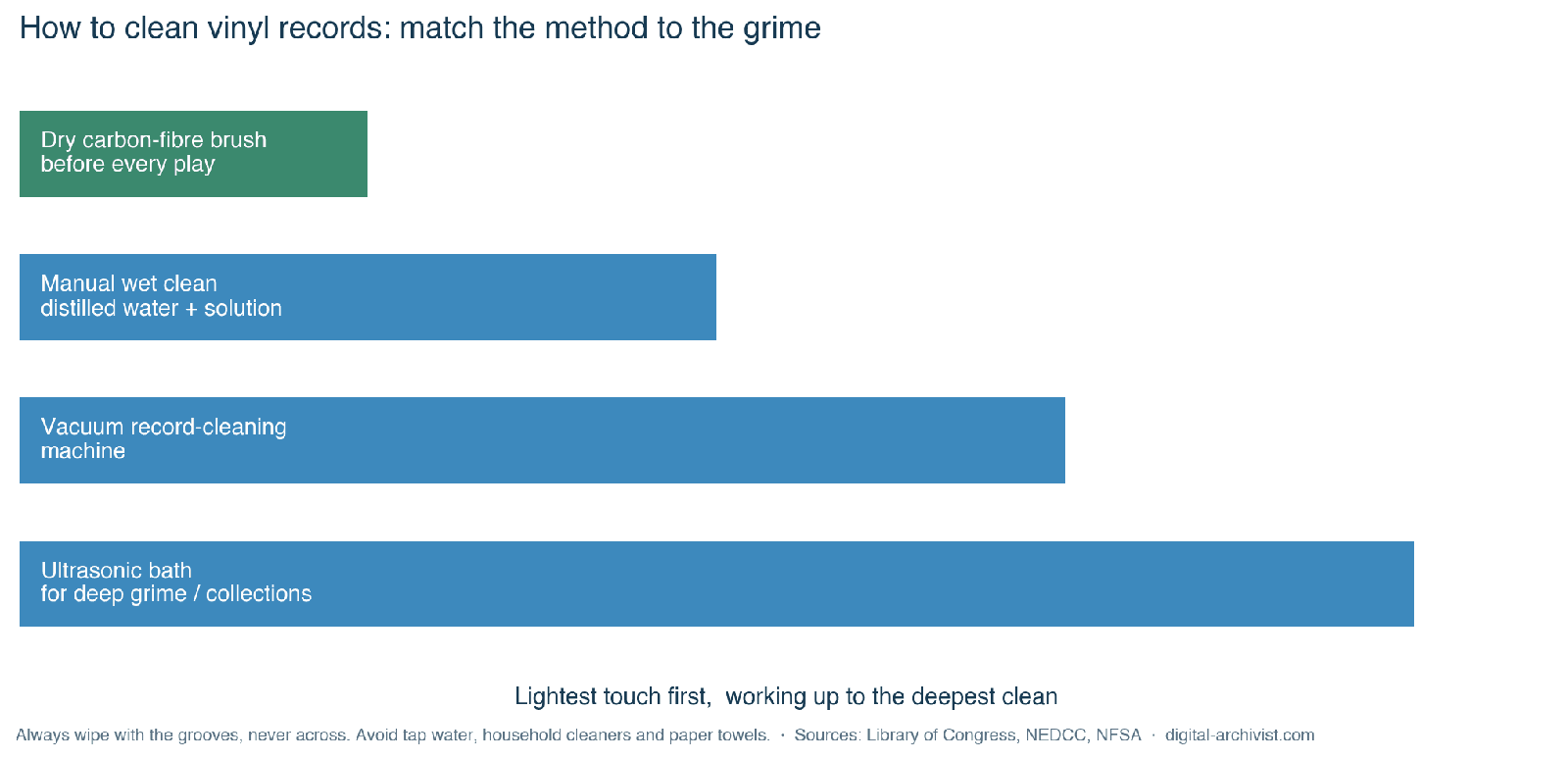
Start light and only move up the ladder when the lighter step is not enough. Most records most of the time need nothing more than the first rung.
1. Dry: a carbon-fibre brush before every play
For everyday surface dust, a carbon-fibre brush is the right tool. Use it before and after each play. The fine fibres reach into the grooves to collect loose dust, and the brush dissipates the electrostatic charge that attracts more dust in the first place. Rest it lightly on the rotating record so the fibres sit in the grooves, let it ride for a revolution or two, then sweep the gathered dust to the edge and lift it away. Treat this as a brush for dry dust only, not for grime. An anti-static record brush is preferred here over a microfibre cloth, which can drag dust around rather than collect it.
2. Wet cleaning for real grime: distilled water and a proper solution
When a brush no longer cuts it, move to wet cleaning. The agent matters as much as the technique. Use distilled or deionised water with a surfactant-based record-cleaning solution. The Northeast Document Conservation Center specifies distilled or deionised water precisely to prevent minerals from depositing on the disc surface. Their documented lab procedure is a preliminary distilled-water rinse to lift loose particulate and soften the dirt layer, then a soapy mixture of deionised water with about 0.5% Tergitol 15-S-7, a mild surfactant that lowers surface tension so the loosened dirt rinses away. Gloves are worn throughout, and water is kept off the paper label.
The one rule that protects the groove is direction. Wipe gently with the grooves, following the circular path the stylus takes, and never across them. Wiping across the grooves drags grit straight over the groove walls, which is exactly the abrasion you are trying to avoid. Apply the solution with a clean lint-free microfibre cloth or a dedicated record-cleaning applicator pad, work it around the disc, then lift the loosened dirt and fluid away. Keep the label dry the whole time.
3. Machines for a collection: vacuum and ultrasonic
If you have shelves of records rather than a handful, a machine pays off. Vacuum record-cleaning machines, such as those from Keith Monks, VPI and Nitty Gritty, apply cleaning fluid, work it in with a brush, then use vacuum suction to draw the dirt and fluid back out of the grooves. This is the industry-standard approach, and it is what the Library of Congress uses, on a Keith Monks or VPI Typhoon vacuum machine. Ultrasonic cleaning takes a different route. The disc is dipped into a chemically infused bath where sonic cavitation dislodges dirt, mould and particles from the surface and from deep within the grooves. The National Film and Sound Archive of Australia uses this sonic-bath method professionally. Quality vacuum machines with proprietary chemistry run into four figures, so they suit a serious collection rather than a casual one.
What not to do
A few common shortcuts do more harm than good.
- No tap water. Unpurified tap water will probably leave limescale deposits on the record surface as it dries. Use distilled or deionised water instead.
- No paper towels. Avoid anything dirty, abrasive or prone to shedding, including paper towels, dish rags and clothing. They scratch the vinyl and leave lint behind. Use a lint-free microfibre cloth.
- Never wipe across the grooves. Always follow the grooves. Cross-groove wiping drags grit across the groove walls.
- No household or glass cleaners. Stick to distilled water and a proper record surfactant. The National Film and Sound Archive also advises against scrubbing acoustic shellac discs to shift stubborn debris, because scrubbing scratches.
- Do not play a record wet as a matter of routine. Let it dry fully before playing. Playing a record wet once, purely to get the cleanest possible capture for a final digital transfer, is a recognised archival technique, but it is not for everyday listening because residue can settle into the groove.
Isopropyl alcohol deserves its own note, because the answer depends on what the record is made of. Per the record restoration literature, isopropyl alcohol should only ever be used on modern vinyl. It will cause permanent damage to shellac, and to master and one-time recordings such as acetate, wax and lacquer, because it dissolves or irreversibly swells them. Even for modern vinyl the institutions disagree on whether to add any alcohol at all. The Northeast Document Conservation Center and the Library of Congress describe a working method of water plus a mild surfactant such as Tergitol with no alcohol. The Association for Recorded Sound Collections favours a low concentration of ethanol over isopropyl, roughly 3 to 5%, applied by wet-vacuum, and only on vinyl from about 1950 onwards. The one point on which everyone agrees is the safe default. No alcohol of any kind on shellac 78s, acetates or lacquers. If you are not certain what a record is, leave the alcohol out and clean with water and surfactant.
Drying and storage afterwards
Let the record air-dry in a dust-free space, or pat it dry with a lint-free cloth, before sliding it back into a clean inner sleeve. The Northeast Document Conservation Center allows lacquer discs up to around 30 minutes to air-dry. Re-sleeving in a fresh inner sleeve after cleaning is standard practice, since putting a clean record back into a dusty old sleeve undoes the work.
Store records upright like books on a shelf, never stacked flat, because stacking warps them. Aim for a cool, stable environment of roughly 16 to 24°C (60 to 75°F) and 30 to 50% relative humidity. A non-fluctuating environment retards warping, mould and delamination, and the less a record is played the longer it lasts. Handle discs by the edges and the label only. Touching the grooves leaves oil that attracts dust and raises surface noise, so good handling is part of keeping a record clean.
Clean before you digitise
If your goal is to preserve a record as a digital file, cleaning is the first step, not an afterthought. Preservation labs treat it that way. The first step is cleaning the playing surface, and only then comes transcription. The Library of Congress cleans every disc before transferring it to a 96 kHz/24-bit WAV file. A clean record gives you a lower noise floor and a cleaner capture, and it spares you from baking grit and surface noise into a file you then have to repair. When you are ready for that stage, our guide to converting vinyl records to digital picks up where this one leaves off.
Frequently asked questions
What is the best way to clean vinyl records?
The best way to clean vinyl records is to match the method to the dirt. For routine dust, a carbon-fibre anti-static brush before and after each play is enough. For real grime, wet-clean with distilled water and a surfactant record-cleaning solution, wiping with the grooves. For a large collection, a vacuum or ultrasonic record-cleaning machine is the most thorough option and the one preservation labs rely on.
Can you clean records with water?
Yes, but only distilled or deionised water, ideally with a mild record-cleaning surfactant. Distilled water is specified so that minerals do not deposit on the disc. Do not use tap water, which leaves limescale deposits as it dries. Wipe with the grooves, keep the label dry, and let the record dry fully before playing it.
Should you use isopropyl alcohol on vinyl?
Use it with caution and only on modern vinyl, never on shellac 78s, acetates or lacquers, which it dissolves or swells permanently. Even on modern vinyl, conservation labs such as the Northeast Document Conservation Center and the Library of Congress clean with water and a mild surfactant and skip the alcohol entirely. If you are unsure what a record is made of, leave the alcohol out.
How do I clean records without a machine?
You can clean records well by hand. Brush off dry dust with a carbon-fibre brush, then for grime apply distilled water and a record-cleaning solution with a clean lint-free microfibre cloth or applicator pad, wiping gently with the grooves and never across them. Keep the label dry, air-dry the record, and re-sleeve it in a clean inner sleeve.