
Can you still buy a VCR? Not a new one. The last factory line closed in 2016, so every machine for sale today is either used or new-old-stock, meaning unsold units that have sat unopened in a warehouse since production stopped. The used market is still healthy, but supply only shrinks while demand from people digitising old tapes holds steady. If you need a player, you buy second hand, and the longer you wait the harder and dearer it gets.
When did VCRs stop being made?
The world’s last VCR rolled off the line in July 2016. Funai Electric of Japan, by then the only company still building them, ceased production by the end of that month. The end date was reported across CNN Money, CBC News and IBTimes UK on 22 July 2016, and the accounts agree on the key figures.
Funai had been making VCRs since 1983, and at its peak it turned out 15 million units a year. Even in its final full year the company sold close to 750,000 machines in 2015, so demand had not vanished. What ran out was the supply of parts. Funai stopped because it could no longer source the components needed to build the machines, not because nobody wanted them. Panasonic had withdrawn from VCR manufacture years earlier, which is what left Funai as the sole maker in the first place.
No one builds VCRs, and no one can readily get the parts to start again, so the installed base of working players only ages and thins out.
Where can you still buy a VCR now?
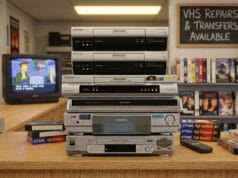
Since there are no new units beyond the occasional sealed new-old-stock find, every channel is a second-hand one. The largest selection, and usually the cheapest prices, sits on eBay. Beyond that, the common sources are Facebook Marketplace, Craigslist or Gumtree-style local listings, op-shops and charity shops (Savers, the Salvation Army and the like), pawn shops, car-boot and yard sales, and electronics recyclers.
A specialist audio-visual repair or refurbisher shop stands apart from the rest. These dealers clean and service a unit before they sell it, replacing worn rubber parts and cleaning the heads, so you pay more but you start from a known-good machine rather than a gamble. For a one-off digitising job that distinction matters a great deal.
One caveat from my own experience, because it complicates that tidy picture. My S-VHS deck came from vcrshop, the specialist most people get pointed towards, and it did not arrive serviced. The remote was dead, and the analogue audio head had not been set properly. Adjusting that head improved the audio out of all recognition. The harder fault took longer to pin down. The picture had symptoms I could not place, and it was only some time later that I worked out a worn pinch roller was behind them. I proved it by swapping in the roller from another machine, which cleared the problem, and once I asked, vcrshop sent a replacement. Pinch rollers are neither easy to find nor cheap, so I was glad to have them supply one. All up it was several months before everything was sorted, in part because the pinch roller took me a while to even identify. So even a well-known specialist may ship a machine that still needs work. Budget to service it, or to sort a few things once it lands, rather than counting on a finished unit. What held up was their integrity. Every single issue, they put right, slowly but completely. That is the trade, and for me it still makes them worth it, because it is the one place I would trust to actually have the deck you are after and to stand behind it after the sale.
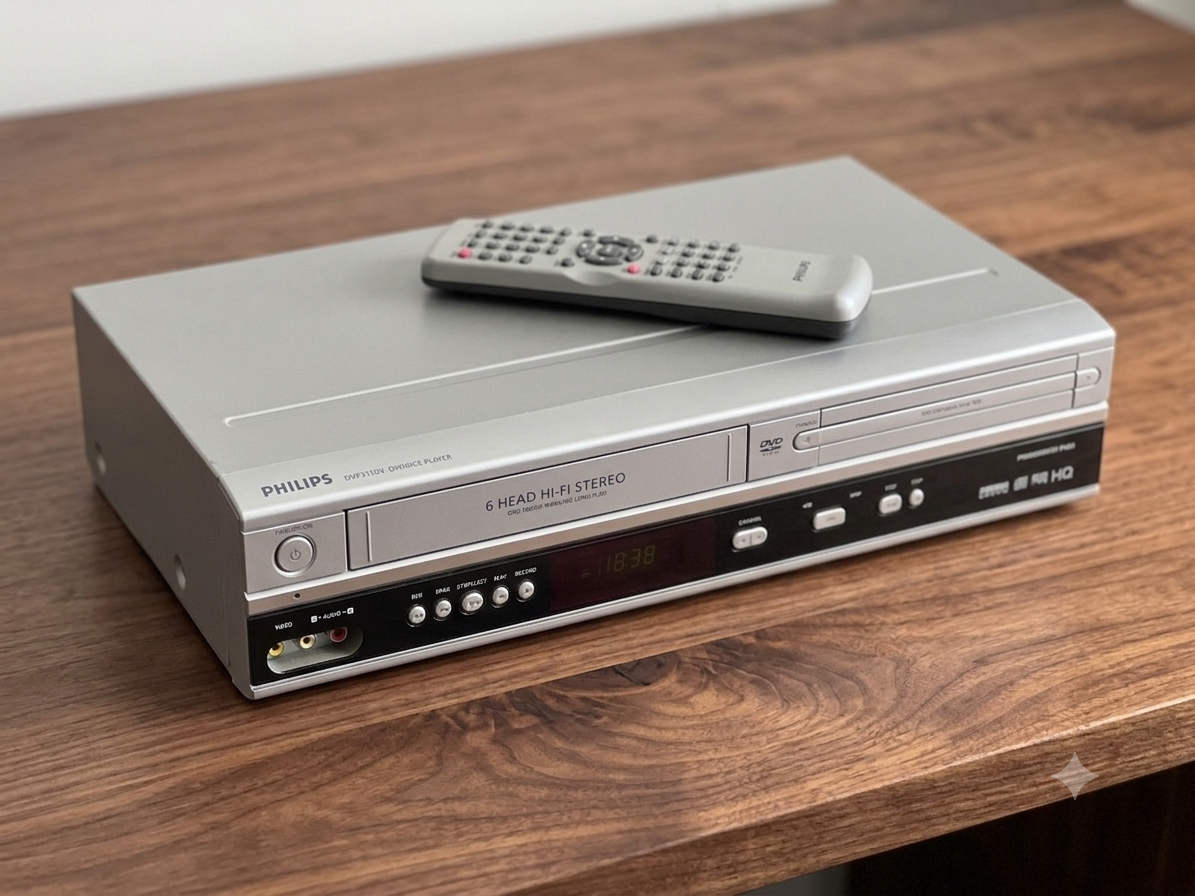
Prices vary widely and they drift upward, so treat any figure as a snapshot rather than a rule. A charity-shop find can cost a few dollars (one listing showed about US$5). A typical everyday VCR in good condition runs somewhere around US$30 to US$100. A refurbished and serviced unit from a specialist sits near US$150. VCR/DVD combo decks tend to start higher, commonly from about US$170 and climbing into the several hundreds. The decks archivists actually want, the high-end S-VHS machines covered below, sell for substantially more again, and practitioners say plainly that you should be prepared to spend real money for a good one.
What to look for in a used VCR
If you are buying to watch the occasional tape, almost any working four-head machine will do. If you are buying to digitise a collection, the player is the single most important link in the chain, and a few features make a real difference to the result.
Four heads, not two
A four-head deck gives noticeably cleaner playback than a two-head one, with steadier picture during pause and slow motion. Two-head machines look visibly worse, so skip them.
S-VHS playback and an S-Video output
An S-VHS deck plays ordinary VHS tapes too, usually with better internal circuitry, and it offers an S-Video (Y/C) output. That connection keeps the luma (brightness) and chroma (colour) signals separate instead of mashing them together the way composite video does, which gives a cleaner capture. Where you have the choice, practitioner consensus is consistent: use the S-Video connection rather than plain composite.
A built-in line time base corrector on higher models
A built-in line Time Base Corrector stabilises a jittery or rolling signal and reduces dropped frames during capture. The classic archival decks pair one with digital noise reduction: the JVC HR-S series (the HR-S7600, 7800 and 7900, and the HR-S9600, 9800 and 9900 lines) and high-end Panasonic and Mitsubishi S-VHS units.
Opinions on brands differ here. JVC is the most recommended and most produced brand, since JVC invented the format. It is sometimes said that JVC ties its Time Base Corrector to its digital noise reduction so the two cannot be used separately, and that some people prefer Panasonic for that reason, though you will find the opposite view argued just as firmly. It is also true that a Time Base Corrector can make some tapes shake rather than settle, and is not always wanted, which is why the better decks let you switch it off. So a line Time Base Corrector is useful, but it is not a guaranteed win on every tape. Two things are worth saying plainly. A Time Base Corrector and a frame synchroniser are not the same device, and there is no genuinely good, affordable standalone Time Base Corrector box to fall back on, so the practical answer is a deck with a capable built-in line TBC rather than an external add-on. What a Time Base Corrector actually does, and how it differs from a frame synchroniser, is worth understanding before you spend, and we cover it in why a Time Base Corrector matters and the difference between a Time Base Corrector and a frame sync.
Condition over specification
On a machine this old, condition matters more than the spec sheet. Late models are easier to repair, but they are still old and you may not get what you pay for. Two age-related faults dominate. The video heads wear with use, and high-end heads in particular can be hit or miss (some D-VHS heads are noted for wearing after only 40 to 50 hours). More commonly, the rubber parts perish: drive belts go brittle or slack and pinch rollers harden or turn sticky, which shows up as tracking and tape-transport faults. Both are replaceable through dedicated VCR repair-parts suppliers, but factor a service into the price. A unit that has already had its heads cleaned and its belts replaced is worth the premium.
Buying a VCR for digitising tapes
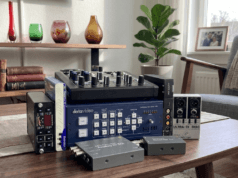
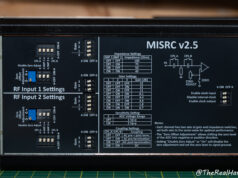
There are two different routes to digitising, and they change how much the deck matters. The traditional analogue route plays the tape, takes the composite or S-Video output, and captures it with an analogue-to-digital device, which is why a clean S-VHS deck with a good line Time Base Corrector matters so much. The modern alternative is vhs-decode, which taps the raw radio-frequency signal straight off the tape heads, before the VCR does any of its own processing, and then handles the time base correction, decoding and clean-up in software afterwards. Because the hard work moves to software, vhs-decode does not need an expensive Time-Base-Corrector deck at all, and a mechanically sound but otherwise ordinary VCR can be enough. If you are starting from scratch it is worth deciding which route you are taking before you spend on a deck, since the two ask for quite different machines. We cover the decode route in how vhs-decode actually works and which VCR to choose for vhs-decode.
For the analogue route specifically, the priorities above all point the same way. Start with the best S-VHS deck you can get, ideally one with an S-Video output and a line Time Base Corrector, then pair it with a decent analogue-to-digital capture device. Rather than repeat the whole chain here, the detail lives in our companion pieces on the best VHS capture card in 2026 and the wider capture hardware to pair with it.
The case for digitising now
Put the pieces together and the long view is plain. Demand is still real, since Funai was selling three-quarters of a million machines a year right up to 2015, but no one makes VCRs and no one can source the parts. The installed base only ages and shrinks, the good archival decks are already scarce and pricey, and every year more machines fail for good. The same scarcity that makes a player hard to buy is the reason to digitise your tapes now, while working machines and readable tapes both still exist. Waiting does not make the job cheaper or easier. It makes it harder on both ends.
Frequently asked questions
Can you still buy a new VCR?
No. Funai Electric, the last manufacturer, stopped production in July 2016, and no company has built VCRs since. The only way to get one that has never been used is to find sealed new-old-stock, an unsold unit left over from before production ended, and even that is uncommon.
Where can I buy a VCR now?
The used market. eBay carries the largest selection and usually the lowest prices, with Facebook Marketplace and local classifieds close behind. Op-shops, pawn shops and car-boot sales turn up cheap finds, while a specialist audio-visual refurbisher sells serviced units that cost more but arrive cleaned and working.
How much does a used VCR cost?
Prices vary and keep drifting up, so treat these as a snapshot. A charity-shop machine can be a few dollars, a good everyday VCR runs roughly US$30 to US$100, and a refurbished serviced unit sits near US$150. Combo decks and the sought-after high-end S-VHS machines cost substantially more.
What VCR is best for converting tapes?
For digitising, look for a four-head S-VHS deck with an S-Video output and, on higher models, a built-in line Time Base Corrector. The JVC HR-S series and high-end Panasonic and Mitsubishi S-VHS decks are the classic choices, though opinion is split on JVC versus Panasonic. Whatever you buy, favour a unit that has been serviced.