

How long does film last? Stored cool and dry, a well-processed reel of home cine film can last a century or more, which makes it the durable one in the box. Unlike magnetic tape, film is a genuine archival medium, and the 8mm or Super 8 reel in your cupboard will usually outlast the VHS tape and DVD sitting beside it. But the reel’s fate is decided by two enemies that work quietly on the shelf: decay of the plastic base the image sits on, and fading of the colour dyes that make up the image itself. Both are slowed dramatically by cold, dry storage, and both can ruin a reel that still looks fine when you pull it out. The practical takeaway is plain. A reel that already smells of vinegar or has gone pink is on a fast clock and should be scanned soon.
This piece covers amateur home movie film, the 8mm, Super 8 and 16mm reels most families have. For the wider picture of how film sits alongside tape and disc, see our reference on how long old media lasts.
The straight answer: how long does film last in real terms
The straight framing is that there is no single number, because two different chemical clocks are running at once. The first is the breakdown of the film base. The second is the fading of the colour dyes. A black-and-white reel kept at room temperature might give you fifty years before trouble starts, and the same reel kept genuinely cold can reach a hundred and fifty years or more. Colour adds a second deadline that often arrives sooner. The good news is that the levers are the same for both problems. Keep the film cold, keep it dry, and you slow every reaction that would otherwise destroy it.
Base decay and vinegar syndrome
Almost all home cine film was made on cellulose acetate, marketed as “safety film” because it replaced the older flammable nitrate stock. 8mm and 16mm were acetate from the start, since they were created for amateur use where a fire risk in the home was unacceptable. Acetate is stable for decades, but it is not permanent. Over time the base undergoes a chemical breakdown called deacetylation, and that process has a name everyone who handles old film learns quickly.
Vinegar syndrome is the slow hydrolysis of the cellulose acetate base. As it breaks down it releases acetic acid, which is the sharp vinegar smell that gives the condition its name. The term was coined by film preservationist Harold Brown. Once it takes hold the film shrinks, becomes brittle, curls and buckles, and can grow crystals or channels across its surface. The reaction is autocatalytic. The acetic acid the film produces speeds up further breakdown, so the decay accelerates as it goes. As the National Film Preservation Foundation puts it, once the process begins in earnest the remaining life of the film is short. There is currently no practical way to halt or reverse acetate breakdown. You can only slow it.
This is where film base matters. Polyester base, sold under names such as Kodak ESTAR or Mylar, is far more stable and is rated to last hundreds of years when stored properly. The catch is that most home cine film is acetate, not polyester, so most family reels are exposed to vinegar syndrome and need to be watched for it.
What cold storage actually buys you
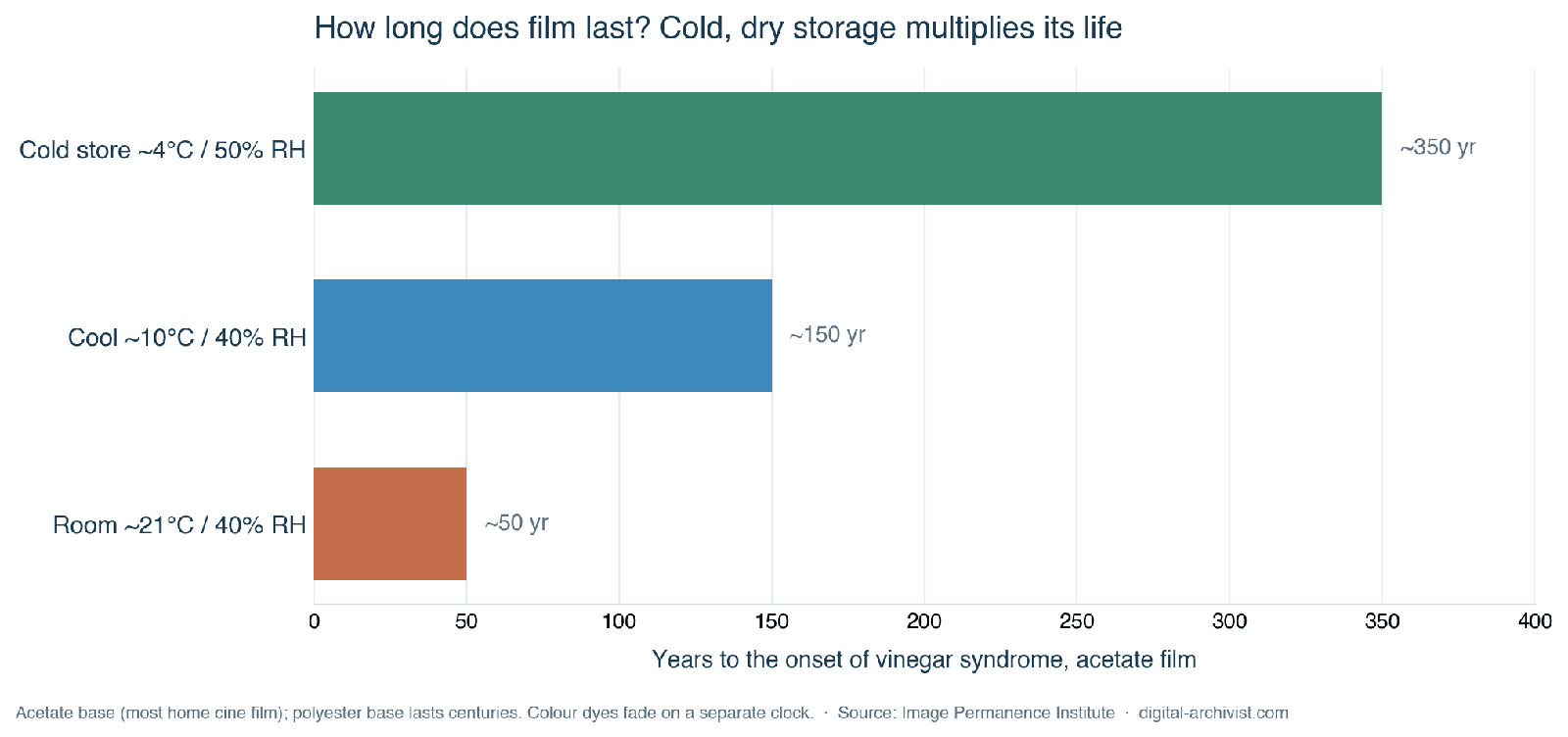
The figures from the Image Permanence Institute show why temperature is the lever that matters most. Fresh acetate film stored at around 21°C (70°F) and 40% relative humidity lasts roughly fifty years before the onset of vinegar syndrome. Drop the temperature while holding the same humidity and the gain is dramatic. At around 10°C (50°F) and 40% humidity the estimated time to onset stretches to about a hundred and fifty years. A modest drop of roughly 11°C roughly triples the safe life of the film.
Colder still buys far more. Storage near 4°C (40°F) and 50% humidity pushes the figure into the hundreds of years, with one summary citing around three hundred and fifty. The optimum is low temperature combined with low humidity, but humidity should not fall below about 20%, or the film dries out and becomes brittle in a different way. Temperature and humidity act together, which is why a damp basement or a hot attic is the worst possible place to keep film. Warm and humid accelerates the chemistry; cold and dry slows it to a crawl.
Catching it early with A-D strips
You do not have to wait for the smell. A-D strips, the acid-detecting strips developed and made by the Image Permanence Institute, are dye-coated paper strips that detect and measure vinegar-syndrome severity in a collection. Placed in the film can, they change colour from blue through blue-green and green to yellow-green and finally bright yellow as acidity rises, read against a reference card with levels from 0 to 3. They can pick up decay before any vinegar smell is noticeable. The strips earned a Technical Achievement Award from the Academy of Motion Picture Arts and Sciences in 1997. Around level 1.5 the film reaches the autocatalytic point, the threshold of rapid self-accelerating decay, and that is the reading at which cold or frozen storage becomes necessary rather than merely helpful. If a reel is already in advanced vinegar syndrome it needs cold or frozen storage, or duplication, to save what is left.
Colour dye fading: the other clock
The second deadline is the image itself. Colour film is an inherently unstable medium. The picture is built from organic dyes, and those dyes all eventually fade, at different rates, even in total darkness. This is called dark fading, and the main drivers are heat and humidity rather than light. Black-and-white silver images are the only film type proven to last for genuine archival storage, which is why a black-and-white reel from the 1920s often looks better today than a colour reel from the 1950s.
The classic sign of ageing colour film is a pink or magenta cast. According to the National Archives and Records Administration, the cyan dye layer fades first, with the yellow also weakening, which leaves magenta dominant and gives old film its familiar pink look. Early colour stocks fade badly. Kodak’s Eastmancolor, introduced in 1950, used unstable dyes, and many 1950s prints survive only as magenta. Ektachrome and other E-6 reversal films are well known for dark fading, again with the cyan layer going first. The industry did not widely acknowledge the problem until the late 1970s.
Kodachrome is the famous exception, but only for dark storage. Its dyes are exceptionally stable on the shelf. Figures cited put Kodachrome at well over a century before significant fading in the dark, with some estimates running to around two hundred and sixty years to 20% dye loss, against roughly seventy-five to eighty years for Ektachrome to reach similar cyan loss under real-world conditions. These are vendor and secondary figures that ultimately trace to Wilhelm Imaging Research, so treat them as indicative rather than exact. Kodachrome’s strength is dark storage only. Under a bright projector lamp it is actually worse than other films and can fade noticeably within an hour of projection. So “Kodachrome lasts forever” is true on the shelf, not in the projector.
As a general benchmark, under poor conditions some colour transparencies need considerable colour correction after as few as twenty-five years, and most colour photographs will not survive undamaged for more than fifty years without cold storage. If you want to rescue the colour while it is still there, our guide to digitising photos, slides and negatives covers the same dyes in still form.
How to store cine film so it lasts
The institutional consensus is short. Cold and dry, as cold as you can practically manage. The National Film Preservation Foundation recommends relative humidity between 20% and 50% with temperature as low as possible. Common guidance for acetate and colour stock sits at roughly 0–8°C (32–46°F) and 30–50% humidity. The National Archives keeps its colour films at around -3°C (27°F) specifically to slow dye fading. Cold storage slows both base decay and colour fading, because both are temperature and humidity-driven chemical reactions.
One handling rule matters when film comes out of cold storage. Let it warm up gradually, still sealed, so that moisture does not condense on the cold film when it meets warmer room air. For most households a cool, dry interior cupboard well away from a hot loft or a damp basement is a realistic compromise, paired with a vented plastic can rather than a sealed tin so that any acetic acid can escape rather than build up.
The bottom line
Film is the durable one in the box. A properly stored acetate reel can reach fifty years at room conditions and over a hundred and fifty cold, and Kodachrome colour can hold for a century or more in the dark, so the tape and disc beside it will usually fail first. But vinegar syndrome is autocatalytic and cannot be stopped, and colour dyes fade silently, so any reel that already smells of vinegar, has shrunk or curled, or has gone pink is on a fast clock. Scan those reels first, then keep everything cold and dry. Digitising does not save the original film, but it saves the pictures on it, and that is what actually matters.
Frequently asked questions
How long does film last, and does 8mm or Super 8 last longer?
Format does not change the answer much, because 8mm, Super 8 and 16mm were all made on the same cellulose acetate base. Stored at room temperature, expect roughly fifty years before vinegar syndrome can begin; stored genuinely cold and dry, well over a century. Black-and-white reels outlast colour ones, and colour reels fade on their own clock regardless of format. What decides the life of any of them is storage, not the film width.
What is vinegar syndrome?
Vinegar syndrome is the chemical breakdown of cellulose acetate film base. The acetate hydrolyses and releases acetic acid, producing the sharp vinegar smell that names it, after which the film shrinks, curls and becomes brittle. It is autocatalytic, meaning the acid it gives off speeds up further decay, so it accelerates once it starts. It cannot be reversed, only slowed by cold, dry storage, so a vinegary reel should be digitised promptly.
Why has my old film gone red or faded?
That pink or red cast is colour dye fading. In most colour stocks the cyan dye layer fades first, leaving magenta dominant, which reads as the familiar pink. Early colour films such as Eastmancolor and Ektachrome are especially prone to it, while Kodachrome resists fading in dark storage. Heat and humidity drive the fade, so warm, damp storage makes it worse. Scanning recovers what colour remains and can correct much of the shift.
How should I store cine film?
Cold and dry is the whole rule. Aim for 20–50% relative humidity and as low a temperature as you can manage, ideally below 8°C, in a vented can so acetic acid can escape. Keep film out of hot lofts and damp basements, the two worst spots in any home. When you take film out of cold storage, let it warm up gradually while still sealed so that moisture does not condense on it.
How long does other media last?
This is part of a series on how long different formats survive, and what actually shortens their life. The companion guides:
- How long does old media last? — the overview across every format.
- How long do VHS tapes last? — magnetic videotape.
- How long do cassette tapes last? — audio cassettes and reel-to-reel.
- How long do CDs and DVDs last? — recordable and pressed optical discs.
- How long do hard drives and SSDs last? — drives, and why digital is not permanent.