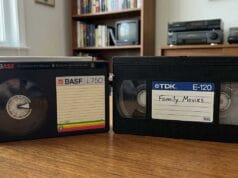

When it comes to choosing the correct way to store your video archive, there are a lot of factors to consider. One of those factors is chroma subsampling. A lot of places on the Internet will recommend 4:2:2 because it is said to be great enough to encapsulate the limited colour properties contained within analog sources. However, what I have never seen discussed is generational loss. I got to wondering, as we connect multiple pieces of equipment together in a chain and then also process through software editing, all of which do Chroma Subsampling, is there any generational loss when doing this? I set off to find out.
Consider the following:
You have an original VHS tape with its included analog reduced chroma signaling that connects to a Capture Device with Chroma Subsampling at 4:2:2 which stores in a Captured File with Chroma Subsampling of 4:2:2 which you then edit and perform a hopefully final export with it’s own Chroma Subsampling, again at 4:2:2. That’s four conversions, (or potentially reductions) in colour information as a minimum starting point. You’ll note I said reductions, not an exactly correct phrase, but my suspicion is it’s more correct than saying ‘if you keep 4:2:2 it will maintain quality because VHS doesn’t have much to begin with’. I would say the opposite, ‘if it’s low to begin with why would you want to make it worse?!’
Side note: This method is also used in compression technology for still images such as JPEG.
What is Chroma Subsampling anyway?
In simple terms, chroma subsampling is a process used to reduce storage requirements and bandwidth requirements for video data by reducing the colour information stored in a video file or transmitted in a video stream. This can and does save a lot of space. It works because the luminance data (the black-and-white part) is more important to the human eye and thus Chroma subsampling effectively leaves this part intact / as is. The Chroma part however (chroma refers to the colour information), is not quite as important to the human eye and thus the theory is we can reduce the accuracy of this information because we’re unlikely to notice a difference unless comparing side-by-side, before and after – exactly what we are going to do here.
The analog Chroma Subsampling method
VHS already uses a form of subsampling by reducing signal bandwidth in the analog domain, however, this is not the same thing exactly as chroma subsampling in the digital domain. However, for the purpose of choosing an archival codec, it is worth mentioning that VHS by its nature already reduces the colour signal quite a bit before we even get a chance to capture it with a modern codec. If interested, Wikipedia has some great articles on how this works on analog systems, such as the PAL article on Wikipedia.
It’s also important to know that before we even get to storing video data in a file, not only has the analog domain reduced the colour information through signal bandwidth optimisation but the capturing device has also subsampled it as well and you can never ever get this colour information back. How bad this is depends on what your capture card is, which colour system you use and a number of other factors. But from a subsampling perspective the likely worst will be 4:1:1 for NTSC and 4:2:0 for PAL. These sampling structures are defined in the ITU-R BT.601 standard.
How much you care about this will depend how much of an archivist you are and the future workflow likely to take place after the video is captured. But most likely by the time you are storing it in a file, you have already suffered three generations of loss (one you can’t control, one you can control only partially through selection of capture device and one you can usually control, the capture file). If you’re like me you won’t want to lose any more colour information than necessary because you will realise there will usually be further activities like editing and exporting to come resulting in even further loss. It is also entirely plausible depending on your workflow that additional losses will be incurred if you cannot process all adjustments for the entire workflow directly from the master file.
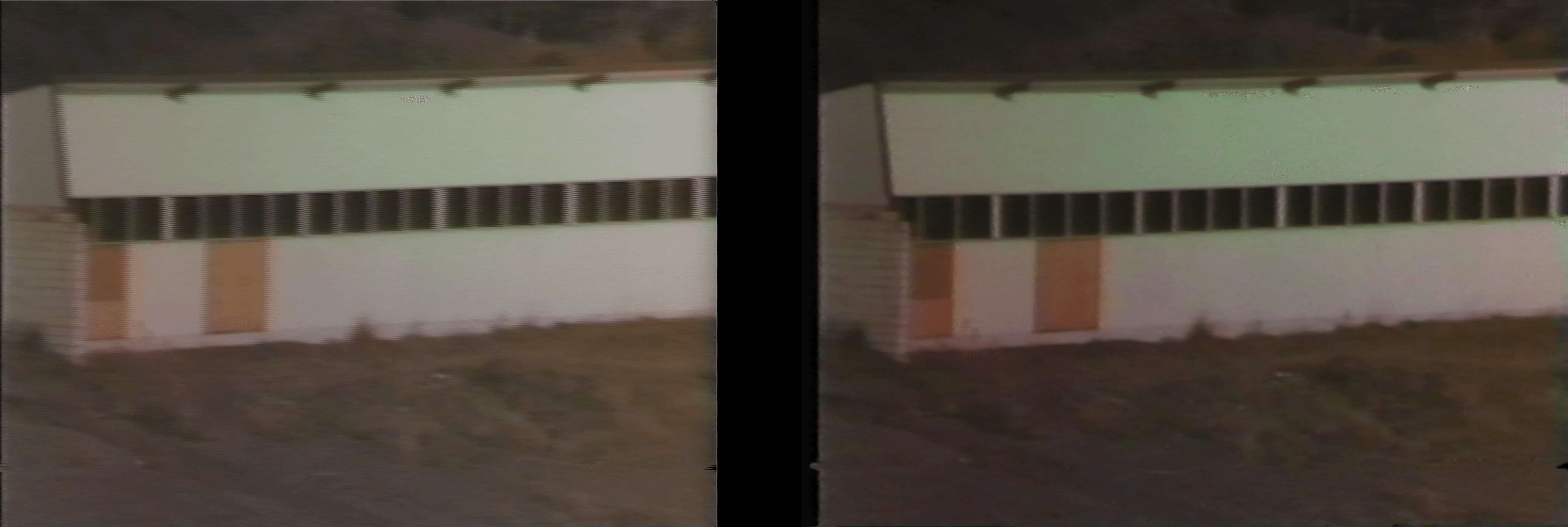
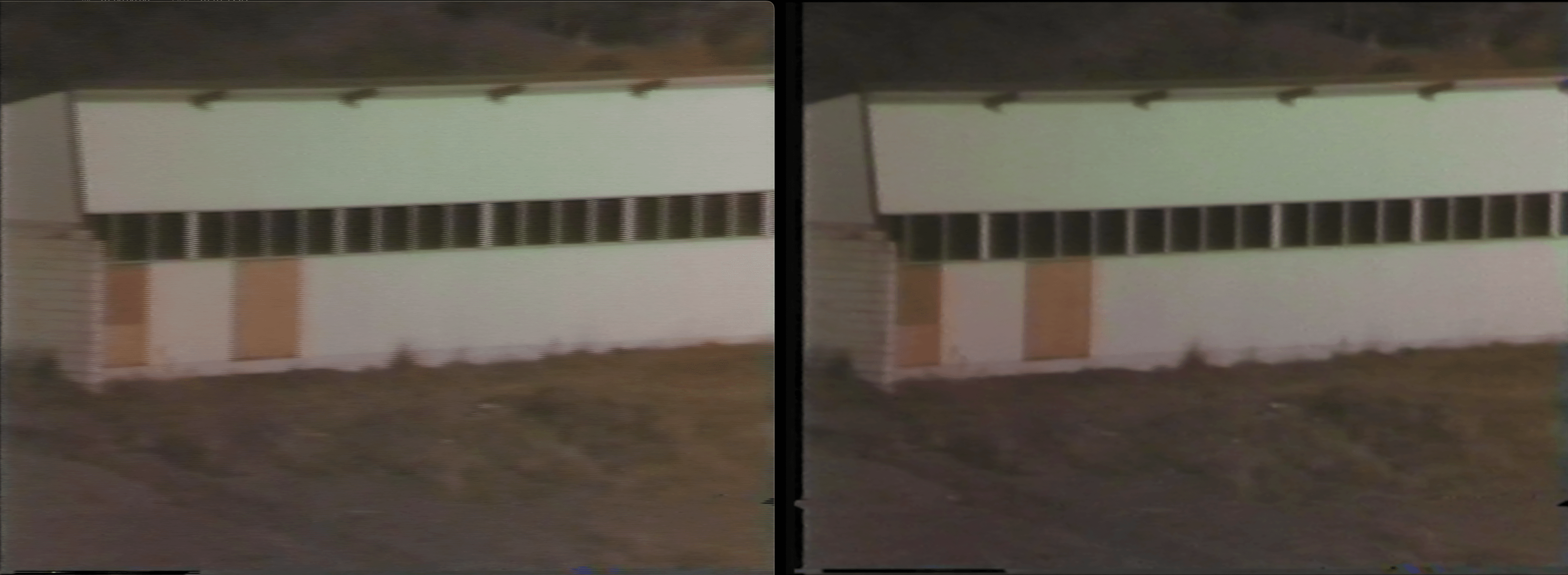
When your source video is of a high resolution (such as modern digital video cameras at 1080p and above), the subsampling issue is far less prevalent, simply due to the visibility (or invisibility) of much smaller pixels to apply losses to. However with VHS being of a lower resolution, particularly in the US and countries that use NTSC with its meagre 480i resolution, the effects become quite noticeable quite quickly. You can test this yourself by re-encoding some source footage with contrasty areas up to 4 times and look at the difference, two examples are shown below.
The below compares a consumer analog PAL 576i VHS source with four generations of exports, in the first 4:2:2 example you can clearly see the loss of colour, colour bleed around edges and blending of colour into areas it’s not supposed to be (click to zoom in for more detail). Whereas in the second 4:4:4 example this is basically non-existent.
Let’s take a closer look at the relevant chroma subsampling ratios.
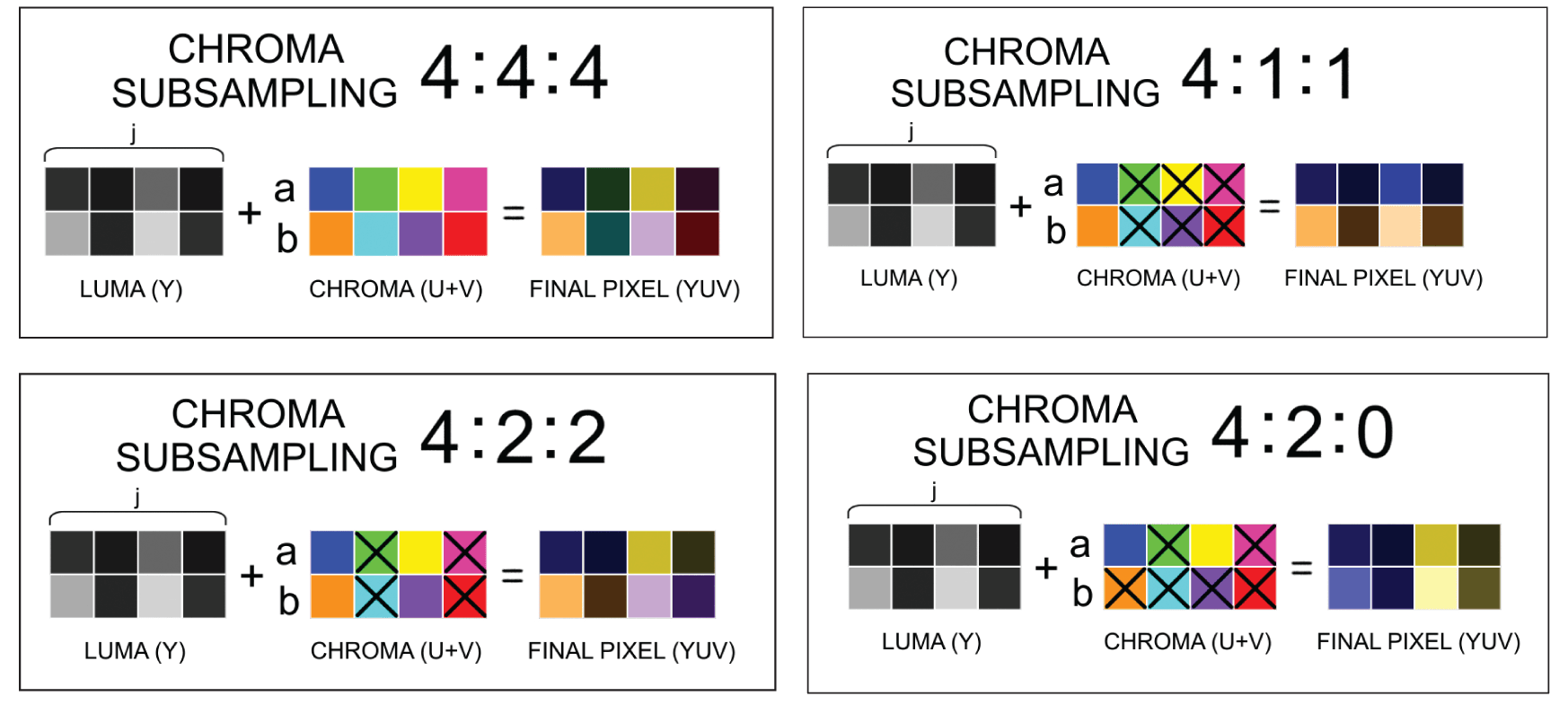
4:4:4 Chroma Subsampling
With 4:4:4 chroma subsampling, there is no loss of colour information because each pixel retains its own unique colour information. This means that the colour resolution is equal to the luminance resolution, resulting in a higher level of detail and colour accuracy. Videos encoded at 4:4:4 chroma subsampling are often used in professional applications where colour fidelity is crucial, such as video editing or color grading.
While 4:4:4 chroma subsampling provides the highest level of colour accuracy, it also requires the most data to be stored and transmitted. This will result in larger file sizes and increased bandwidth requirements.
4:2:2 Chroma Subsampling
In 4:2:2 chroma subsampling, there is a 50% loss of colour information. For every four pixels, two pixels share the same colour information. This means that the colour information is sampled at half the resolution of the luminance information. While this ratio is widely used and provides good image quality, it may not be ideal for certain use cases such as archiving. This is the better of the two fairly typical subsampling rates in PAL and NTSC sources.
4:2:0 Chroma Subsampling
4:2:0 chroma subsampling loses 75% of the colour information. For every four pixels of colour, three share the same colour information as the first. This is unfortunately another fairly typical PAL Chroma Subsampling rate.
4:1:1 Chroma Subsampling
4:1:1 chroma subsampling also loses 75% of the colour information. However, if you look at the diagram above you will see the samples are taken from both the a row and the b row, whereas 4:2:0 takes samples from just the a row. For analog capturing purposes 4:1:1 is used in NTSC formats. Whether 4:2:0 or 4:1:1 is better has been a topic of hot debate. Tip: many of the capture cards use 4:1:1 or 4:2:0, so make sure you check yours to make sure you’re not losing 75% of your colour information.
But what about Nyquist?
The strongest argument against everything I’ve said above is the Nyquist sampling theorem. cut trailing clause — becomes: “It comes up every time this discussion happens, often with a degree of confidence that makes the rest of the conversation hard to have.”
The argument runs like this: VHS chroma is band-limited to around 400 kHz. The chroma channel in 4:2:2 has bandwidth of around 2.75 MHz, around seven times the source bandwidth. Nyquist’s theorem says you can perfectly reconstruct any signal so long as you sample at more than twice its highest frequency. Therefore (the argument goes), 4:2:2 sampling captures every bit of information present in VHS chroma, and any “loss” you think you’re seeing must be coming from somewhere else — your eyes, the test methodology, conversion to RGB for display, anything but chroma subsampling.
That argument is mathematically correct, but only under three conditions that don’t all hold in a real archival workflow.
Condition one: the source signal must be strictly band-limited. For a pristine VHS chroma signal coming straight off the head, this is plausibly true — the format itself imposes the bandwidth limit. But the moment that signal has been through one encode/decode cycle, this stops being true. Codecs add their own artefacts — compression noise, edge ringing, block boundaries — and those artefacts contain energy at all frequencies, including well above the original 400 kHz limit. After generation one, you are no longer subsampling a pristine band-limited signal. You’re subsampling a signal that has artefacts everywhere, and Nyquist’s promise doesn’t cover artefacts that weren’t in the original.
Condition two: the reconstruction filter must be ideal. Nyquist’s “perfect reconstruction” needs what is called an ideal sinc filter — a low-pass filter with a perfectly flat passband, a perfectly sharp cutoff, and zero stopband leakage. Such a filter would need to be infinitely long in time, and so it doesn’t exist. Every real filter in every real codec is a finite-length approximation. It has small ripples in the passband, small leakage in the stopband, and a less-than-perfectly-sharp cutoff. Each pass through such a filter loses a small amount of information that an ideal filter wouldn’t have. Cascade ten generations of these and the small losses compound into something visible — particularly on edges, where the loss tends to show up first.
Condition three — and this is the one the Nyquist argument almost never addresses — there must be only one subsampling step. The whole “perfect reconstruction” claim is about a single round-trip: sample once, reconstruct once, done. The moment you process the file in any way, the reconstruction is no longer the final step. You decode the 4:2:2 file, which upsamples chroma to full resolution internally so the processing tool can work on it. You apply whatever you’re applying — a colour grade, a deinterlacer, a denoise, even just displaying it on screen. Then you re-encode back to 4:2:2, which subsamples again. That re-subsample is a second event, separate from the first, and Nyquist’s theorem doesn’t say anything about it.
That last condition is the one that’s hardest to talk readers out of, because the practical reality of every NLE, every grading tool, every player and every export pipeline is that chroma gets upsampled to full resolution as soon as the file is in memory, and re-subsampled at the moment of save. The reason is straightforward: most processing operations only make sense on a full-resolution plane. You can’t sensibly apply a sharpening filter to chroma that has half the horizontal resolution of luma. The tool upsamples, processes, and downsamples — and that round-trip is where further generational loss happens, every time.
This is also why the codec choice doesn’t fully save you, even though it helps. A mathematically lossless codec like FFV1 at 4:2:2 will give you bit-identical results if your workflow consists only of remux operations (changing the container but not the picture data) or pure file copies. But the moment a tool processes the file — even just displaying it for review involves a chroma upsample internally — the bit-identical guarantee is broken. The “ten generations of lossless re-encoding” idea is a thought experiment with no archival equivalent in real life. Archives get worked on. Each piece of work upsamples and re-subsamples the chroma, and each round-trip loses a small amount of information that the original chroma plane contained.
So the practical version of the Nyquist argument is this: “for the very first 4:2:2 capture of a VHS signal, you haven’t lost any chroma information that was actually present in the source.” I’m willing to grant that. What I am not willing to grant is that this protects the chroma across the multi-generation, multi-tool reality of archival work. The second, third, and tenth subsampling events that happen during that work aren’t covered by the theorem at all.
For an archivist looking ten or twenty or fifty years ahead — at multiple tool generations, multiple recapture passes from the archive master, multiple format migrations as standards change — the conservative position isn’t “trust Nyquist on one capture and stop worrying”. It’s “don’t put yourself in a position where the subsampling argument has to be made at all”. Stay at 4:4:4 (or full RGB) for the master, and you never need to litigate the question. The marginal extra storage cost is a small price for the absolute confidence it gives you about what is preserved.
A related precision question: bit depth
The chroma subsampling debate often gets tangled up with a separate technical dimension that’s worth keeping straight: bit depth, which is how many distinct values each pixel can hold per channel.
Chroma subsampling is about how many chroma samples you store across an image. Bit depth is about how precisely each individual sample is recorded. They’re independent decisions, and a codec can be lossy on either dimension or both.
Most consumer video sits at 8-bit per channel — meaning each pixel’s value lives on a scale of 256 steps. That’s enough range that you can’t tell the difference on a quick playback, but the moment you push the image in post — brightening shadows, recovering highlights, doing aggressive colour correction — those 256 steps are not enough. Bands and posterisation appear in skies, in low-light footage, in skin tones, wherever a smooth gradient existed in the source. The precision ran out and the eye can see exactly where.
10-bit ProRes pushes this to 1024 steps per channel — four times the precision of 8-bit. ProRes 4444 at the higher profiles is 12-bit (4096 steps). And 16-bit per channel — common for raw photographs, the 48-bit TIFF and DPX files used by film scanners, and raw camera workflows — gives you 65,536 steps per channel.
I was fortunate to know this in advance when I recently had some 8mm film digitised. I asked the archivist for 16-bit TIFF scans (48-bit RGB total, full 4:4:4 chroma, mathematically lossless) alongside the ProRes 4444 deliverables — which I’d otherwise have accepted as “lossless” because of how that codec is marketed. It took a little pressing to get the TIFFs out of him as well, but he was happy enough to do it once I’d asked. When I came to grade some of the darker scenes, the request paid off: the 16-bit TIFFs held detail in the shadows that I could pull back into visibility with ease. The ProRes 4444 versions, processed through the same grade, showed banding and posterisation where the TIFFs had smooth tones — because even at 12-bit per channel, ProRes had quantised away precision that I genuinely needed. Those darker scenes would have been a lost cause without the TIFFs.
So when you read “ProRes 4444 is visually lossless”, read it as “visually lossless if you don’t push the image significantly past the way it looked when you encoded it”. The moment you grade it aggressively, or pull shadows, or boost highlights, the codec’s quantisation reveals itself. A mathematically lossless 16-bit-per-channel format (TIFF, DPX, EXR, FFV1 16-bit RGB) does not have this failure mode, because the precision was never quantised away in the first place.
For analog tape captures specifically, bit depth matters less than it does for film — VHS isn’t carrying 16 bits of useful information per channel anywhere in the signal chain. But it still matters more than nothing, and for film scans — especially Kodachrome with its still-rich dynamic range, or anything you might want to colour-grade hard — the bit-depth question is at least as important as the chroma subsampling question. Both are precision losses in the YCbCr or RGB representation, and both should be preserved as fully as possible if you want a master that can be re-touched in the future.
Conclusion
Understanding which chroma subsampling ratio sits at each step of your workflow is essential if you want to avoid a discovery years from now that you’ve quietly lost detail you can never recapture. The last thing I’d want after spending months on an archive is to find out I cut corners on subsampling to save a little disk space, and that the only fix is to start again — by which point the tapes are another decade older. Chroma subsampling generational loss is real, and the reasons it’s real are covered in the Nyquist section above.
If your capture source is VHS, it’s already known for its imperfections — noise, colour bleeding, edge artefacts. When you encode at 4:2:2, each device or step in the chain compounds those imperfections rather than passing them through unchanged.
4:2:2 offers good image quality and is widely used, but I couldn’t recommend it for archives where colour accuracy matters most. As shown above, 4:2:2 is literally the process of removing colour information from your painstakingly captured sources — and on lower-resolution standard-definition sources (480i / 576i), the effect is far more obvious than on modern HD or UHD footage. Starting from a 4:4:4 master keeps the question of cumulative subsampling loss out of your archive entirely, so you can be confident the work you’re doing now will hold up against future tools and workflows.
Of course, you may not think it matters enough, and that choice is entirely up to you — just make it knowing what you’re trading for the disk savings.
For capturing methods that include a 4:4:4 path, see our capturing guides.